
Introduction
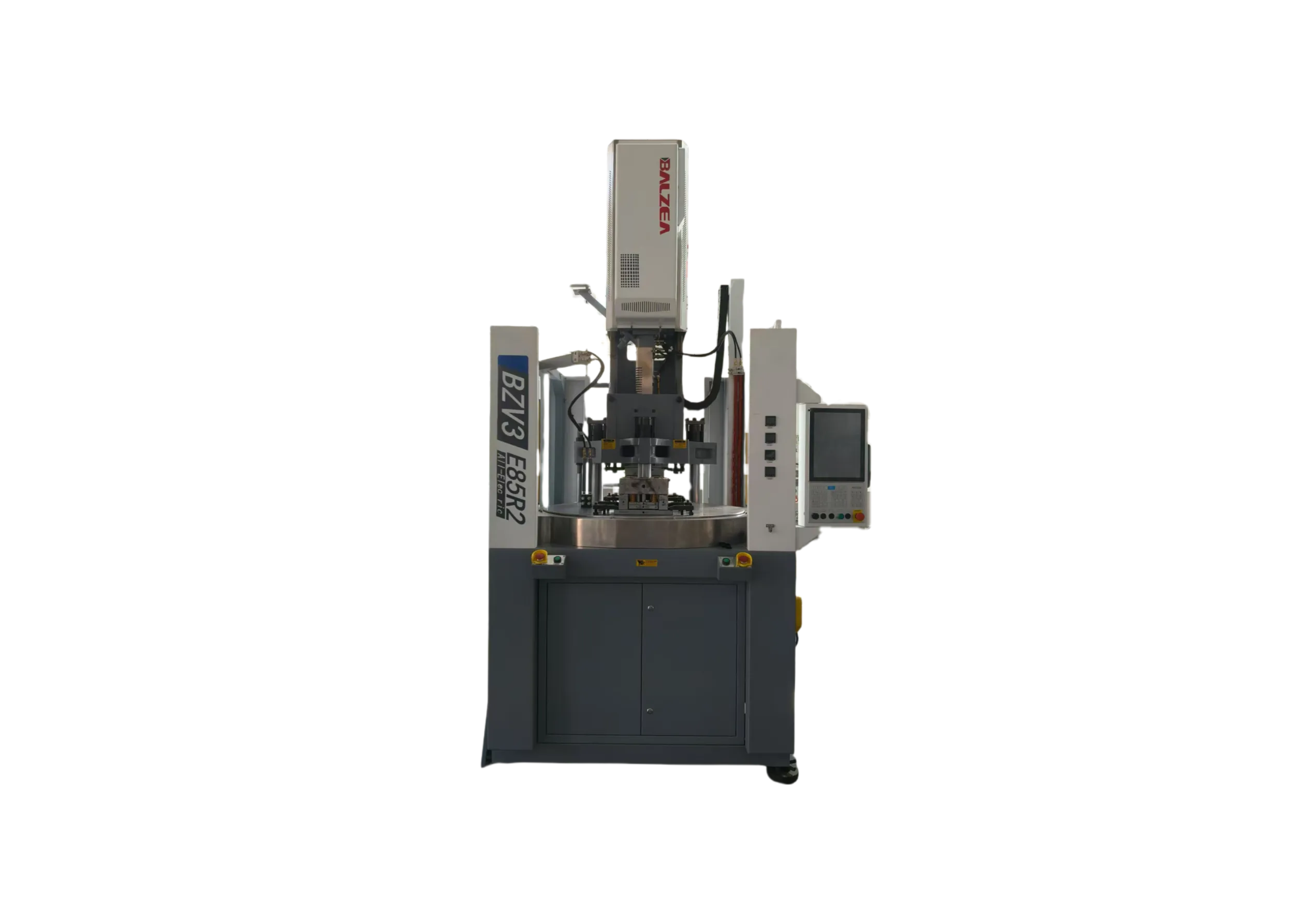
Vertical injection molding machines are a specialized class of plastic injection molding equipment in which the clamping axis is vertical, making them especially well suited to insert molding, overmolding, and other applications where components must be placed into the mold before injection. Compared with horizontal machines, their upright layout improves access to the mold area, allows gravity-assisted insert positioning, and can simplify semi-automated or fully automated handling, while often using less floor space in compact production cells.
These machines are used across electronics, automotive, medical, consumer goods, and electrical-component manufacturing, particularly for parts that combine plastic with metal, ceramic, magnetic, or preformed polymer substrates. Their technology has evolved from conventional hydraulic vertical presses to more compact, precise, and energy-efficient designs, including all-electric variants and rotary-table systems for multi-station production.
History and Development
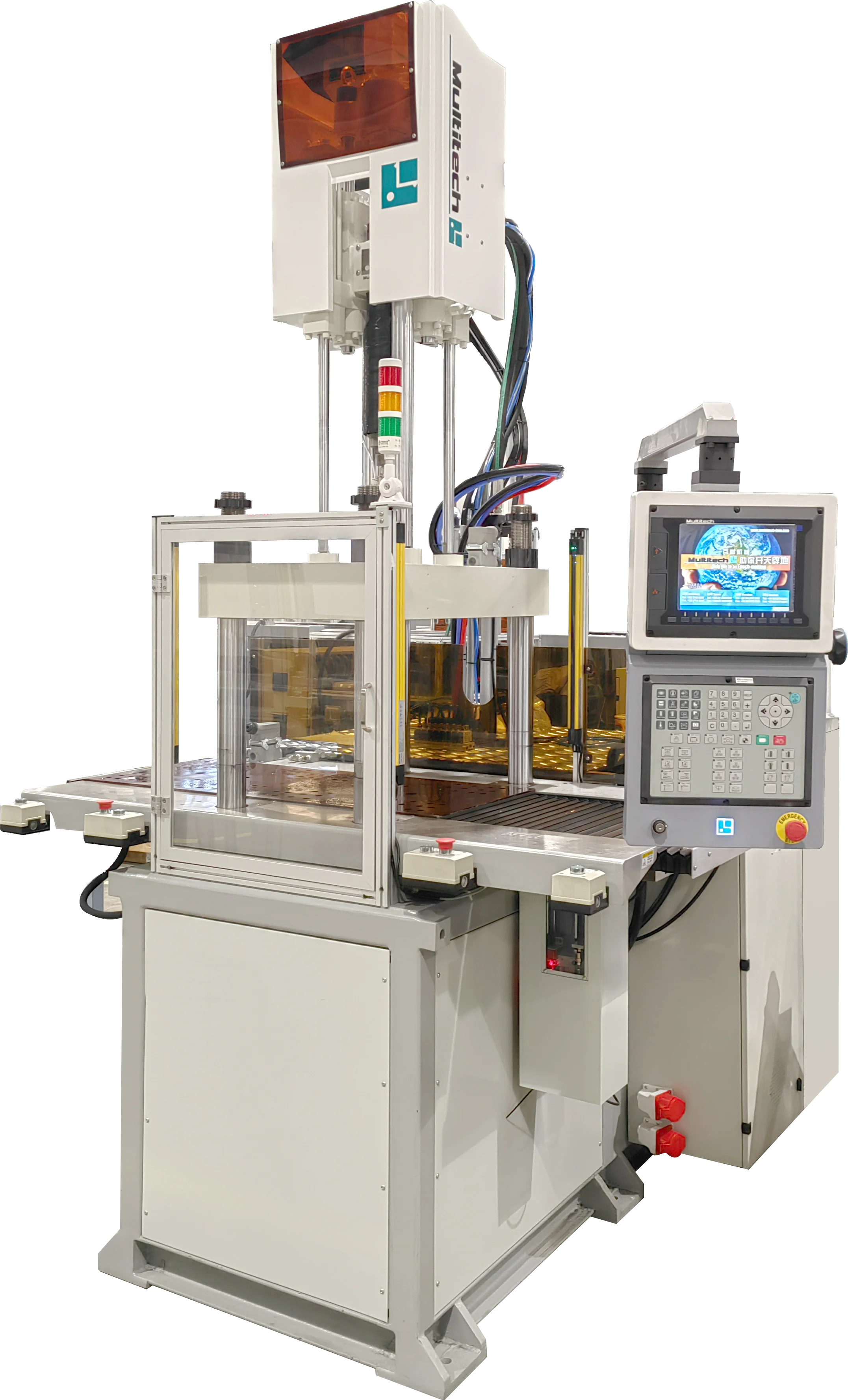
Vertical molding configurations emerged as a practical response to insert placement challenges in early injection molding, when operators needed better access to the cavity and more reliable positioning of metal inserts before the mold closed. Over time, manufacturers refined the concept into dedicated vertical platforms with rotary tables, shuttle tables, and slide tables to improve throughput and reduce idle time between loading and unloading.
A notable development milestone was the commercialization of rotary-table vertical systems, which enabled molding and insert handling to overlap in separate stations, improving productivity in high-mix and small-part production. Another important step was the introduction of all-electric vertical machines, which improved positioning accuracy, repeatability, and energy efficiency compared with traditional electro-hydraulic designs. More recently, OEMs have integrated servo drives, advanced controls, and automated insert handling to support lights-out production and tighter process windows.
Key Characteristics and Technical Overview
A vertical injection molding machine typically consists of an injection unit, vertical clamping unit, platens or table system, and control architecture that coordinates heating, plasticization, clamping, injection, cooling, and part removal. In many designs, the mold opens upward, allowing operators or robots to place inserts directly into the cavity before the next shot.
Typical technical characteristics include:
- Clamping force: commonly from about 15 to 160 tons in smaller to mid-size vertical platforms, with some product lines extending to 600–3000 kN or even broader ranges depending on the OEM and application.
- Table configurations: fixed, slide, shuttle, and rotary tables are widely used to support manual loading, dual-station operation, or alternating mold functions.
- Machine orientation: both the mold closing action and the injection axis are arranged vertically in many systems, although some designs use a horizontal injection unit paired with a vertical clamp.
- Process advantage: gravity helps hold inserts in place, which is especially valuable for overmolding electrical contacts, threaded inserts, ferrules, terminals, and hybrid assemblies.
In process terms, vertical machines follow the same basic injection molding cycle as horizontal presses: plasticizing in the barrel, mold clamping, melt injection, packing, cooling, opening, and part ejection. The main difference lies in mold access and insert handling rather than in the fundamental melt-forming principle.
Typical production metrics
Publicly available specifications vary widely by machine size and application, but industry practice for vertical insert-molding systems often falls within these approximate ranges:
| Parameter | Typical range | Notes |
|---|---|---|
| Clamp force | 15–160 tons; also 600–3000 kN in larger families | Depends on part size and insert load. |
| Rotor/table speed | Application-specific, often optimized for insert transfer rather than rapid part ejection | Rotary-table machines prioritize cycle overlap. |
| Shot size | Small to medium, especially for precision inserts and compact housings | Common in electronics and medical parts. |
| Energy use | Lower in all-electric versions than in conventional hydraulic machines | Efficiency gains come from servo-based actuation. |
| Floor space | Generally smaller than equivalent horizontal cells | Especially useful in compact manufacturing lines. |
Specific values for flake size and residual moisture after centrifugal dewatering are not generally relevant to vertical injection molding machines, since those metrics are used in recycling and washing equipment rather than injection presses.
Types and Variations
Vertical injection molding machines are commonly grouped by clamp and table architecture:
- Fixed-table vertical machines: suited to simpler insert-molding operations and lower automation complexity.
- Rotary-table machines: use rotating platens or tables to separate loading and molding stations, improving cycle efficiency.
- Shuttle-table machines: move the mold horizontally between stations while retaining vertical clamping geometry, which can improve operator access.
- Slide-table machines: support insert loading and unloading outside the injection zone for safer and faster handling.
- All-electric vertical machines: provide high precision, cleaner operation, and improved energy efficiency relative to hydraulic systems.
- Hybrid electro-hydraulic machines: combine hydraulic clamp force with electric or servo-controlled injection functions.
Some OEMs also offer specialized layouts for compression molding, pressing, or insert overmolding in a single machine platform.
Applications and Uses
Vertical injection molding machines are most valuable where part assembly and molding occur together, or where component placement before injection is critical.
Major application areas include:
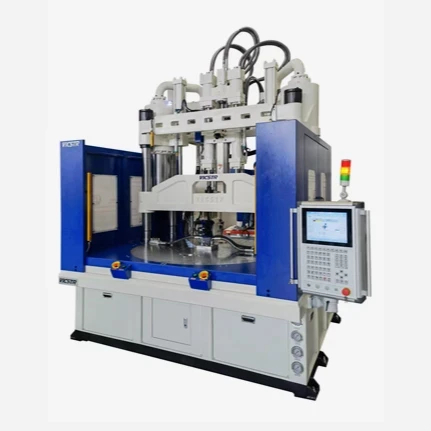
- Electronics: connectors, sensor housings, terminals, bobbins, and PCB-related components, where accurate insert placement is essential.
- Automotive: switches, control modules, interior trim parts, sensors, and hybrid assemblies that combine plastic with metal or conductive inserts.
- Medical devices: instrument housings, grips, fittings, and components requiring precision and repeatability.
- Consumer goods: ergonomic handles, appliance controls, knobs, and compact functional parts.
- Industrial and electrical products: terminals, switches, connectors, and protective housings.
A poor-fit use case is very large, high-tonnage commodity part production, where horizontal machines often offer better automation density, more standardized part removal, and stronger economics at scale.
Working Principle
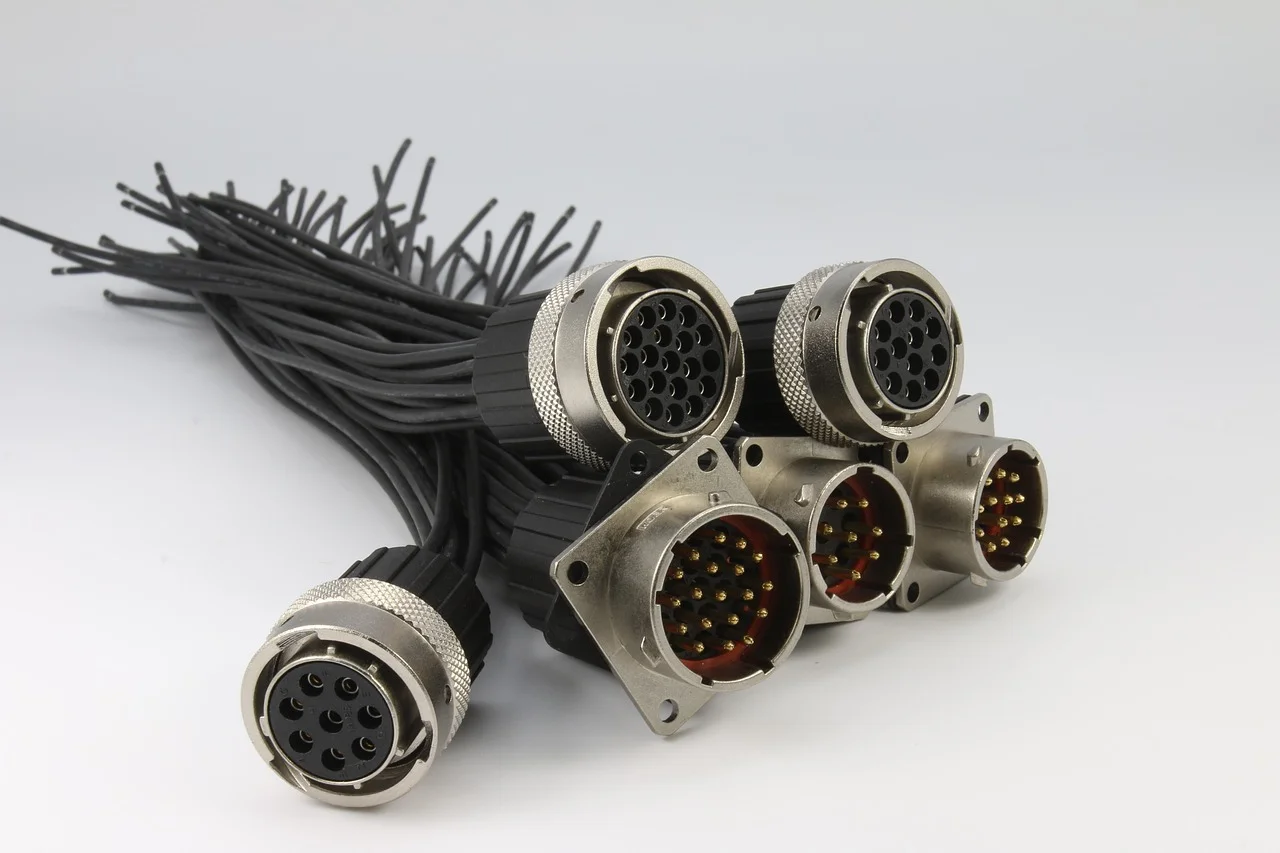
The machine cycle is conceptually simple:
- Plasticization: pellets enter the hopper and melt in the heated barrel under screw action.
- Clamping: the mold closes vertically and holds the insert or cavity shut under pressure.
- Injection: molten polymer is forced into the cavity and around the insert.
- Packing and cooling: the part consolidates while the polymer shrinks and solidifies.
- Opening and ejection: the mold opens vertically, and the part is removed manually or robotically.
This vertical arrangement is particularly effective for gravity-stable inserts, because the insert can rest naturally in the cavity before closure and is less likely to shift during positioning.
Technological Innovations and Automation
Recent development has focused on servo-driven motion, closed-loop process control, and robot integration for insert loading and part handling. Rotary-table and dual-station platforms enable overlap between molding and loading, which improves machine utilization and reduces non-productive time.
Automation is especially important in:
- High-precision insert placement
- Thermoset and elastomer processing
- Inline inspection and reject handling
- Multi-component overmolding
- Lights-out manufacturing cells
Advanced machine builders also emphasize safety interlocks, platen synchronization, and ergonomic access, since operator interaction with a vertical mold area can be more direct than with enclosed horizontal systems.
Environmental and Sustainability Aspects
Vertical machines can support sustainability goals in several ways:
- Reduced floor-space demand, which can lower plant infrastructure requirements.
- All-electric actuation, which can reduce energy consumption relative to hydraulic systems.
- Lower scrap in insert overmolding, because accurate insert positioning can reduce misruns and rejects.
- Compatibility with lightweight hybrid assemblies, which can reduce the number of separate parts and secondary assembly steps.
At the same time, sustainability performance depends strongly on machine type, resin, cycle design, and automation level. Hydraulic systems remain common where very high clamp force is needed, but they typically require more maintenance and may consume more energy than electric alternatives.
Economic and Global Market Impact
Vertical injection molding machines occupy a specialized segment of the plastics machinery market rather than the largest-volume mainstream category, but they are strategically important in precision manufacturing, medical technology, electronics, and automotive subassemblies. Their economic value comes from their ability to merge molding and assembly, reduce manual post-processing, and enable compact production cells with high part integrity.
OEM offerings from companies such as ENGEL, ARBURG, BOY, Sodick, YIZUMI, DESMA, and Niigata/Absolute Haitian show that the segment spans both premium and cost-competitive machine families, with differentiation based on force range, motion control, automation compatibility, and insert-molding specialization.
Current Challenges and Innovations
Key technical and operational challenges include:
- Insert stability during loading and mold closure
- Cycle efficiency when manual loading is still used
- Process window sensitivity for thin-wall or precision overmolding
- Safety and ergonomics in open vertical work zones
- Capital cost for rotary-table and fully automated platforms
Current innovations are addressing these issues through better servo control, smarter tooling, quick-change mold systems, and robotic insertion. The trend is toward machines that combine precision, repeatability, and automation readiness rather than maximizing clamp force alone.
Future Outlook
The future of vertical injection molding machines is likely to be shaped by three main forces: automation, energy efficiency, and integration with hybrid manufacturing cells. Demand should remain strongest in sectors that rely on embedded components, compact electromechanical assemblies, and high-value precision parts.
Longer term, growth is likely to favor all-electric and hybrid platforms, digital process monitoring, and machine architectures optimized for robotic insert placement and in-line quality control. Vertical machines will probably remain a niche but technically important tool where part geometry, insert placement, and production ergonomics justify a vertical clamp design over conventional horizontal molding.
References
- •
ENGEL. (2022, August 22). Vertical injection molding machine. https://www.engelglobal.com/en/us/products/injection-molding-machines/vertical-injection-molding-machineLink
- •
KNAVI GROUP. (n.d.). Vertical injection molding machines — with slide, shuttle, rotary tables, up to 160 tons. https://knavi.us/catalog/vertical-injection-molding-machinesLink
- •
ENGEL. (2022, August 22). Vertical injection moulding machine. https://www.engelglobal.com/en/products/injection-moulding-machines/vertical-injection-moulding-machineLink
- •
Sodick. (n.d.). Vertical injection moulding machine. https://www.sodick.co.jp/en/product/injection/trvvc_lamping_system/Link
- •
BOY Machines, Inc. (n.d.). Vertical injection molding machines. https://www.boymachines.com/products/injection-molding-machines/vertical-injection-molding-machinesLink
- •
Paheej. (2025, December 8). Top 6 applications of vertical injection moulding machine. https://paheej.com/vertical-injection-moulding-machine-applications/Link
- •
Absolute Haitian. (n.d.). Niigata MDV vertical S8000 series injection molding machines. https://www.absolutehaitian.com/product-series/niigata/niigata-mdv-vertical-s8000-seriesLink
- •
Arburg. (n.d.). Vertical Allrounders: Ergonomic overmolding of inserts. https://www.arburg.com/en/us/product-world/injection-molding-machines/vertical-machines/Link
- •
DESMA. (2024, November 15). Vertical injection molding machines. https://desma-usa.com/machines/vertical-machines/Link
- •
Mechrank. (2025, August 1). What is a vertical injection molding machine and how does it work. https://mechrank.com/vertical-injection-molding-machine/Link
- •
ENGEL. (2022, August 22). Vertical injection molding machine. https://www.engelglobal.com/en/ca/products/injection-molding-machines/vertical-injection-molding-machineLink
- •
Elite Precision Plastics. (2022, December 19). Vertical injection molding. https://www.eliteprecisionplastics.com/glossary-2/vertical-injection-moldingLink
- •
Paheej. (2026, April 9). Why vertical injection molding is ideal for insert & overmolding. https://paheej.com/vertical-injection-molding-for-insert-and-overmolding-applications/Link
- •
Samfacc. (2026, January 7). How does a vertical injection machine work? https://www.samfacc.com/how-does-a-vertical-injection-machine-work/Link
- •
Pars-BM. (n.d.). Vertical injection molding machine. https://pars-bm.com/vertical-injection-molding-machine/?lang=enLink
- •
Swiftauxi. (2024, July 26). Understanding vertical injection moulding machines. https://www.swiftauxi.com/post/understanding-vertical-injection-moulding-machines-a-comprehensive-guide-1-3Link
- •
Yizumi. (n.d.). VM series vertical injection molding machine. https://www.yizumi.com/en/ims/Vertical-Injection-Molding-MachineLink
- •
CENS.com. (2022, March 25). Vertical injection molding machines. https://www.cens.com/cens/html/en/category/cate_list_M0133.htmlLink
- •
Plastima Breda BV. (n.d.). Vertical injection moulding machines. https://www.plastima.nl/en/markets/injection-moulding/vertical-injection-moulding-machinesLink
- •
Yuhdak. (n.d.). Vertical clamping vertical injection molding machines. https://www.yuhdak.com/en/category/Vertical-Clamping-Vertical-Injection.htmlLink
- •
JSW America. (n.d.). Vertical injection molding machines. https://www.jswamerica.com/vertical.htmlLink
- •
Crescent Industries. (2021, January 4). Vertical vs horizontal injection molding for plastic components. https://www.crescentind.com/blog/vertical-vs-horizontal-plastic-injection-moldingLink
- •
Multiplas Enginery Co., Ltd. (2019, July 25). Vertical injection molding machine. https://www.multiplas-tw.com/category-vertical-injection-molding-machine.htmlLink
- •
Min-Hui. (2024, January 1). Standard vertical injection molding machine. https://en.min-hui.com/Product_Detail/3.htmlLink
- •
International Journal of Innovative Research in Science, Engineering and Technology. (n.d.). Vertical injection plastic moulding machine [PDF]. https://www.ijirset.com/upload/2024/june/219_Vertical.pdfLink
- •
ENGEL. (2022, August 22). Vertical injection molding machine insert. https://www.engelglobal.com/en/us/products/injection-molding-machines/insert-moldingLink
- •
IPROS GMS. (n.d.). Vertical injection molding machine product list. https://mono.ipros.com/en/cg3/Vertical%20injection%20molding%20machine/Link
- •
Deboge. (2024, September 1). Vertical injection molding machines. https://deboge.com/vertical-injection-molding-machine/Link
- •
ENGEL. (2022, August 22). Injection moulding machine for overmoulding inserts. https://www.engelglobal.com/en/products/injection-moulding-machines/insert-mouldingLink
- •
Hisson. (2021, March 14). Composition, principle and development of vertical injection molding machine. https://hisson.com/article/detail/id/278.htmlLink
- •
Optosem. (n.d.). Vertical injection molding machine. https://www.optosem.com/service/Technologies/Injection_Molding/Vertical_Injection_Molding_Machine.htmlLink
- •
Cavity Mold. (n.d.). About vertical injection molding. https://www.cavitymold.com/vertical-injection-molding/Link
- •
Min-Hui. (2022, June 1). What are the performance advantages of vertical injection molding machine? https://en.min-hui.com/news_Detail/2.htmlLink
- •
Dakumar. (2024, March 8). A comprehensive guide to horizontal and vertical injection molding machine. https://www.dakumar.com/knowledge/Guide-to-Horizontal-and-Vertical-Injection-Molding-Machine.htmlLink
- •
U.S. Patent No. 6,722,875. (2002, April 17). Vertical injection molding machine. U.S. Patent and Trademark Office. https://patents.google.com/patent/US6722875B2/enLink
- •
Integrated. (2025, April 3). How our vertical injection molding machine works. https://integrated.electro-matic.com/mini-injection-molding/how-our-injection-molding-machine-works-2/Link
- •
Crescent Industries. (2017, July 19). How vertical injection molding assists the insert & over molding process. https://www.crescentind.com/blog/how-vertical-injection-molding-assists-the-insert-over-molding-processLink
- •
Wikipedia. (2007, June 6). Injection molding machine. https://en.wikipedia.org/wiki/Injection_molding_machineLink
- •
Topstar Machine. (2024, January 8). Choosing between vertical and heavy duty injection molding machine. https://www.topstarmachine.com/choosing-between-vertical-and-heavy-duty-injection-molding-machine/Link
- •
Yuhdak. (2024, November 1). Applications of vertical injection molding machine. https://www.yuhdak.com/en/applications.htmlLink
- •
Essentra Components. (2023, December 11). What is plastic injection molding and how does it work? https://www.essentracomponents.com/en-us/news/manufacturing/injection-molding/what-is-plastic-injection-molding-and-how-does-it-workLink
- •
RJG. (2024, October 14). How injection molding machines work. https://rjginc.com/back-to-basics-how-does-a-plastic-injection-molding-machine-work/Link
- •
Boyanmfg. (2023, September 30). How does an injection molding machine work with animation. https://boyanmfg.com/how-does-injection-molding-machine-work/Link
- •
Wikipedia. (2003, September 23). Injection moulding. https://en.wikipedia.org/wiki/Injection_mouldingLink