
Introduction
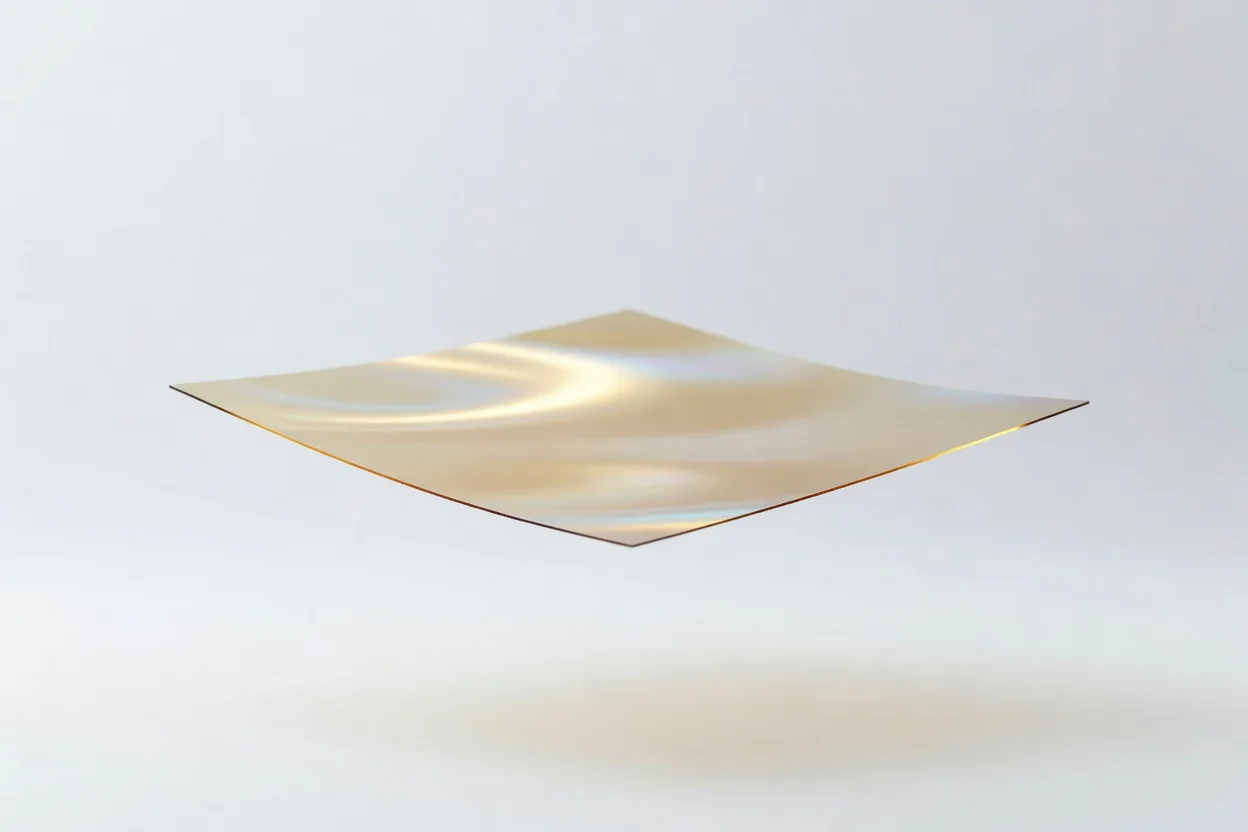
Polyimide (PI) is a family of high-performance polymers defined by the imide linkage in the backbone and valued for exceptional thermal stability, electrical insulation, chemical resistance, and mechanical integrity across a very wide temperature range. In plastics and auxiliaries markets, PI is used both as a finished engineering material and as a functional enabler in films, coatings, fibers, foams, adhesives, composites, membranes, and microelectronic materials.
The material occupies a distinctive position in the plastics ecosystem because it is not chosen primarily for low cost or ease of molding, but for performance under extreme conditions: high heat, cryogenic exposure, radiation, vacuum, and aggressive solvents. Its development has been driven by aerospace, electronics, and semiconductor manufacturing, and more recently by flexible electronics, advanced batteries, biomedical devices, and separation membranes.
Polyimides are made in several important variants, including thermosetting PI, thermoplastic PI, soluble PI, transparent PI, fluorinated PI, and specialty grades optimized for low coefficient of thermal expansion, low dielectric loss, or high char yield. This diversity has helped PI remain a core high-value material even as downstream industries demand thinner films, finer features, and lower environmental footprints.
History and Development
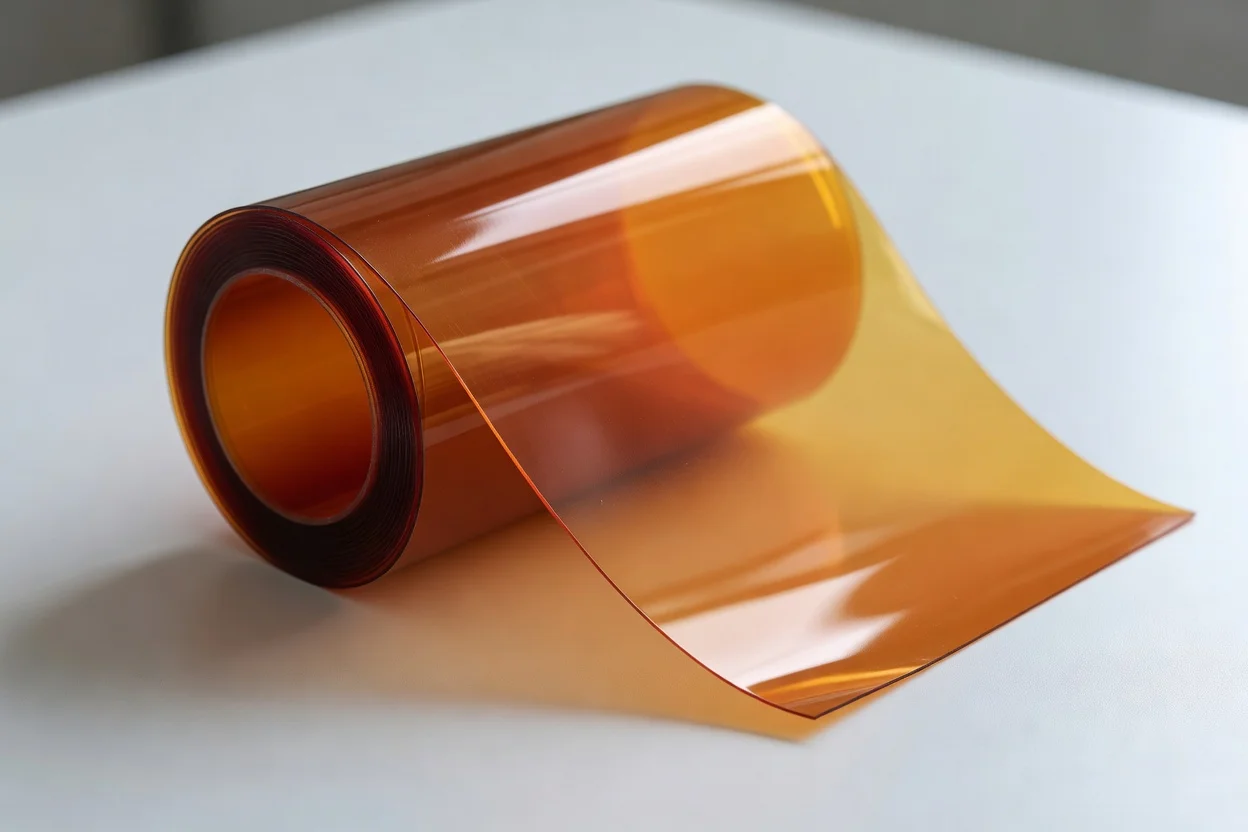
Polyimides were developed as part of the broader postwar expansion of high-temperature polymers, with early commercial success in film and insulation applications where conventional thermoplastics and epoxies could not survive prolonged heat exposure. The classic commercial film products established the material’s reputation for stability, dimensional precision, and long service life in electrical and aerospace uses.
As microelectronics advanced, PI expanded from bulk insulation into thin films, coatings, and patterned layers for flexible printed circuits, wafer-level packaging, and display technologies. More recent research has focused on processable polyimides, porous and nanostructured PI membranes, and biofriendly or implantable grades for medical devices.
Chemical Structure and Key Properties
Polyimides contain rigid imide rings integrated into aromatic or semi-aromatic chains, which is the principal molecular reason for their high glass transition temperature, low creep, and outstanding thermal endurance. The rigid chain structure also contributes to excellent dielectric performance and resistance to many organic solvents.
| Property | Typical significance |
|---|---|
| Thermal stability | Suitable for continuous high-temperature service and short-term exposure to very high temperatures. |
| Electrical insulation | Widely used in cable wrapping, flexible circuits, and dielectric layers. |
| Chemical resistance | Resists many solvents, oils, and fuels, though alkalis remain a weak point for many grades. |
| Dimensional stability | Low thermal expansion supports precision parts and multilayer electronics. |
| Mechanical strength | Retains strength and stiffness at temperatures where many polymers soften. |
Key limits should be understood clearly:
- Poor processability for many grades → highly rigid molecular structure and insolubility after imidization → workaround: use polyamic acid precursors, soluble PI, thermoplastic PI, or staged thermal/chemical imidization.
- Moisture uptake can affect dielectric and dimensional performance → polar imide chemistry and amorphous structure in many grades → workaround: use low-absorption formulations, moisture control, and grade-specific lamination or curing protocols.
- Vulnerability to strong alkalis in some formulations → hydrolysis and chain attack at elevated pH → workaround: select chemically resistant grades and avoid alkali-rich service environments.
- High production cost → multistep synthesis, high-purity monomers, and solvent-intensive film manufacture → workaround: target only applications where PI’s performance premium offsets cost.
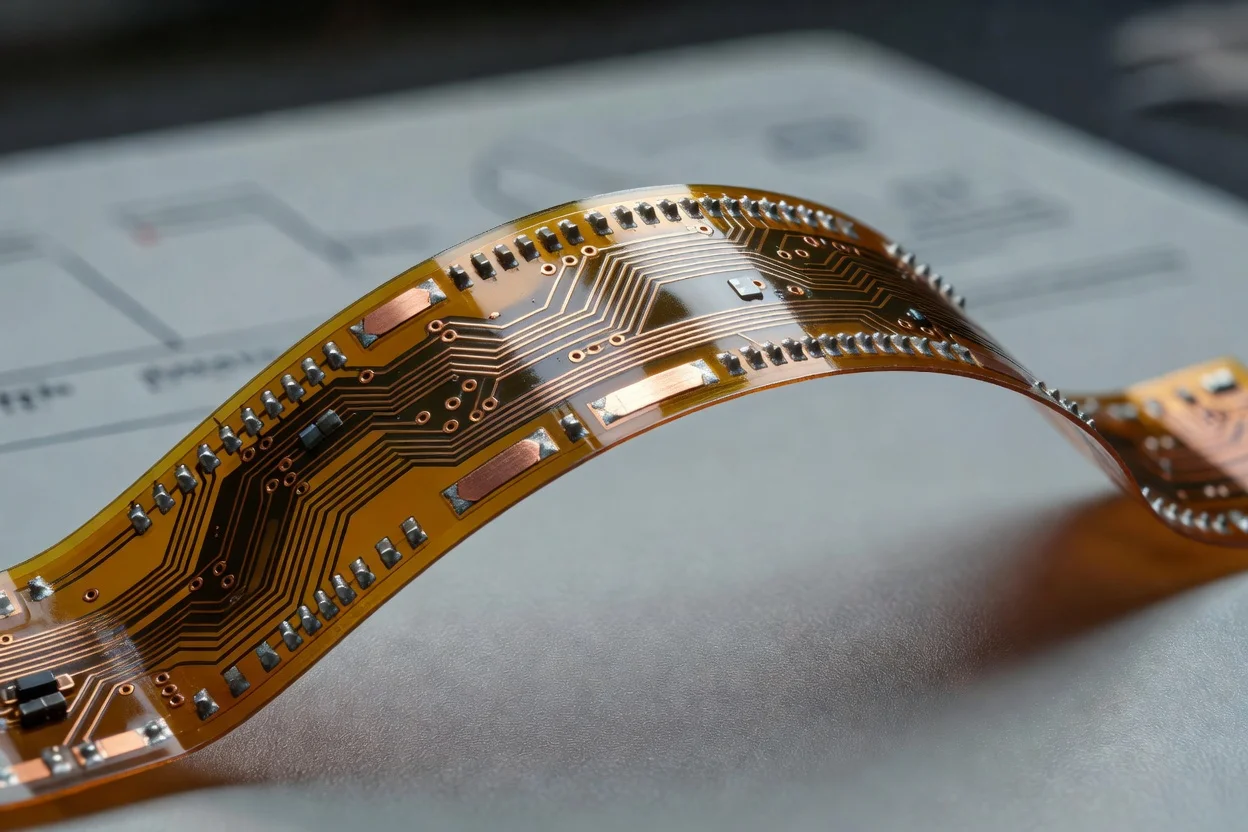
A practical reason PI is so valuable in electronics is that its dielectric constant is low and stable, while its dielectric strength remains high even in thin cross-sections. In flexible circuit substrates, this combination reduces signal loss and thermal failure risk during repeated bending and solder-reflow cycles.
Production Processes and Raw Feedstocks
Most industrial polyimides are produced by step-growth polymerization of tetracarboxylic dianhydrides with diamines, first forming polyamic acid and then converting it to the imide through thermal or chemical imidization. Common processing solvents include polar aprotic media such as NMP, DMAc, and DMF, which dissolve the precursor before final ring closure.
Typical manufacturing routes include:
- Two-step film production: polyamic acid is cast, dried, then imidized at elevated temperature to create PI film.
- Direct imidization or one-step routes: used in some specialty systems to simplify processing or reduce solvent burden.
- Prepreg and composite routes: PI varnish or oligomer is used to impregnate fibers, followed by staged drying and cure.
- Thermoplastic PI processing: melt-processable grades can be compression molded or machined into precision parts.
A simplified process example is the standard film route: a dianhydride and diamine are reacted to polyamic acid, a precursor film is cast at 15–25 wt% solids, then the film is heated in stages around 200–350°C to complete imidization. The molecular mechanism is cyclodehydration: amide-acid groups close into the imide ring while water is eliminated.
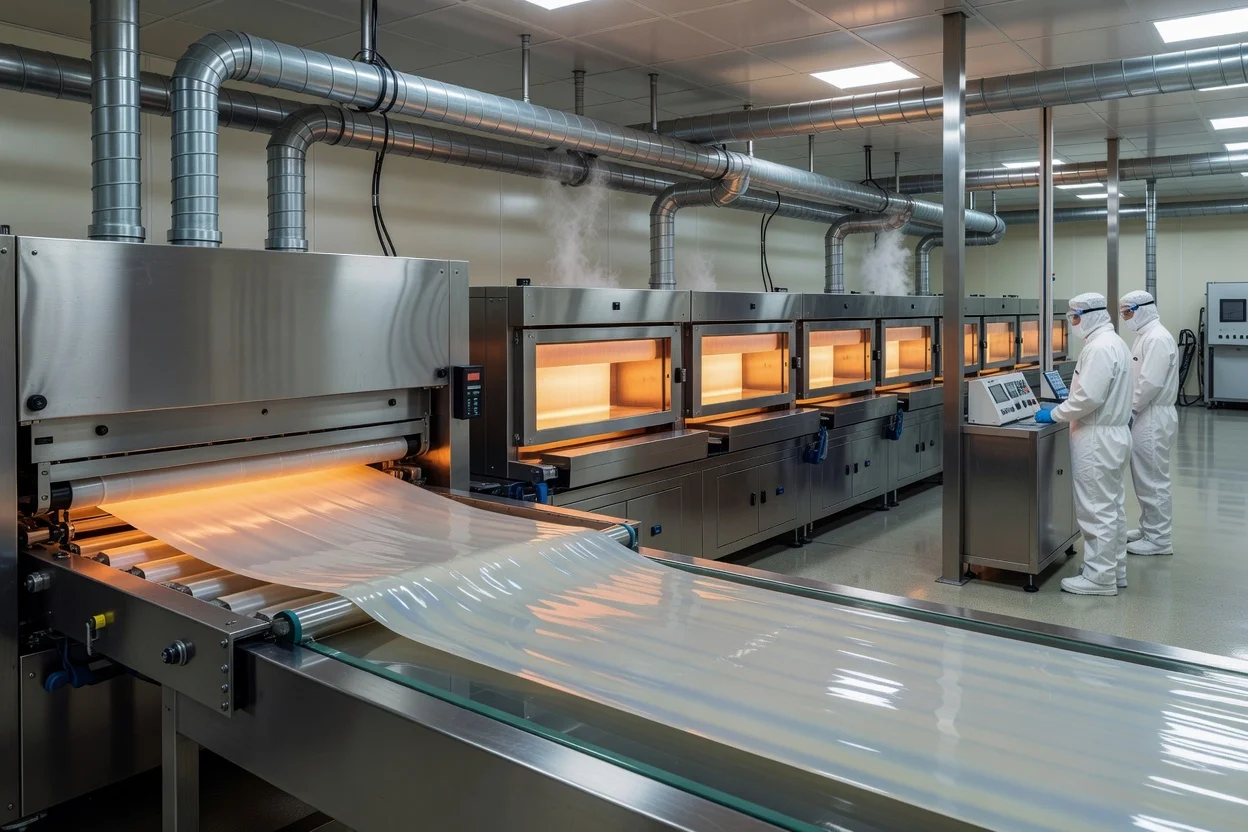
Leading producers and technology holders include major specialty polymer manufacturers such as DuPont, UBE, Toray, and other global electronics-materials suppliers, with strong positions in film, resin, and solution-grade PI used for flexible circuits and high-end insulation. These firms have been particularly influential in defining performance standards for film thickness, dimensional stability, and dielectric reliability.
Applications and End-Use Markets
PI is best viewed as a performance platform rather than a single-use resin, because the same chemistry can be adapted into films, fibers, coatings, adhesives, and membranes.
| End use | Typical PI form | Why PI fits |
|---|---|---|
| Flexible printed circuits | Film | High dielectric performance, thermal endurance, bend durability. |
| Motor and cable insulation | Film or varnish | Heat resistance and electrical insulation at elevated service temperatures. |
| Aerospace and space hardware | Film, composite, fiber | Low outgassing, thermal stability, radiation resistance, dimensional stability. |
| Semiconductor and display processing | Coating or patterned film | Thin dielectric layers, stress buffering, photopatterning compatibility. |
| Gas separation membranes | Membrane | Selective transport combined with thermal and chemical stability. |
| Biomedical devices | Film, coating, microstructure | Flexibility, sterilizability, and biocompatibility in selected grades. |
| High-temperature filtration | Fiber | Filter media for hot gases and aggressive environments. |
Major sectors include:
- Electronics: FCCL, FPCs, chip packaging, dielectric layers, buffer layers, and cover films.
- Aerospace: insulation, radomes, seals, structural components, and thermal protection parts.
- Energy and industrial: hot-gas filtration, membranes, and insulation in high-temperature systems.
- Medical and life sciences: implantable or sterilizable components, specialized tubing, and microdevices.
- Transportation and machinery: bearings, seals, sliding elements, and wear parts in thermoplastic PI grades.
One poor-fit use is low-cost, high-volume consumer packaging, where PI’s price and processing complexity are generally unjustified relative to commodity polyolefins or PET.
In practice, film is the most commercially visible form. Standard PI film is especially important where copper-compatible thermal expansion is needed; engineered grades can be tuned to reduce delamination in flexible circuits. For fibers, PI’s high temperature performance makes it useful in refractory protective clothing and filtration media, while composite applications exploit its low creep and high modulus at elevated temperature.
Environmental and Sustainability Aspects
PI is durable, and that durability is both its greatest asset and a sustainability challenge. Long service life reduces replacement frequency in mission-critical systems, but end-of-life recovery is difficult because many PI products are multi-layer, highly engineered, or thermoset-like in behavior after cure.
Recyclability depends strongly on grade:
- Thermoplastic PI can be mechanically reprocessed more readily than cured thermoset-like PI.
- Thermosetting PI is difficult to remelt and is generally limited to downcycling, energy recovery, or specialized chemical routes.
- Film and electronics scrap can sometimes be recycled in controlled manufacturing loops, but contamination and laminates often limit circularity.
Bio-based substitution remains a research topic rather than a large commercial reality. The main sustainability pathway today is not bio-PI at scale, but rather:
- lower-solvent or solvent-recovery manufacturing,
- processable PI grades that reduce scrap,
- thinner films with equal performance,
- and designs for longer life in electronics and aerospace.
From a carbon-footprint perspective, PI is generally more energy- and solvent-intensive than commodity plastics because of its monomer purity requirements, high-temperature curing, and controlled film processing. Nevertheless, in applications where PI prevents failure in satellites, aircraft, semiconductors, or high-voltage systems, its lifecycle value can outweigh its higher cradle-to-gate burden.
Economic and Global Market Impact
PI is a comparatively small-volume but high-value segment of the plastics market, with demand concentrated in electronics, aerospace, and industrial high-performance niches. According to recent industry analyses cited in technical literature, global PI film consumption reached about 2.2 billion dollars in 2021, reflecting its strategic role in flexible electronics and advanced packaging.
Market dynamics are shaped by several factors:
- Electronics miniaturization increases demand for thinner, more dimensionally stable films.
- 5G, advanced packaging, and flexible displays support demand for low-loss dielectric materials.
- Aerospace and defense continue to value PI for low outgassing and thermal resilience.
- Battery and energy systems are opening additional demand for separators, binders, and thermal barriers.
The supply base is more concentrated than for commodity polymers because the market depends on specialized monomers, proprietary synthesis know-how, and tight quality control. This concentration gives established producers a strong position but also makes the market sensitive to monomer availability, solvent regulation, and electronics-cycle volatility.
Current Challenges and Innovations
The main technical challenge remains the trade-off between performance and processability. Highly rigid, thermally robust PI often becomes difficult to dissolve, mold, or bond, which complicates mass production and multilayer integration.
Current innovation themes include:
- Soluble polyimides for easier coating and lower-temperature processing.
- Low-CTE formulations for copper-matched flexible electronics.
- Transparent PI for displays and optical components.
- Porous and nanostructured PI membranes for gas separation and energy applications.
- Biomedical PI for implantable devices and microsystems.
- High-purity low-outgassing grades for vacuum and space environments.
A practical formulation example is the use of reactive end-capped PI oligomers or crosslinkers in prepregs to improve thermal stability after cure; one reported route uses terminal modifiers such as phthalic anhydride derivatives at low levels to tune post-cure performance. At the molecular level, such modifiers help control network formation, cure balance, and residual volatility.
Future Outlook
Polyimide is likely to remain a premium material wherever polymer failure is unacceptable. Its strongest long-term prospects are in flexible and wearable electronics, semiconductor packaging, high-temperature membranes, aerospace systems, and medical microdevices.
The most important technical direction is not replacing PI’s core function, but making PI easier to manufacture, pattern, recycle, and integrate into circular value chains. Innovations in solvent reduction, recyclable thermoplastic architectures, and hybrid PI nanocomposites are likely to determine which suppliers capture future growth.
For the plastics industry more broadly, PI illustrates a central truth: the highest-value materials are often those that solve a narrow but critical engineering problem better than any lower-cost alternative.
References
- •
PI polyimide plastic. (n.d.). Ensinger Plastics. https://www.ensingerplastics.com/en-us/thermoplastic-materials/pi-polyimideLink
- •
Polyimide. (2004, August 8). Wikipedia. https://en.wikipedia.org/wiki/PolyimideLink
- •
Polyimides: Definition, properties and applications. (2020, March 18). AZoM. https://www.azom.com/article.aspx?ArticleID=19119Link
- •
Polyimide - An overview. (n.d.). ScienceDirect. https://www.sciencedirect.com/topics/materials-science/polyimideLink
- •
The basics of polyimide: An explanation of how it is used. (n.d.). Toray. https://www.electronics.toray/en/column/polyimide_01.htmlLink
- •
Focus on polyimides. (n.d.). Zeus. https://www.zeusinc.com/wp-content/uploads/2019/07/RESINATE-No7-Focus-On-Polyimides.pdfLink
- •
Polyimide (PI) - Uses, structure, properties & applications. (2025, July 8). SpecialChem. https://www.specialchem.com/plastics/guide/polyimide-pi-plasticLink
- •
What are the applications of polyimide. (2025, February 13). China Puxiong Group. https://chinapuxionggroup.com/blog/news2025021302.htmlLink
- •
Polyimide (PI). (n.d.). GOBA Glossary. https://www.goba.de/en/glossary/polyimidLink
- •
What are the properties of polyimide? (2025, February 12). China Puxiong Group. https://chinapuxionggroup.com/blog/news2025021202.htmlLink
- •
Polyimide (PI) - Properties. (n.d.). Matmake. https://matmake.com/materials-data/polyimide-properties.htmlLink
- •
Polyimide (PI) properties & uses. (2025, July 17). PEEK China. https://www.peekchina.com/blog/polyimide-pi-properties-uses.htmlLink
- •
Polyimide physical.... (2021, January 27). IntechOpen. https://www.intechopen.com/chapters/74939Link
- •
Polyimide synthesis explained: Shaping modern electronics. (2024, April 19). AZoM. https://www.azom.com/article.aspx?ArticleID=23617Link
- •
Polyimide. (n.d.). Laminated Plastics. https://laminatedplastics.com/polyimide.pdfLink
- •
Polyimide as a biomedical material: Advantages and applications. (2024, July 4). PMC. https://pmc.ncbi.nlm.nih.gov/articles/PMC11334982/Link
- •
Polyimide PI. (n.d.). Swicofil. https://www.swicofil.com/commerce/products/polyimide/321/applicationsLink
- •
Polyimide. (n.d.). MIT. https://www.mit.edu/~6.777/matprops/polyimide.htmLink
- •
Microfabrication of functional polyimide films and microstructures for flexible MEMS applications. (2023, March 21). Nature. https://www.nature.com/articles/s41378-023-00503-5Link
- •
Chemical and physical properties of polyimides. (2012, December 19). IntechOpen. https://www.intechopen.com/chapters/41500Link
- •
What are polyimides? (n.d.). UBE Corporation. https://www.ube.com/ube/en/contents/chemical/polyimide/polyimide_column.htmlLink
- •
Polyimide film: Properties, grades, processing & applications. (2021, June 14). Goodfellow. https://www.goodfellow.com/eu/resources/polyimide-film/Link
- •
Polyimides: Pioneering next-gen electronics applications. (2024, May 17). AZoM. https://www.azom.com/article.aspx?ArticleID=23658Link
- •
Polyimide: Comprehensive analysis of molecular design, synthesis.... (n.d.). Eureka PatSnap. https://eureka.patsnap.com/materials/polyimide-synthesis-applicationsLink
- •
Polyimide film: Properties, grades, processing &.... (2021, June 14). Goodfellow. https://www.goodfellow.com/global/resources/polyimide-film/Link
- •
Polyimide PCB manufacturing: A step by step guide to the.... (2026, April 10). AllPCB. https://www.allpcb.com/allelectrohub/polyimide-pcb-manufacturing-a-step-by-step-guide-to-the-processLink
- •
Applications of flexible polyimide: Barrier material, sensor.... (2023, January 11). OAE Publishing. https://www.oaepublish.com/articles/ss.2022.24Link
- •
"Polyimides". In: Kirk-Othmer encyclopedia of chemical technology. (n.d.). Softbeam. http://softbeam.net:8080/txt/ko2008/article/polytake.a01/current/polytake.a01.pdfLink
- •
Polyamide-imide. (2005, February 7). Wikipedia. https://en.wikipedia.org/wiki/Polyamide-imideLink
- •
Polyimide film: Comprehensive analysis of molecular design.... (n.d.). Eureka PatSnap. https://eureka.patsnap.com/materials/polyimide-film-designLink
- •
How is polyimide film made? (2024, June 5). Filmide. https://filmide.com/how-is-polyimide-film-made/Link
- •
Synthesis and characterization of thermosetting polyimide oligomers.... (n.d.). VTechWorks. https://vtechworks.lib.vt.edu/server/api/core/bitstreams/0fd60f7d-422a-4268-a1c4-27f7187de733/contentLink
- •
Polyimide - The ultimate champion among polymers. (2023, July 7). Poly Fluoro Ltd. https://polyfluoroltd.com/blog/polyimide-the-ultimate-champion-among-polymers/Link
- •
Production process of polyimide film for electronic products. (2020, August 5). Milabels. https://www.milabels.com/info/production-process-of-polyimide-film-for-elect-48253971.htmlLink
- •
Polyimide prepreg: Advanced manufacturing methods.... (n.d.). Eureka PatSnap. https://eureka.patsnap.com/materials/polyimide-prepreg-methodsLink
- •
Recent development of polyimides: Synthesis, processing, and application in gas separation. (n.d.). Wiley. https://onlinelibrary.wiley.com/doi/am-pdf/10.1002/pol.20210001Link
- •
Mechanical, dielectric and thermal properties of polyimide.... (n.d.). ScienceDirect. https://www.sciencedirect.com/science/article/pii/S0263822320332311Link
- •
Upgrading polyimides through enhanced process technology. (2020, April 23). Halocarbon. https://www.halocarbon.com/upgrading-polyimides-through-enhanced-process-technology/Link
- •
Thermo-mechanical properties of polyimide films for high.... (2025, October 7). TA Instruments. https://www.tainstruments.com/applications-notes/thermo-mechanical-properties-of-polyimide-films-for-high-temperature-applications-rh153/Link
- •
US4405550A - Manufacture of polyimide film by solvent casting. (2001, April 17). Google Patents. https://patents.google.com/patent/US4405550A/enLink
- •
Chapter 6: High-performance polyimide fibers. (n.d.). ScienceDirect. https://www.sciencedirect.com/science/article/pii/S2542504822000069Link