
Introduction
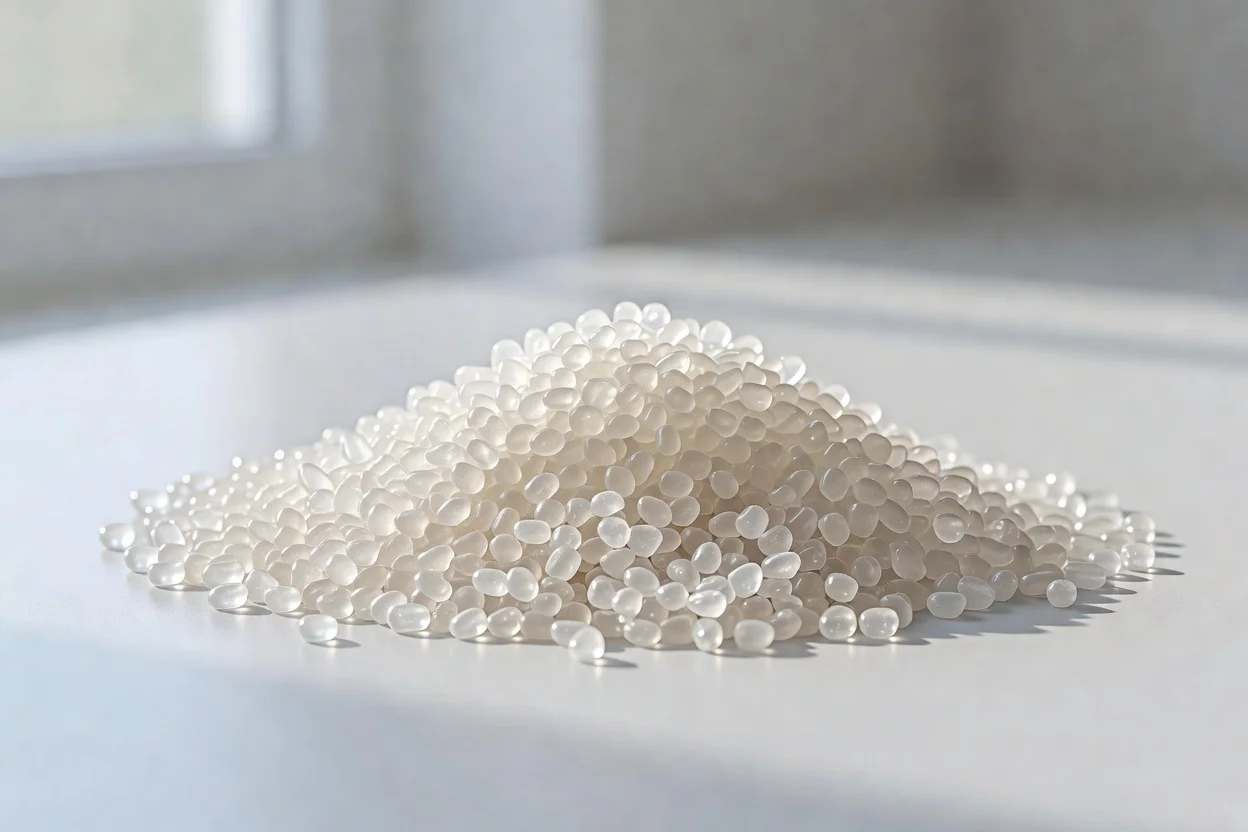
Ethylene/vinyl acetate copolymers (EVA, also written E/VAC) are a family of thermoplastic, random copolymers made from ethylene and vinyl acetate. Their key industrial value is tunable softness: as vinyl acetate content rises, crystallinity falls, while flexibility, clarity, adhesion, and low-temperature performance generally increase.
EVA occupies a broad middle ground between commodity polyethylenes and rubbery elastomers, which is why it is used in films, hot-melt adhesives, footwear foams, wire and cable insulation, photovoltaic encapsulants, and several medical and specialty applications.
The material has been commercially important since the 1960s, and today it remains strategically relevant because it combines easy thermoplastic processing with performance features that would otherwise require blending, foaming, or crosslinking.
At the same time, EVA sits within the plastics sustainability debate: it is not inherently biodegradable, yet it is recyclable in principle within polyolefin streams when formulation and contamination allow, and it is increasingly being reconsidered in packaging, solar, and consumer goods where end-of-life design is becoming more important.
History and Development
EVA emerged as a high-pressure copolymer derived from the same industrial logic that underpins low-density polyethylene production, with vinyl acetate incorporated to modify the stiffness and polarity of the ethylene backbone.
Commercial uptake accelerated as manufacturers recognized that small changes in vinyl acetate content could produce distinct grade families for adhesives, foams, molded parts, and flexible packaging.
Over time, EVA became established as an engineering material for applications where polyethylene alone was too nonpolar and rubber too difficult to process economically.
Chemical Structure and Key Properties
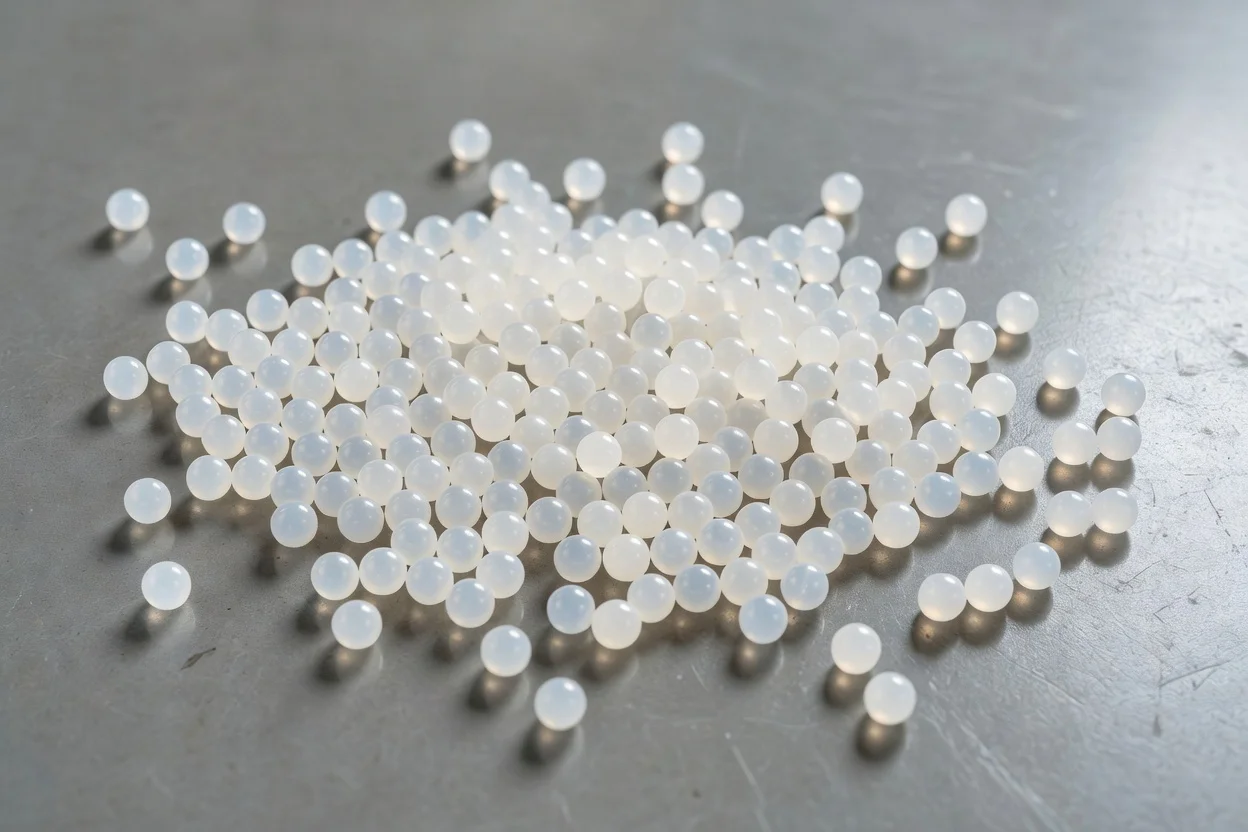
EVA is a random copolymer in which vinyl acetate units are distributed along the ethylene chain, reducing regular chain packing and therefore lowering crystallinity and melting behavior relative to polyethylene.
The most important design variable is vinyl acetate content, which is commonly described in the approximate 1–40 wt.% range for many commercial grades, though specialty formulations can fall outside this window.
| Property trend | Lower vinyl acetate content | Higher vinyl acetate content |
|---|---|---|
| Crystallinity | Higher | Lower |
| Stiffness | Higher | Lower |
| Flexibility | Lower | Higher |
| Adhesion / polarity | Lower | Higher |
| Transparency | Often lower | Often higher |
| Low-temperature performance | Moderate | Better |
The material is valued for flexibility, toughness, transparency, impact resistance, heat-sealability, and good low-temperature behavior.
Two important practical limits define where EVA performs well and where it does not:
- Poor oxygen and grease barrier → the polymer is relatively permeable compared with barrier specialty polymers → workaround: multilayer films, coatings, or blends with barrier layers.
- Low surface energy before treatment → untreated EVA can bond poorly to inks, adhesives, and coatings in some uses → workaround: corona treatment, plasma treatment, primers, or polar comonomer/additive packages.
EVA also has a broad processing window because it can be extruded, injection molded, blow molded, calendered, thermoformed, foamed, and used in hot-melt adhesive systems.
Production Processes and Raw Feedstocks
EVA is produced by copolymerization of ethylene and vinyl acetate, typically using high-pressure radical polymerization technology similar in broad industrial architecture to LDPE manufacture.
The principal feedstocks are:
- Ethylene, generally from steam cracking of hydrocarbon feedstocks.
- Vinyl acetate monomer, usually produced from ethylene, acetic acid, and oxygen-based oxidation routes in integrated chemical chains.
Industrial EVA production is strongly influenced by polymerization pressure, reactor design, comonomer feed control, and the target VA content, because these parameters determine molecular weight distribution, melt behavior, and final softness.
A practical consequence is that producers can deliver a wide grade spectrum, from relatively stiff films and molded grades to soft, highly adhesive, and foamable elastomeric grades.
Applications and End-Use Markets
EVA is used across a wide set of markets because its property profile is unusually adaptable.
| End-use sector | Typical EVA grade / form | Usual processing route | Why EVA fits |
|---|---|---|---|
| Packaging films | Lower- to mid-VA film grades | Blown film, cast film, lamination | Sealability, flexibility, clarity |
| Hot-melt adhesives | Mid- to high-VA adhesive grades | Compounding, adhesive formulation | Tack, cohesion, broad substrate adhesion |
| Footwear | Foamed/crosslinked EVA | Foaming, molding, die cutting | Cushioning, light weight, resilience |
| Wire and cable | Flame-retardant or insulating grades | Extrusion, jacketing, coating | Flexibility, electrical insulation, toughness |
| Photovoltaic modules | Optically clear encapsulant grades | Film extrusion and lamination | Transparency, adhesion, moisture protection |
| Pipe, sheet, molded parts | Modified or compounded grades | Extrusion, injection molding | Processability, impact resistance |
| Agriculture and greenhouse films | Film grades | Film extrusion | Light transmission, flexibility, sealability |
| Medical and controlled-release systems | Specialty grades | Extrusion, molding, film conversion | Biocompatibility and flexibility in selected uses |
Major application areas include:
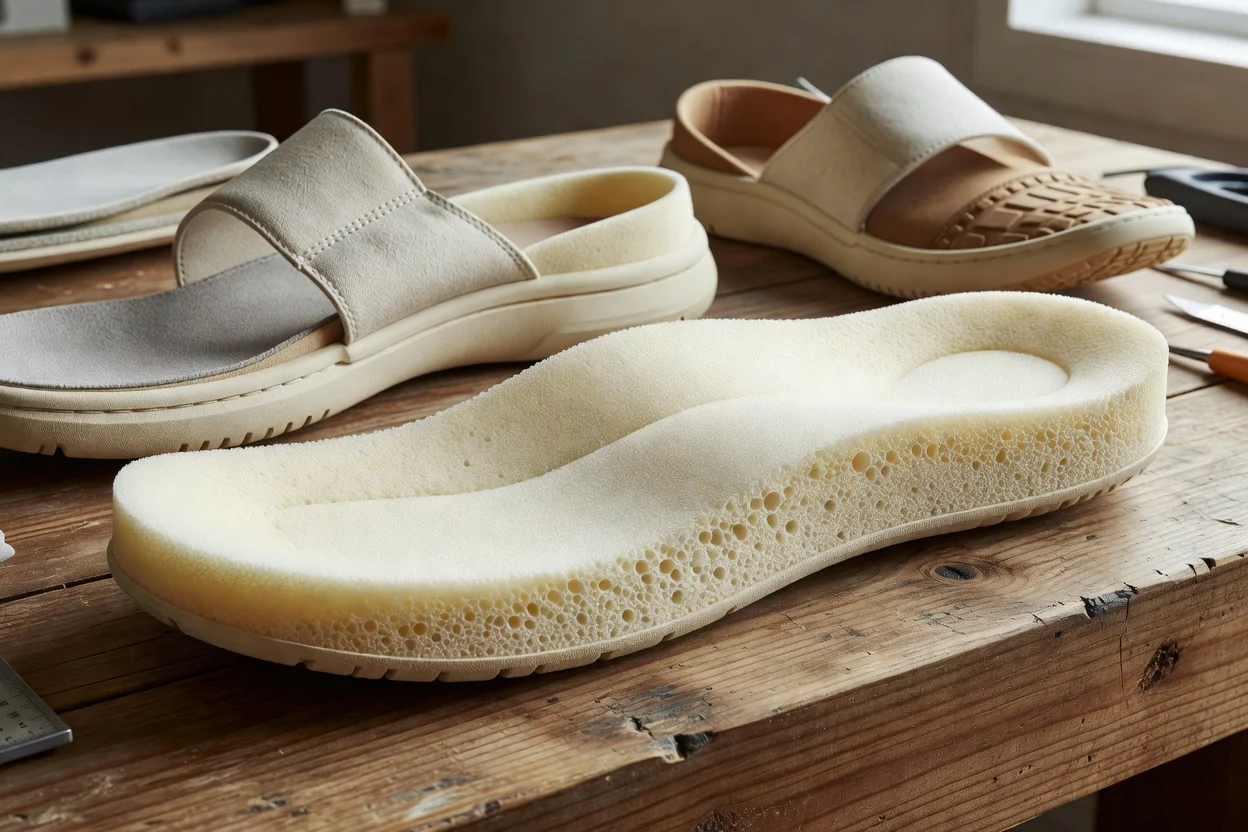
- Footwear, especially midsoles, insoles, and padding, where EVA foams provide shock absorption and low density.
- Hot-melt adhesives, where EVA’s polarity and melt behavior support bonding in packaging, bookbinding, assembly, and laminating.
- Wire and cable insulation, including flame-retardant and heat-shrinkable constructions.
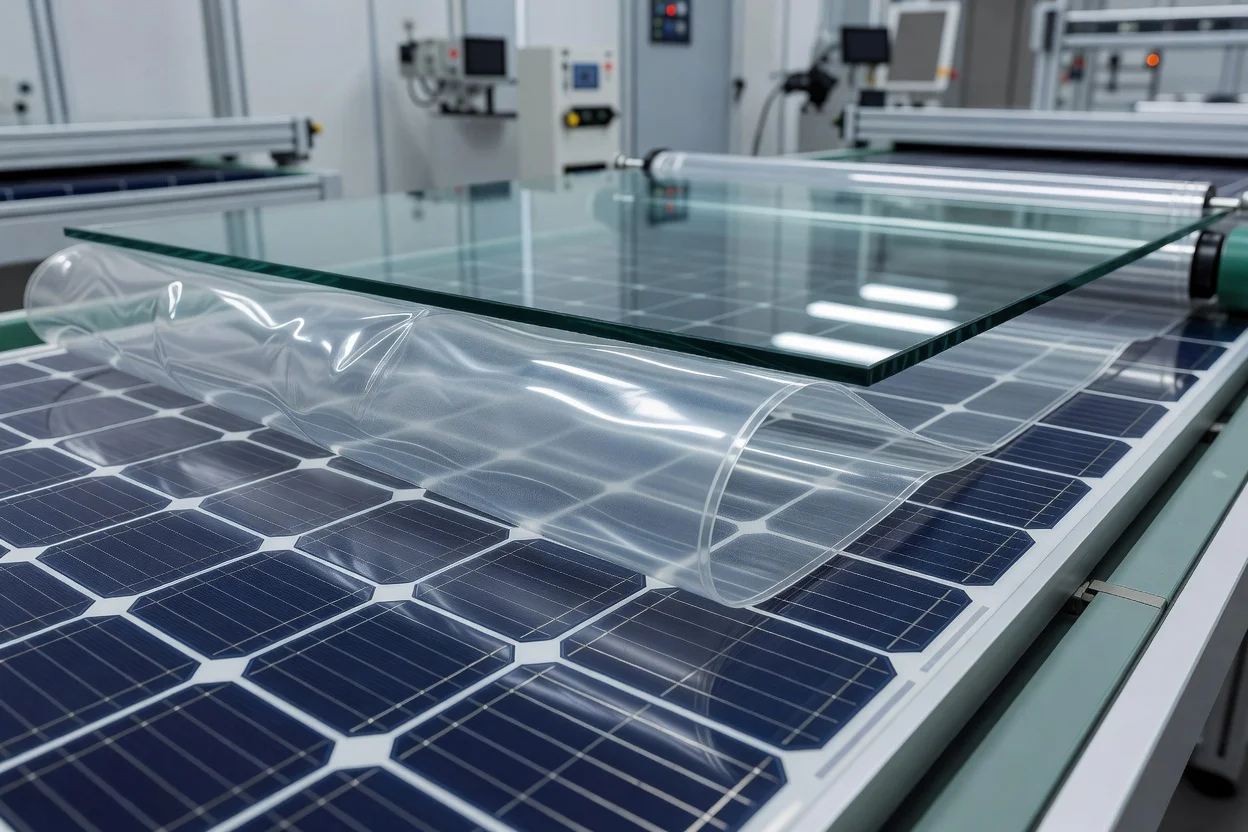
- Photovoltaic encapsulation, where EVA films are laminated into solar modules for optical clarity, adhesion, electrical insulation, and moisture management.
- Packaging films, where EVA improves heat sealing, softness, and puncture tolerance.
- Molded consumer and industrial parts, such as pads, strips, seals, and protective components.
- Medical and biomedical uses, where selected EVA grades are used in controlled-release and device applications.
One comparatively poor-fit use is high-barrier food packaging: EVA is useful for seal layers, but it is not a strong standalone oxygen barrier, so it is usually combined with other materials rather than used alone.
Environmental and Sustainability Aspects
EVA is a fossil-derived polymer in most of its current industrial supply, so its carbon footprint is tied to ethylene and vinyl acetate production as well as to downstream energy use in polymerization, foaming, and conversion.
From a circularity perspective, EVA is not biodegradable, and its recyclability is complicated by three factors:
- It is often used in multilayer or crosslinked products.
- It is frequently compounded with fillers, pigments, tackifiers, flame retardants, or peroxide systems.
- It can be difficult to separate from co-located polymers in finished goods such as solar modules, laminated films, and footwear foams.
Mechanical recycling is feasible for relatively clean scrap streams, especially in industrial film and conversion waste, but post-consumer recovery is much harder.
In photovoltaic modules, EVA encapsulants are especially relevant to end-of-life design because they can hinder disassembly if not engineered for delamination or recycling pathways.
Bio-based and lower-carbon options are under development in the wider EVA value chain, but these are often partial substitutions rather than fully drop-in replacements, because they must preserve melt behavior, adhesion, optical clarity, and durability.
Economic and Global Market Impact
EVA is a globally traded specialty commodity with demand linked to consumer goods, construction, electronics, solar power, and packaging.
The most important market drivers are:
- growth in solar module encapsulation,
- continued demand for footwear foams,
- stable use in hot-melt adhesives,
- and broad consumption in wire and cable and flexible packaging.
Leading producers and brand owners include Dow with ELVAX grades, which are used in injection molding, sheet extrusion, blow molding, and wire coating, and other major global resin suppliers that serve regional film, adhesive, and compounding markets.
Producer competition is shaped less by raw volume than by grade specialization, comonomer control, consistency, optical quality, and suitability for demanding conversion steps such as solar lamination and adhesive formulation.
Current Challenges and Innovations
Current technical challenges include:
- improving barrier performance without sacrificing sealability or softness,
- reducing cable and module aging under heat, UV, and humidity,
- enabling recycling of crosslinked and laminated products,
- and lowering dependence on fossil-based feedstocks.
Innovation directions include:
- formulation tuning by VA content to balance softness, adhesion, and processability,
- crosslinking control in foams and cable systems to improve heat resistance,
- multilayer design to overcome barrier limitations,
- and recyclable encapsulation concepts for photovoltaic modules.
In adhesives, one common formulation approach is to use EVA with tackifiers and waxes to tune open time and cohesion; in foams, peroxide crosslinking and blowing systems are used to create closed-cell structures with low density and high energy absorption.
Future Outlook
EVA is likely to remain important because it is one of the few materials that can simultaneously deliver softness, clarity, adhesion, and thermoplastic processability across such a wide range of uses.
Its strongest future opportunities are in solar, advanced packaging, medical devices, lightweight consumer products, and engineered foams, provided that recyclability, delamination, and lower-carbon feedstocks improve.
The most plausible long-term trajectory is not replacement by a single alternative, but rather a gradual segmentation of the market into conventional EVA, more recyclable EVA-based designs, and partially bio-attributed or circular feedstock variants where performance and economics justify them.
Summary
EVA is a highly versatile copolymer whose industrial importance comes from the ability to tailor performance through vinyl acetate content.
Its combination of flexibility, adhesion, transparency, and processability makes it central to films, adhesives, foams, cables, footwear, and solar encapsulation, while its main limitations are modest barrier performance and end-of-life complexity.
References
- •
Ethylene-vinyl acetate. (2005, March 3). Wikipedia. https://en.wikipedia.org/wiki/Ethylene-vinyl_acetateLink
- •
EVA copolymer properties and applications. (2025, November 12). Goodfellow. https://www.goodfellow.com/global/resources/polyethylene-co-vinyl-acetate-eva-material-information/Link
- •
Ethylene-vinyl acetate copolymer. (n.d.). ChemicalBook. https://amp.chemicalbook.com/ProductChemicalPropertiesCB0356004_EN.htmLink
- •
EVA copolymer properties and applications. (2025, November 12). Goodfellow. https://www.goodfellow.com/fr/resources/polyethylene-co-vinyl-acetate-eva-material-information/Link
- •
EVA (ethylene vinyl acetate): Properties & applications. (2026, May 19). Linseis. https://www.linseis.com/en/wiki/eva-ethylene-vinyl-acetate-material-science-properties-and-applications/Link
- •
Ethylene vinyl acetate. (2022, August 5). Museum of Fine Arts Boston. https://cameo.mfa.org/wiki/Ethylene_vinyl_acetateLink
- •
Properties and applications of EVA polymers. (2025, August 20). Scribd. https://www.scribd.com/document/463355214/EVALink
- •
Ethylene-vinyl acetate copolymer. (2019, May 19). QMplus Hub. https://hub.qmplus.qmul.ac.uk/group/pdp-material-library/ethylene-vinyl-acetate-copolymerLink
- •
Ethylene vinyl acetate copolymer: An overview. (n.d.). ScienceDirect. https://www.sciencedirect.com/topics/pharmacology-toxicology-and-pharmaceutical-science/ethylene-vinyl-acetate-copolymerLink
- •
EVA polymers: Properties & uses. (2025, December 22). Scribd. https://id.scribd.com/document/463355214/EVALink
- •
Ethylen-vinylacetat-copolymer. (2004, July 6). Wikipedia. https://de.wikipedia.org/wiki/Ethylen-Vinylacetat-CopolymerLink
- •
Ethylene-vinyl acetate copolymer: Comprehensive analysis of ... (n.d.). Patsnap Eureka. https://eureka.patsnap.com/materials/eva-copolymer-design-appsLink
- •
ELVAX™ EP2288 ethylene vinyl acetate copolymer. (2023, October 28). Dow Inc. https://www.dow.com/en-us/pdp.elvax-ep2288-ethylene-vinyl-acetate-copolymer.1893348z.htmlLink
- •
Miniemulsion copolymerization of ethylene and vinyl acetate. (n.d.). University of California, Riverside. https://guolab.engr.ucr.edu/sites/default/files/2018-08/6._eva_miniemulsion_polymerization.pdfLink
- •
Applications of ethylene vinyl acetate copolymers (EVA) in ... (n.d.). Sci-Hub. https://2024.sci-hub.se/6728/fc06e2621c2804a2829e3ecea7eaec43/schneider2017.pdfLink
- •
Ethylene vinyl acetate: An in-depth overview of EVA. (2024, August 30). Patsnap Eureka. https://eureka.patsnap.com/blog/material-tech-resources/what-is-ethylene-vinyl-acetate/Link
- •
4.4: Polyolefin and non-polyolefin copolymers. (2007, January 1). GlobalSpec. https://www.globalspec.com/reference/27104/203279/4-4-polyolefin-and-non-polyolefin-copolymersLink
- •
Decoding ethylene vinyl acetate: A look at EVA. (2024, September 10). Patsnap Eureka. https://eureka.patsnap.com/blog/material-tech-resources/what-is-ethylene-vinyl-acetate-2/Link
- •
Poly(ethylene-co-vinyl acetate) EVA: Material information. (2025, November 12). Goodfellow. https://www.goodfellow.com/usa/resources/polyethylene-co-vinyl-acetate-eva-material-information/Link
- •
21 CFR § 177.1350 - Ethylene-vinyl acetate copolymers. (n.d.). Cornell Law School. https://www.law.cornell.edu/cfr/text/21/177.1350Link
- •
Ethylene vinyl acetate copolymer and preparation method therefor. (2018, August 31). Google Patents. https://patents.google.com/patent/WO2019124675A1/enLink
- •
Ethylene vinyl acetate copolymer EVA resin. (2026, January 20). Chemate Group. https://www.chemategroup.com/eva-resin/Link
- •
The performance of ethylene-vinyl acetate copolymer. (2024, July 10). ChemicalBook. https://www.chemicalbook.com/article/the-performance-of-ethylene-vinyl-acetate-copolymer.htmLink
- •
Introduction to vinyl acetate ethylene (VAE). (n.d.). Mallard Creek Polymers. https://www.mcpolymers.com/intro-to-vinyl-acetate-ethyleneLink
- •
Safety data sheet (SDS). (n.d.). ExxonMobil Chemical. https://www.exxonmobilchemical.com/en/chemicals/webapi/dps/v1/safetydatasheets/1169020/enLink
- •
Ethylene vinyl acetate EVA copolymer. (2026, January 20). Chemate Group. https://www.chemategroup.com/eva-copolymer/Link
- •
Ethylene vinyl acetate: Benefits & uses. (2025, February 3). Thermtest. https://thermtest.com/benefits-ethylene-vinyl-acetateLink
- •
Ethylen-vinylacetat-copolymer (EVA). (2024, November 19). Wanplas. https://www.wanplas.com/de/industry-knowledge/plastic-materials/ethylene-vinyl-acetate-copolymer-eva/Link
- •
Decoding ethylene vinyl acetate: A look at EVA. (2024, September 10). Patsnap Eureka. https://eureka.patsnap.com/blog/what-is-ethylene-vinyl-acetate-2/Link
- •
Medium vinyl acetate ethylene vinyl acetate. (n.d.). Patsnap Eureka. https://eureka.patsnap.com/materials/medium-va-eva-copolymersLink
- •
Use of an ethylene vinyl acetate copolymerisate as laminate sheet. (1997, July 30). Google Patents. https://patents.google.com/patent/EP0622430A1/enLink
- •
1lig_86f4_fkm111326. (n.d.). ExxonMobil Chemical. https://www.exxonmobilchemical.com/en/chemicals/webapi/dps/v1/safetydatasheets/p000004364/enLink
- •
What all should you know about ethylene vinyl acetate? (2026, August 28). Research Dive. https://www.researchdive.com/blog/ethylene-vinyl-acetate-resins-properties-advantages-applications-and-their-recyclabilityLink
- •
Ethylene vinyl acetate compound: Comprehensive analysis of ... (n.d.). Patsnap Eureka. https://eureka.patsnap.com/materials/eva-compound-propertiesLink
- •
Ethylene-vinyl acetate (EVA) & blends. (n.d.). Formerra. https://www.formerra.com/products/chemistries/ethylene-vinyl-acetate-eva-blendsLink
- •
Ethylene vinyl acetate: EVA 33% VA. (2001, May 9). AZoM. https://www.azom.com/article.aspx?ArticleID=412Link
- •
Eva request for quotation. (n.d.). ChemBK. https://www.chembk.com/en/chem/evaLink
- •
Characterization of the ethylene-vinyl acetate copolymer ... (n.d.). Lund University. https://lup.lub.lu.se/luur/download?func=downloadFile&recordOId=9015982&fileOId=9015986Link
- •
EVA: Ethylene-vinyl acetate copolymers. (n.d.). USI. https://www.usife.com/en-us/dirProduct/frmProduct2Link
- •
ELVAX™ 460 ethylene vinyl acetate copolymer. (2025, November 5). Dow Inc. https://www.dow.com/en-us/pdp.elvax-460-ethylene-vinyl-acetate-copolymer.1893117z.htmlLink
- •
UV aging behaviour of ethylene-vinyl acetate copolymers (EVA) with different vinyl acetate contents. (2010, May 12). ScienceDirect. https://www.sciencedirect.com/science/article/abs/pii/S0141391010000911Link
- •
Ethylene-vinyl acetate: An overview. (n.d.). ScienceDirect. https://www.sciencedirect.com/topics/agricultural-and-biological-sciences/ethylene-vinyl-acetateLink
- •
Сополимеры этилена/ВАХ (ЭВА). (2025, February 24). Tamin Kalatak. https://ru.taminkalatak.com/product/eva-ethylene-vac-copolymers/Link
- •
乙烯-醋酸乙烯酯共聚物的生产技术与展望. (2025, September 22). Scribd. https://www.scribd.com/document/759749566/%E4%B9%99%E7%83%AF-%E9%86%8B%E9%85%B8%E4%B9%99%E7%83%AF%E9%85%AF%E5%85%B1%E8%81%9A%E7%89%A9%E7%9A%84%E7%94%9F%E4%BA%A7%E6%8A%80%E6%9C%AF%E4%B8%8E%E5%B1%95%E6%9C%9BLink
- •
Ethylene vinyl acetate foam sheet: Comprehensive analysis of ... (n.d.). Patsnap Eureka. https://eureka.patsnap.com/materials/eva-foam-sheet-compositionLink
- •
เอทิลีน | ไวนิลอะซิเตทโคพอลิเมอร์ CAS 24937-78-8 C18H30O6X2 VAE EVA. (n.d.). Thai High Mountain Chem. https://thai.highmountainchem.com/sale-13759332-ethylene-vinyl-acetate-copolymer-cas-24937-78-8-c18h30o6x2-vae-eva.htmlLink
- •
EVA resin properties and applications. (2022, May 18). ElephChem. https://www.elephchem.com/eva-resin-properties-and-applicationsLink
- •
Vinyl acetate content influence. (2025, December 13). Scribd. https://www.scribd.com/document/956635228/Vinyl-Acetate-Content-InfluenceLink
- •
Ethylene-vinyl acetate copolymer as a polyfunctional modifier for ... (2025, October 17). PMC. https://pmc.ncbi.nlm.nih.gov/articles/PMC12566735/Link
- •
EWG skin deep® | What is ethylene/ vinyl acetate copolymer. (2025, January 1). EWG. https://www.ewg.org/skindeep/ingredients/702330-ETHYLENE_VINYL_ACETATE_COPOLYMER/Link
- •
Ethylene copolymers in hot-melt applications: A complete guide. (2025, July 17). SpecialChem. https://www.specialchem.com/adhesives/guide/ethylene-copolymers-for-adhesives-and-sealantsLink