
Introducción
Polihidroxibutirato (PHB) es un poliéster microbiano de la familia de los polihidroxialcanoatos (PHA) y uno de los termoplásticos (termoplásticos) de base biológica y biodegradables más conocidos. Es producido por muchos microorganismos como reserva intracelular de carbono y energía, y ha atraído un interés industrial sostenido porque combina renovabilidad, procesabilidad termoplástica y amplia biodegradabilidad con propiedades que pueden asemejarse al polipropileno en rigidez y resistencia al calor.
PHB es importante en la cadena de valor de los plásticos porque se sitúa en la intersección de la tecnología de fermentación, la química de polímeros y el diseño de materiales de economía circular. Su historia se remonta al descubrimiento microbiológico de principios del siglo XX, pero su relevancia comercial se ha expandido más recientemente a medida que ha aumentado la presión para reducir las materias primas fósiles y mejorar los resultados al final de la vida útil de determinados usos de plásticos. El material también es central en una familia más amplia de PHA, incluidos copolímeros como PHBV, que a menudo se desarrollan para abordar las limitaciones de procesamiento y fragilidad del PHB.
Desde una perspectiva de sostenibilidad, PHB es significativo porque se deriva de carbono renovable o de residuos y puede biodegradarse en suelo, compost, aguas residuales e incluso entornos marinos bajo condiciones adecuadas, aunque las tasas de degradación dependen fuertemente de la geometría, la cristalinidad, la temperatura y la actividad microbiana. Su futuro está, por lo tanto, estrechamente ligado a los avances en materias primas de bajo costo, fermentación de alto rendimiento, recuperación aguas abajo, mezcla y modificación de propiedades, todo lo cual determina si el PHB puede pasar de aplicaciones de nicho a mercados de mayor volumen.
Historia y desarrollo
PHB se identificó por primera vez en el desarrollo temprano de la microbiología y más tarde se reconoció como un poliéster natural distinto almacenado por bacterias bajo condiciones limitantes de nutrientes. El polímero se convirtió en un material de referencia porque demostró que macromoléculas similares a plásticos podían ser biosintetizadas por organismos vivos en lugar de derivarse de petroquímicos.
El interés en la investigación se aceleró cuando se demostró que PHB era biodegradable, termoplástico y biocompatible, abriendo vías hacia el envasado y uso biomédico. Con el tiempo, el campo se expandió desde la caracterización microbiana básica hasta la biotecnología industrial, con énfasis en la ingeniería de cepas, sustratos alternativos y optimización de la fermentación para reducir costos y mejorar la productividad.
El desarrollo comercial también ha pasado del PHB como homopolímero independiente hacia copolímeros y mezclas que contienen PHB, porque el PHB puro suele ser demasiado frágil y tiene una ventana de procesamiento estrecha para muchas aplicaciones de alto volumen. Esta evolución refleja una estrategia de materiales más amplia: utilizar el fuerte perfil de sostenibilidad y barrera del PHB compensando sus limitaciones mecánicas y de procesamiento térmico mediante formulación y copolimerización.
Estructura química y propiedades clave
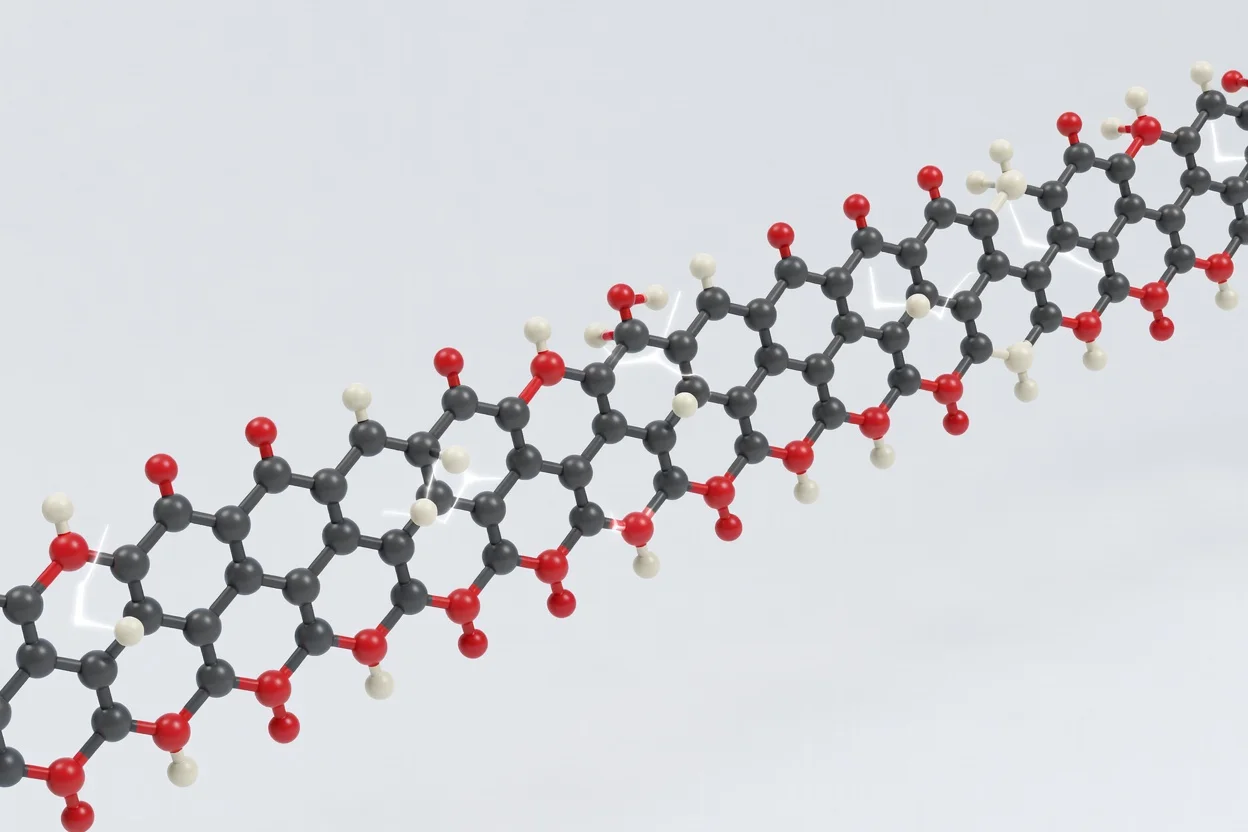
PHB es un poliéster alifático lineal compuesto por unidades repetidas de 3-hidroxibutirato, comúnmente escrito en forma estructural como un esqueleto de éster repetido con grupos laterales metilo. Es isotáctico y altamente cristalino, lo que contribuye a su rigidez y punto de fusión relativamente altos, pero también a su fragilidad.
| Propiedad | Significado típico |
|---|---|
| Alta cristalinidad | Proporciona rigidez y buen rendimiento como barrera, pero también fragilidad. |
| Punto de fusión alrededor de 175 a 180 °C | Permite su uso en procesamiento termoplástico, pero la degradación térmica puede comenzar cerca de la ventana de procesamiento por fusión. |
| Bajo alargamiento a la rotura | Limita su uso en piezas resistentes y sometidas a impacto a menos que se modifique. |
| Buena barrera al oxígeno y a la humedad | Útil en envasado donde importa la extensión de la vida útil. |
| Biodegradabilidad | Admite escenarios de fin de vida en suelo, compost, aguas residuales y marinos bajo condiciones adecuadas. |
Una forma útil de entender el PHB es a través de su equilibrio estructura-propiedad. La estereoquímica regular y la alta cristalinidad producen un material fuerte y relativamente rígido, pero el mismo orden molecular lo hace más frágil que muchos plásticos comerciales.
PHB tiene varias limitaciones prácticas:
- Fragilidad → alta cristalinidad y movilidad limitada de cadenas → solución: copolimerización con unidades de hidroxi<|eos|>
Referencias
- •
Polyhydroxybutyrate. (2004, November 5). Wikipedia. https://en.wikipedia.org/wiki/PolyhydroxybutyrateLink
- •
Polyhydroxybutyrate (PHB): Production, Properties ... - PMC. (2026, July 20). https://pmc.ncbi.nlm.nih.gov/articles/PMC13413960/Link
- •
Polyhydroxybutyrate (PHB): Critical Perspectives on Material Properties, Production Advances, and Challenges Toward Sustainable Commercialisation. (2026, July 13). https://www.mdpi.com/1996-1944/19/14/3013Link
- •
Review of Biopolymer Polyhydroxybutyrate (PHB) and Blends. (2025, November 20). https://pmc.ncbi.nlm.nih.gov/articles/PMC12655965/Link
- •
Polyhydroxybutyrate (PHB): microbial synthesis and waste ... (n.d.). https://link.springer.com/article/10.1007/s42452-026-08715-w?error=cookies_not_supported&code=39dfdd9f-2ddb-48f6-a1d2-d623b6fcdd28Link
- •
Polyhydroxybutyrate (PHB)-Based Biodegradable Polymer from ... - PMC. (2022, September 23). https://pmc.ncbi.nlm.nih.gov/articles/PMC9571180/Link
- •
Synthesis, Structure, and Properties of Polyhydroxybutyrate ... (2025, May 6). https://pmc.ncbi.nlm.nih.gov/articles/PMC12518049/Link
- •
Polyhydroxybutyrates: A Sustainable Alternative for ... (2024, September 30). https://www.biotech-asia.org/vol21no3/polyhydroxybutyrates-a-sustainable-alternative-for-synthetic-polymers/Link
- •
Polyhydroxybutyrate: Comprehensive Analysis Of Biosynthesis ... (n.d.). https://eureka.patsnap.com/materials/polyhydroxybutyrate-analysisLink
- •
Poly Beta Hydroxybutyric Acid (PHB) As A Sustainable Material (n.d.). https://eureka.patsnap.com/materials/phb-sustainable-materialLink
- •
PHB profile – material | technology | sustainability | design (n.d.). https://www.burg-halle.de/gast/process/phb-profile/Link
- •
Production of Polyhydroxybutyrate (PHB) and Factors Impacting Its ... - PMC. (2020, December 4). https://pmc.ncbi.nlm.nih.gov/articles/PMC7761907/Link
- •
Polyhydroxybutyrate. (2014, October 26). ScienceDirect. https://www.sciencedirect.com/topics/agricultural-and-biological-sciences/polyhydroxybutyrateLink
- •
[PDF] Industrial and Biomedical Applications Biobased Polymers of ... (n.d.). https://fjet.fudutsinma.edu.ng/index.php/fjet/article/download/74/65Link
- •
Polyhydroxybutyrate: plastic made and degraded by ... (n.d.). PubMed. https://pubmed.ncbi.nlm.nih.gov/9921137/Link
- •
Mechanical properties and biodegradation characteristics of PHB-based films (n.d.). ScienceDirect. https://www.sciencedirect.com/science/article/pii/S0032959299001077Link
- •
Biodegradable and active materials based on PHBV for sustainable ... (2026, May 28). https://pubs.rsc.org/en/content/articlehtml/2026/fb/d5fb00936gLink
- •
A review on Polyhydroxybutyrate (PHB): Production ... - IJNRD (n.d.). https://www.ijnrd.org/papers/IJNRD2404734.pdfLink
- •
PHB (2022, January 1). https://bioweb.supagro.inrae.fr/ESTHER/substrate/PHBLink
- •
[PDF] A comprehensive review on production of polyhydroxybutyrate (PHB) (n.d.). https://www.microbiojournal.com/article/142/5-1-22-572.pdfLink
- •
Polyhydroxybutyrate - an overview (n.d.). ScienceDirect. https://www.sciencedirect.com/topics/engineering/polyhydroxybutyrateLink
- •
Polyhydroxybuttersäure – Wikipedia. (2007, April 27). https://de.wikipedia.org/wiki/Polyhydroxybutters%C3%A4ureLink
- •
Biodegradable and active materials based on PHBV for sustainable food packaging (n.d.). https://pubs.rsc.org/en/content/articlepdf/2026/fb/d5fb00936gLink
- •
Polyhydroxybutyrate (PHB): microbial synthesis and waste ... (n.d.). https://link.springer.com/article/10.1007/s42452-026-08715-w?error=cookies_not_supported&code=15a5ea87-6025-4bca-9a50-b2bacac098fdLink
- •
Polyhydroxybutyrat – Wikipedia tiếng Việt. (2015, January 10). https://vi.wikipedia.org/wiki/PolyhydroxybutyratLink
- •
Complete Biodegradable Plastics Compared: PHA, PHB, PBAT, PLA ... (2025, July 2). https://specialty-polymer.com/biodegradable-compared-pha-phb-pbat-pla-pbs-pcl-and-tps/Link
- •
Review of recent advances in the biodegradability ... - RSC Publishing. (2020, August 31). https://pubs.rsc.org/en/content/articlehtml/2020/gc/d0gc01647kLink
- •
ポリヒドロキシ酪酸 - Wikipedia. (2009, November 18). https://ja.wikipedia.org/wiki/%E3%83%9D%E3%83%AA%E3%83%92%E3%83%89%E3%83%AD%E3%82%AD%E3%82%B7%E9%85%AA%E9%85%B8Link
- •
Poly-β-Hydroxybutyric Acid: Comprehensive Analysis Of ... (n.d.). https://eureka.patsnap.com/materials/phb-biosynthesis-propertiesLink
- •
Biosynthesis of bioplastic polyhydroxybutyrate (PHB) from ... (n.d.). ScienceDirect. https://www.sciencedirect.com/science/article/abs/pii/S0957582024005317Link
- •
PLA/PHB-Based Materials Fully Biodegradable under Both ... - PMC. (2022, September 30). https://pmc.ncbi.nlm.nih.gov/articles/PMC9572414/Link
- •
Polyhydroxybutyrate (PHB) in the Real World: 5 Uses You'll Actually ... (2025, October 23). https://www.linkedin.com/pulse/polyhydroxybutyrate-phb-real-world-5-uses-youll-actually-nkejfLink
- •
Biodegradable Plastic: Types, Properties & Material Table (2026, June 24). https://www.specialchem.com/plastics/guide/biodegradabilityLink
- •
Novel Production Methods of Polyhydroxyalkanoates and Their ... - PMC. (2022, November 30). https://pmc.ncbi.nlm.nih.gov/articles/PMC9740486/Link
- •
Production of biodegradable plastic by polyhydroxybutyrate (PHB) accumulating bacteria using low cost agricultural waste material - PMC. (2016, December 12). https://pmc.ncbi.nlm.nih.gov/articles/PMC5154074/Link
- •
Poly Beta-Hydroxybutyric Acid Food Packaging (n.d.). https://eureka.patsnap.com/materials/phb-food-packaging-solutionsLink
- •
In search of poly-3-hydroxybutyrate (PHB): A comprehensive review ... (n.d.). ScienceDirect. https://www.sciencedirect.com/science/article/abs/pii/S0960308524001603Link
- •
Recent Updates on the Economic Use of Poly Hydroxy ... (n.d.). https://bbrc.in/recent-updates-on-the-economic-use-of-poly-hydroxy-butyrate-phb-a-green-alternative-to-plastics/Link
- •
Development and Advantages of Biodegradable PHA ... - PMC. (2021, October 15). https://pmc.ncbi.nlm.nih.gov/articles/PMC8672356/Link
- •
Frontiers | In vivo and Post-synthesis Strategies to Enhance the Properties of PHB-Based Materials: A Review (2021, January 14). https://www.frontiersin.org/journals/bioengineering-and-biotechnology/articles/10.3389/fbioe.2020.619266/fullLink
- •
Review Polyhydroxybutyrate blends: A solution for biodegradable packaging? (2022, May 15). ScienceDirect. https://www.sciencedirect.com/science/article/abs/pii/S014181302200441XLink
- •
Polyhydroxybutyrate (PHB) Market Size, Trends & Growth (2025, March 27). https://marksparksolutions.com/reports/polyhydroxybutyrate-phb-marketLink
- •
What are PHB and PHA bioplastics? (2023, March 19). https://goecopure.com/faq-items/what-are-phb-and-pha-bioplastics/Link
- •
PHB production by bacteria and its applications | PPTX (2015, November 20). https://www.slideshare.net/slideshow/phb-production-by-bacteria-and-its-applications/55338260Link
- •
PHB-based biodegradable polymer composite films to replace ... (n.d.). https://acs.digitellinc.com/p/s/phb-based-biodegradable-polymer-composite-films-to-replace-conventional-packaging-materials-533852Link