
Introduction
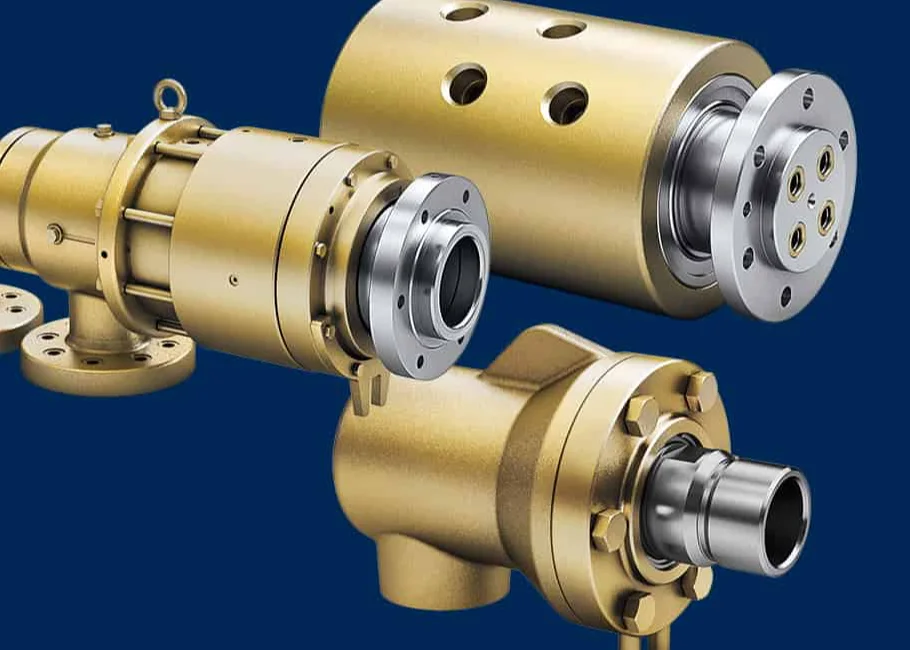
Rotary unions for liquids are precision mechanical sealing devices that transfer liquid media between a stationary supply line and a rotating machine component without interrupting rotation or causing unacceptable leakage. In plastics processing and other continuous manufacturing systems, they are used primarily for cooling water, thermal oil, hydraulic fluid, emulsions, and cleaning media in rotating rolls, drums, spindles, and other moving assemblies.
In practice, the term covers both single-pass and multi-pass designs, with variants optimized for low-speed, high-pressure, high-temperature, or multi-circuit service. Their engineering is closely tied to seal technology, bearing support, pressure balancing, and material compatibility, and the selection process is governed by media type, pressure, temperature, rotational speed, and flow rate.
Within the plastics industry, rotary unions are especially important in calendering, film and sheet lines, chill rolls, extruder auxiliaries, winding systems, and injection molding peripherals, where rotating heat-transfer or hydraulic interfaces are needed to maintain product quality and process stability. Sustainability considerations increasingly shape their design through lower leakage, longer seal life, improved thermal efficiency, and reduced maintenance-related downtime.
History and Development
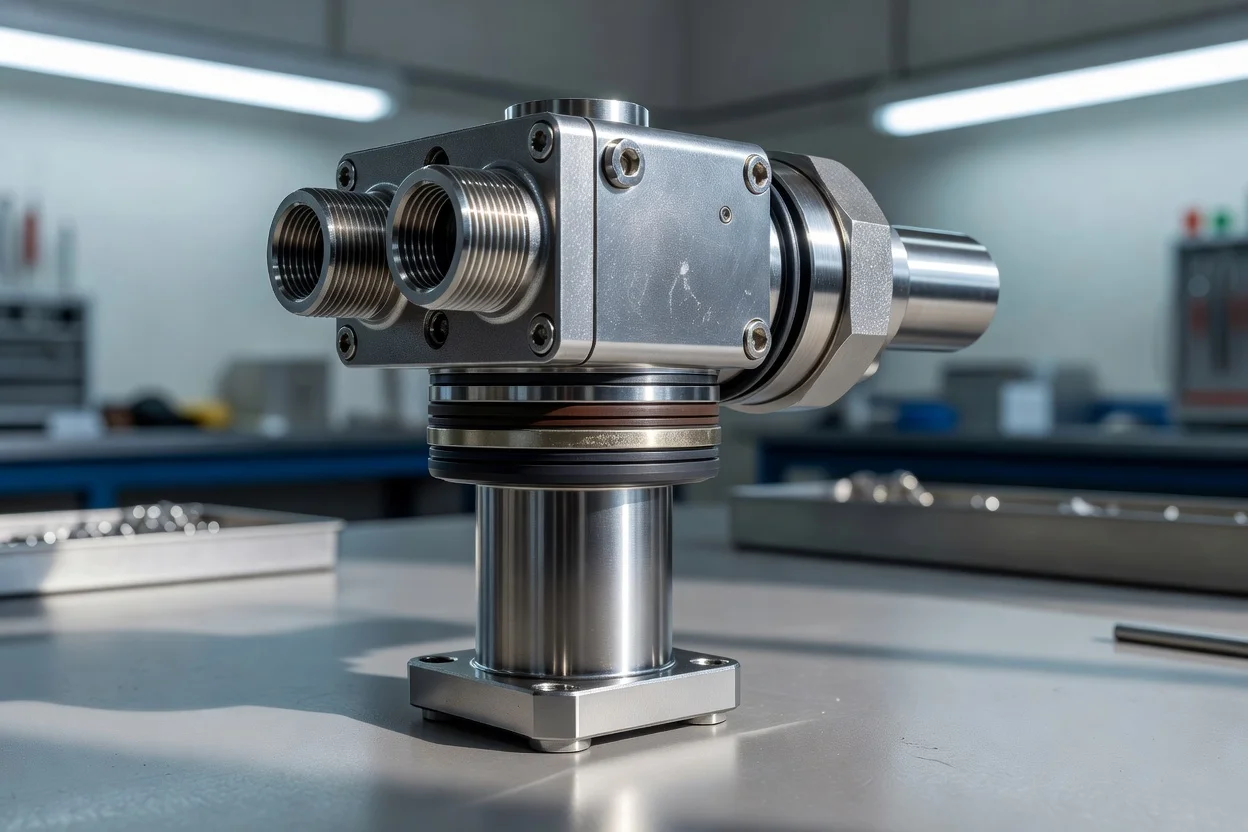
Rotary unions evolved from general rotary sealing and swivel-joint technology used in steam, water, and industrial fluid handling. Their modern form combines precision-machined housings, rotating elements, seals, and bearings to permit continuous fluid transfer while maintaining a leak-tight interface.
Key development milestones include:
- Industrial steam and hot-water service established the basic rotary-joint concept for heated rolls and cylinders in paper, textile, and converting machinery, later adapted for plastics processing equipment.
- Balanced mechanical seal designs improved durability and reduced wear by using precision lapped seal faces, especially in water, steam, and thermal-oil applications where stable sealing performance is critical.
- Multi-passage rotary unions expanded the function of a single device from simple fluid transfer to simultaneous handling of multiple isolated media, such as cooling water and inert gas or hydraulic circuits with separate return lines.
More recent development has focused on higher speed, higher pressure, and harsher media service, including stainless-steel construction for corrosion resistance and specialty designs for high-temperature fluids.
Key Characteristics and Technical Overview
A rotary union is fundamentally a rotary sealing interface between a fixed inlet and a rotating outlet. The liquid enters through the stationary side, passes through internal flow passages, and exits through the rotating member into the machine component being served.
Typical construction includes:
- Housing connected to the stationary piping
- Rotor fixed to the rotating shaft, drum, or spindle
- Seals that prevent leakage and contamination ingress
- Bearings that support rotation and reduce frictional load
Two major sealing concepts are common:
- Mechanical seal rotary unions, which use precision lapped faces and are widely used for water, coolant, air, and hydraulic oil service.
- Hydrostatic seal designs, which use a small fluid film gap; these require drain return management because a controlled amount of fluid passes through the gap.
Important selection parameters include:
- Media: water, coolant, hydraulic oil, thermal oil, emulsion, steam, or specialty liquids
- Pressure: from vacuum service to high-pressure systems; industrial product ranges cited by manufacturers extend from low-pressure water duty to several hundred bar in specialized units.
- Speed: from slow roll rotation to very high-speed spindle service; published products cover ranges from below 100 rpm to tens of thousands of rpm, depending on design.
- Temperature: water-cooling service at ambient to hot-oil and steam applications at elevated temperatures.
- Flow rate: sized by required thermal load, hydraulic demand, and allowable pressure drop.
For liquid service, practical performance benchmarks vary by machine class and seal design. In many industrial systems, centrifugal dewatering or process-liquid handling is not relevant to rotary unions themselves; instead, the key metrics are sealing integrity, thermal endurance, and service life. For process rolls and cooling circuits, unions are often specified to maintain stable flow under continuous rotation with minimal pressure loss and low torque.
Types and Variations
Rotary unions for liquids are commonly grouped by passage count, media, and duty class.
| Type | Typical use | Main feature |
|---|---|---|
| Single-flow | One liquid circuit such as cooling water or hot oil | Simplest construction and lowest complexity |
| Multi-flow / multi-passage | Separate supply and return lines, or multiple fluids | Enables isolated circuits in one rotating assembly |
| Water unions | Cooling rolls, chillers, process drums | Often optimized for corrosion resistance and seal wear control |
| Oil / thermal-oil unions | Heated rolls, calendaring, tempering | Designed for elevated temperature stability |
| Hydraulic unions | Actuation, clamping, pitch or pressure circuits | Built for higher pressure and fluid power duty |
| Vacuum-capable unions | Process or laboratory rotating systems | Focus on leakage control under negative pressure |
| High-speed unions | Spindles and rotating tooling | Low torque and dynamic balance are critical |
Manufacturers also distinguish between monoflow and duoflow arrangements, as well as end connections such as threaded, flanged, or custom manifold interfaces.

Applications and Uses
Rotary unions for liquids appear across many industrial sectors, but in plastics processing their most common roles are tied to temperature control, hydraulic actuation, and rotating production equipment.
Major plastics-industry uses include:
- Calender rolls and chill rolls for sheet, film, and foil lines, where water or thermal oil is circulated through rotating rolls to control surface temperature.
- Winding and unwinding systems, where liquid cooling or hydraulic functions may be routed through rotating shafts or reel drums.
- Injection molding auxiliaries, especially where rotating platens, index tables, or tooling services need fluid transfer.
- Extrusion peripherals, such as rotating screening, pellet handling, or auxiliary cooling assemblies that require continuous liquid transfer.
A poor-fit application is static piping service, because a rotary union is specifically intended for relative motion between fixed and rotating parts; if no rotation is present, a standard pipe fitting or flexible hose is usually more appropriate.
Beyond plastics, the same technology is used in paper, food, pharmaceuticals, machine tools, wind energy, marine systems, and industrial processing equipment.
Performance and Design Considerations
The technical performance of a liquid rotary union is usually judged by:
- Leakage control
- Seal wear rate
- Torque
- Pressure capability
- Thermal stability
- Rotational balance
- Contamination resistance
For liquid service, material selection is critical. Stainless steel is commonly used for hot water, steam, and corrosive or high-purity duties, while seal materials must be matched to the media and temperature range. In severe water applications, manufacturers often use seal combinations that reduce early wear and extend service intervals.
Low torque is important in high-speed or precision machinery because excess friction can raise heat, increase wear, and affect drive efficiency. High-pressure designs, by contrast, may sacrifice some simplicity for more robust sealing geometry and stronger bearing support.
Technological Innovations and Automation
Recent innovation has focused on:
- Multi-channel manifolds that route several isolated liquid circuits through one rotating assembly.
- Improved seal materials and face finishes for longer life under abrasive, hot, or chemically aggressive liquids.
- Condition-monitoring integration in larger machine systems, allowing predictive maintenance based on temperature, vibration, or leakage trends.
- Compact high-speed designs for machine tools and precision equipment, where low torque and minimal imbalance are essential.
In automated plastics lines, these improvements help stabilize temperature control, reduce scrap risk, and support tighter process windows.
Environmental and Sustainability Aspects
Rotary unions for liquids contribute to sustainability mainly through closed-loop fluid transfer, reduced leakage, and longer equipment life.
Their environmental relevance includes:
- Lower fluid loss, especially in water, oil, and coolant circuits
- Improved energy efficiency through better thermal transfer and reduced mechanical drag
- Reduced downtime, which lowers waste from process interruptions and start-up scrap
- Compatibility with heat-transfer optimization, supporting lower process energy use in heated or cooled rotating systems
The sustainability impact depends heavily on seal quality and maintenance practice. Poorly matched unions can leak, overheat, or wear prematurely, increasing both environmental burden and operating cost.
Economic and Global Market Impact
Rotary unions are a relatively small component in capital equipment, but they can have an outsized impact on total cost of ownership because failure can stop an entire production line. This is especially true in plastics manufacturing, where a union may serve a critical chill roll, heated roll, or rotating hydraulic interface.
Market demand is supported by:
- Continuous-process industries
- Higher automation
- More compact machine design
- Greater use of temperature-controlled rotating components
Global suppliers emphasize broad application coverage, from general industry water and oil service to high-pressure and high-speed specialty markets.
Current Challenges and Innovations
The main technical challenges are:
- Seal wear under continuous rotation
- Media contamination
- Thermal expansion and misalignment
- Corrosion from aggressive liquids
- Balancing high pressure with low torque
Innovation is concentrated on extending seal life, improving corrosion resistance, and broadening the usable operating envelope. Multi-passage units are also being refined to support increasingly complex machine architectures, where cooling, hydraulic power, and inerting functions must be integrated into one rotating node.
Future Outlook
Future development is likely to favor higher integration, better diagnostics, and more application-specific designs. In plastics processing, this means rotary unions that are more compact, more energy-efficient, and more resistant to thermal cycling and contamination in demanding continuous lines.
Growth in precision roll processing, electric and hybrid machine architectures, and more automated process control should continue to increase demand for reliable liquid transfer at rotating interfaces. At the same time, sustainability pressure will keep pushing the industry toward longer seal life, fewer fluid losses, and lower-maintenance operation.
Summary
Rotary unions for liquids are essential enabling components for continuous rotation with fluid transfer, especially in machine systems that require cooling, heating, or hydraulic power. In plastics machinery, they underpin stable temperature control and reliable operation in rotating rolls, drums, spindles, and auxiliary assemblies, while ongoing engineering progress continues to improve durability, efficiency, and multi-media integration.
References
- •
English. (2020).Link
- •
Rotary joints for fluids, hydraulics & pneumatics. (n.d.).Link
- •
Rotary unions. (n.d.).Link
- •
Rotary unions & rotary joints. (n.d.).Link
- •
Rotary unions swivel joints. (n.d.).Link
- •
Multi-passage rotary unions: Technology, benefits and applications. (2026).Link
- •
What is a rotary union and how can it be sealed effectively? (n.d.).Link
- •
Rotary joint water. (2000).Link
- •
Rotary unions for water, coolant, oil, air, vacuum, steam. (n.d.).Link
- •
High temperature rotary unions: G series. (2025).Link
- •
Industrial fluid rotary unions. (n.d.).Link
- •
Rotary union. (2013).Link
- •
Standard rotary joints. (2019).Link
- •
Hydraulic rotating joint. (n.d.).Link
- •
Rotary union: Industrial rotary coupling guide. (2026).Link
- •
Rotating unions for steam, hot oil and water applications. (n.d.).Link
- •
Rotary unions. (n.d.).Link
- •
Rotary unions for high-performance applications. (2025).Link
- •
Water rotary unions: Proven, tested & trusted. (n.d.).Link
- •
Rotary unions. (n.d.).Link
- •
Water rotary joint—RX. (2023).Link
- •
Customize your globalspec experience. (n.d.).Link
- •
Fluid rotary unions product guide. (n.d.).Link
- •
FAQs. (2020).Link
- •
Rotary unions. (n.d.).Link
- •
Rotary unions for water: Single and multi-channel. (2024).Link
- •
Water: Rotary unions. (n.d.).Link
- •
Water rotary unions: An in-depth exploration. (2024).Link
- •
Fluid rotary unions: A comprehensive guide. (2024).Link
- •
Featured article: Rotary unions & swivels. (n.d.).Link
- •
Dynamic: Rotary union. (n.d.).Link
- •
Rotary joints 101: Function, design and industrial benefits. (2026).Link