
Introduction
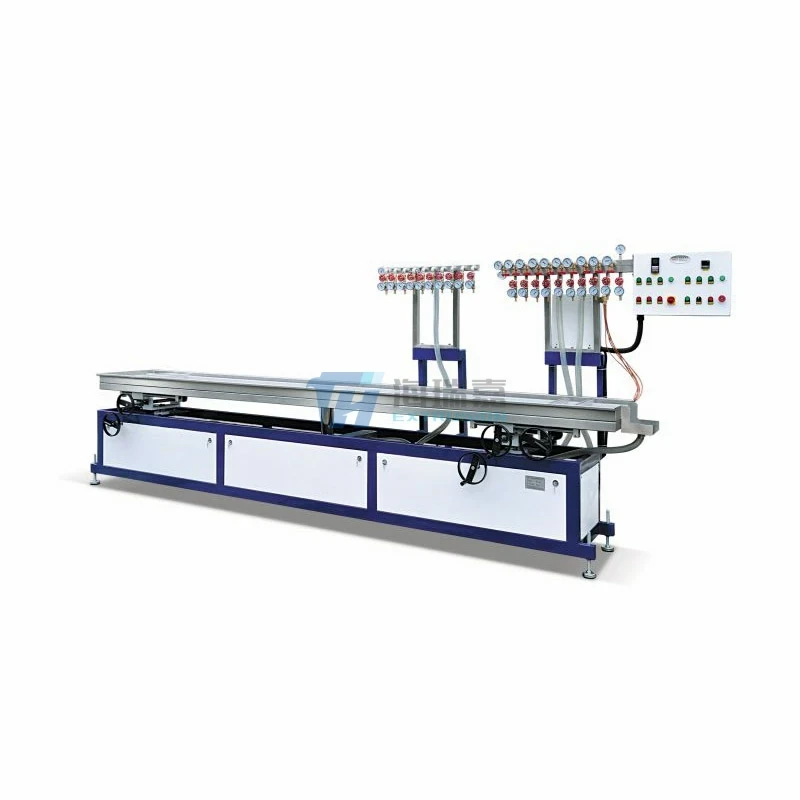
In plastics processing, calibrator most often refers to the sizing and shaping unit used immediately after extrusion to hold a newly formed profile, tube, or sheet to its final dimensions while it cools and solidifies. In Chinese industry usage, 定型装置 likewise denotes the calibration/sizing device that stabilizes geometry, surface quality, and dimensional accuracy in extrusion lines.
A calibrator is therefore not a metrology instrument in this context, but a process machine component whose function is to control outer dimensions, ovality, wall thickness distribution, and shrinkage during the critical transition from molten polymer to finished semi-finished product. Its design strongly affects line speed, dimensional tolerances, and product consistency.
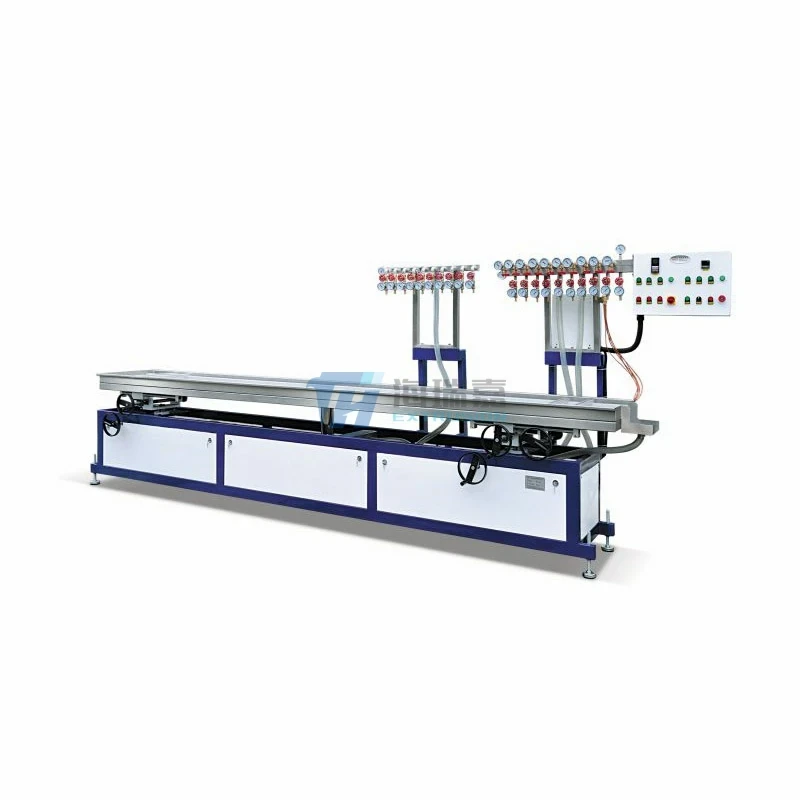
Calibrators are central to the production of PVC profiles, PE and PP pipes, window and door sections, technical profiles, and certain sheet and panel lines. Common forms include vacuum calibrators, pressure calibrators, spray or bath cooling calibrators, and contact or sizing plates, each selected according to polymer type, wall thickness, line speed, and required surface finish.
Historically, calibrator technology evolved alongside extrusion itself: early lines relied on simple guides and water cooling, while modern systems use precision-machined calibration sleeves, vacuum chambers, controlled cooling circuits, and automated vacuum/temperature control. Current development trends emphasize lower energy use, better melt guidance, faster changeover, and more stable processing of higher-output recycled and filled compounds.
History and Development
Early extrusion lines used relatively simple cooling fixtures and manually adjusted guides, which limited output and dimensional precision. As profile and pipe production expanded, especially in building materials and infrastructure applications, the need for stable cross-sectional control led to the adoption of dedicated sizing and calibration equipment.
A major milestone was the integration of vacuum calibration for hollow and semi-hollow profiles. By drawing the soft extrudate against a precisely machined calibration surface, vacuum systems improved shape retention and surface accuracy while allowing more consistent cooling immediately after the die.
A second milestone was the shift toward closed-loop control of vacuum level, cooling water temperature, and haul-off synchronization. This made it possible to support higher line speeds without sacrificing dimensional stability, particularly for PVC and polyolefin profiles.
A third development has been the use of modular calibrator blocks and application-specific sizing shoes, sleeves, or plates that can be swapped more quickly for different products. This reflects the broader extrusion industry shift toward flexibility, shorter downtime, and lower scrap rates.
Technical Overview
A calibrator operates in the first downstream zone after the extruder die. The hot extrudate enters the calibration section while still deformable, and the equipment fixes the external geometry by combining contact guidance, vacuum retention, and controlled heat removal. In profile lines, the calibrator often works together with a haul-off unit and cooling tank to complete solidification.
Working principle
- The melt exits the die in an oversized or partly free state.
- The calibrator establishes the final contour by forcing the material against a defined surface or within a calibrated cavity.
- Vacuum channels or pressure balancing stabilize the part against collapse or distortion.
- Water cooling or air cooling removes heat until the polymer retains its shape.
Common engineering elements
- Calibration sleeve or block: machined to the target cross-section.
- Vacuum ports and manifolds: hold the profile against the sizing surface.
- Cooling channels: extract heat rapidly and uniformly.
- Guide rails and entry cones: align the hot profile and reduce abrasion.
- Adjustable support sections: compensate for product-specific shrinkage.
Typical performance benchmarks
- For profile and tube calibration, line throughputs commonly range from tens to several hundred kilograms per hour, depending on section size, polymer, and line design; large pipe lines can exceed this range. This is an industry-wide operating pattern rather than a fixed specification.
- Rotor speed is not a standard parameter for most calibrators because the device is usually stationary; instead, performance is governed by vacuum level, cooling intensity, line speed, and haul-off pull force.
- In downstream plastic size-reduction and finishing systems adjacent to extrusion plants, typical flake and granule sizes are often in the millimeter range, but that is not a calibrator parameter and is only relevant when a plant integrates regrind or recycling preparation equipment.
- Residual moisture after centrifugal dewatering in related plastics recycling lines can fall to a few percentage points by mass, but this is outside calibrator function and should not be confused with extrusion calibration.
Practical technical implications
- Higher vacuum generally improves shape retention for thin-walled sections, but excessive vacuum can increase surface marking or destabilize delicate geometries.
- Cooling uniformity is often more important than maximum cooling rate because uneven heat extraction can create warpage, shrink marks, or dimensional drift.
- Calibration length must balance stabilization time against line footprint and pressure drop; a longer calibrator can improve dimensional control but may reduce flexibility and increase cost.
Types and Variations
| Type | Main principle | Typical use |
|---|---|---|
| Vacuum calibrator | Uses suction to press the extrudate against a precise surface | PVC profiles, pipes, hollow sections |
| Pressure calibrator | Applies positive pressure or internal support | Certain tubes and specialty profiles |
| Sleeve calibrator | Uses a shaped sleeve or bushing to define the contour | Round pipe and compact sections |
| Plate or shoe calibrator | Uses contact surfaces to stabilize flat or open profiles | Sheet edges, technical profiles |
| Spray-cooled calibrator | Combines sizing with direct water cooling | High-throughput lines where rapid heat removal is needed |
| Modular calibrator | Interchangeable inserts for different products | Multi-product extrusion plants |
Vacuum calibrators are the most widely recognized configuration in rigid profile extrusion because they combine high dimensional precision with relatively simple operation. Pressure and hybrid designs are used where the product geometry or polymer melt strength makes vacuum-only sizing less effective.
Applications and Uses
- PVC window and door profiles: Calibrators are essential for maintaining tight tolerances on visible surfaces, interlocking geometries, and sealing channels.
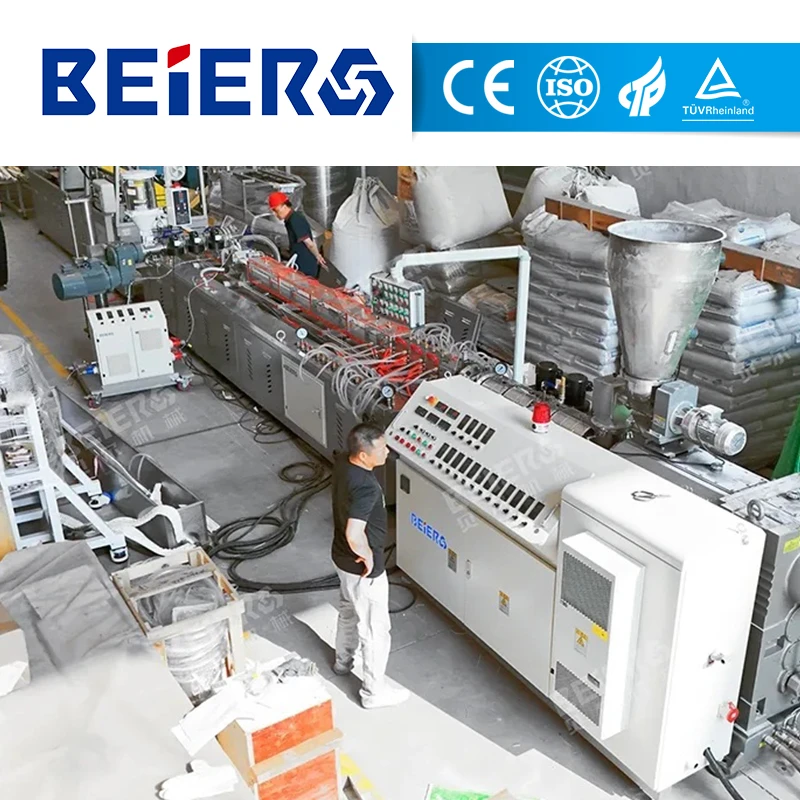
- Pipe extrusion: They help control roundness, diameter, and wall consistency, especially in pressure and utility pipes.
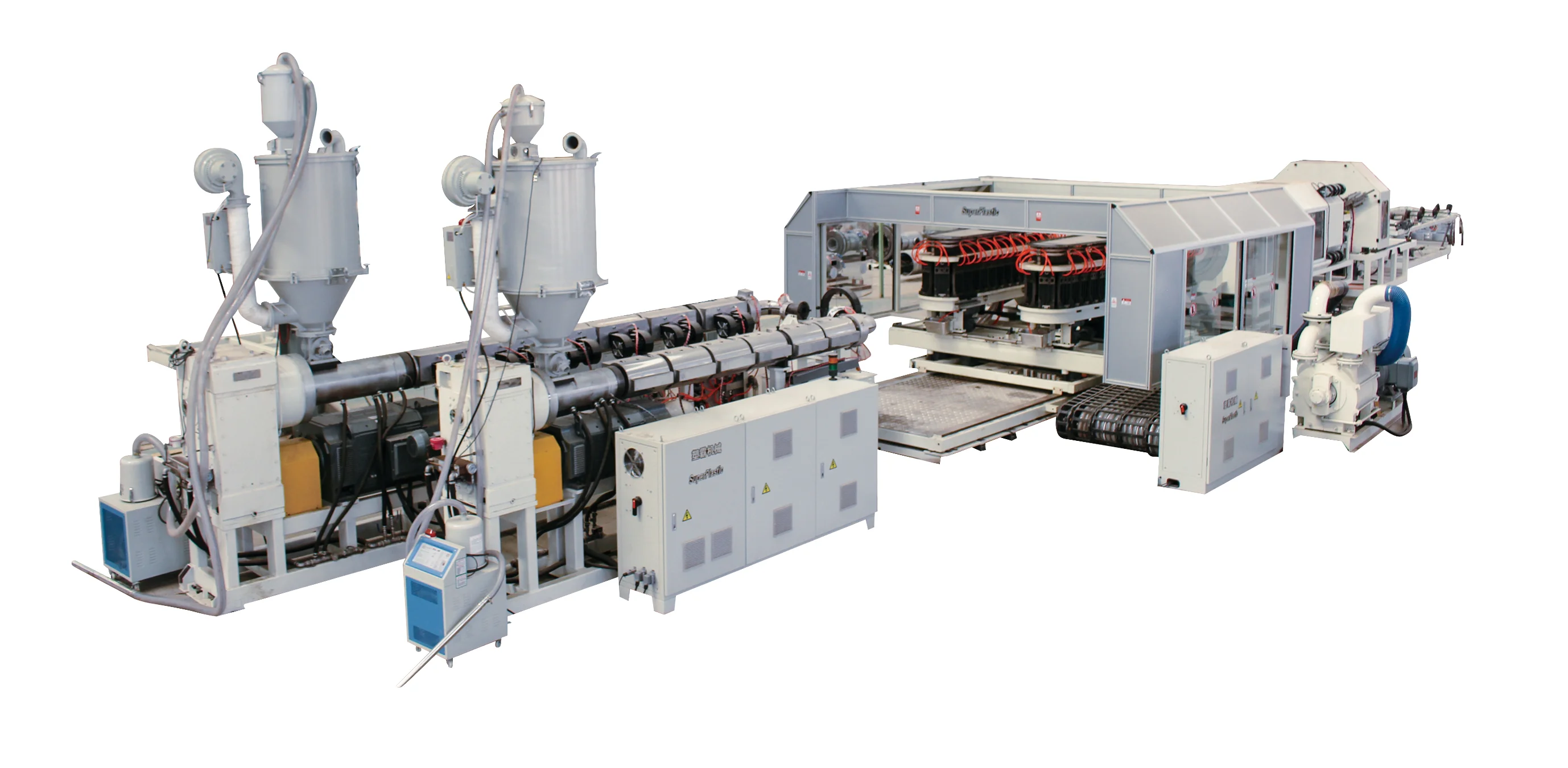
- Technical profiles: Furniture trims, cable ducts, and construction sections rely on calibration to hold complex cross-sections.
- Sheet and board lines: Some systems use flat calibration or chill-roll/sizing sections to stabilize thickness and surface quality.
- Composite or specialty shaping lines: Certain pultrusion or continuous forming systems use a sizing die or calibrator-like unit to define final geometry.
A weaker fit is highly elastic or highly foamed materials, where the extrudate may recover shape aggressively after exiting the calibrator; in such cases, alternative cooling or post-forming strategies are often more effective than conventional vacuum calibration. This is an engineering inference consistent with the role of melt strength and elastic recovery in extrusion control.
Technological Innovations and Automation
Modern calibrators increasingly incorporate servo-controlled vacuum valves, digital temperature control, and recipe-based setup for repeatable product changeovers. These features reduce operator dependence and improve batch-to-batch consistency.
Key innovation themes include:
- Adaptive vacuum control to compensate for resin viscosity variation and speed changes.
- Inline measurement with laser or contact gauges to link calibration directly to dimensional feedback loops.
- Modular quick-change tooling to reduce downtime in mixed-product production.
- Optimized flow channels that improve cooling uniformity and reduce pressure losses.
Automation is especially valuable because the calibrator sits at the point where the extrudate is most vulnerable to distortion. Small control errors here can propagate into the final product as ovality, twist, shrinkage, or surface waviness.
Environmental and Sustainability Aspects
Calibrators influence sustainability mainly through energy use, scrap reduction, and material efficiency. Better dimensional control reduces start-up waste, off-spec output, and rework, all of which lower material consumption per usable meter of product.
Energy efficiency improvements generally come from:
- Reduced cooling-water demand through better heat-transfer design.
- Shorter stabilization zones with improved thermal management.
- Faster recipe changeover and reduced idle running.
- Lower reject rates because profiles are less likely to warp or drift out of tolerance.
In recycled-content extrusion, calibrators also support the processing of compounds whose melt behavior may be less predictable than virgin resin. However, higher variability in recycled feedstock can increase the need for adaptive control and wider process windows.
Economic and Global Market Impact
Calibrators are not usually sold as standalone consumer products; they are embedded in extrusion lines and therefore influence the economics of the entire line. Their commercial importance is greatest in regions with large demand for construction profiles, infrastructure pipe, and industrial extrusion.
For manufacturers, the economic value of a calibrator lies in:
- Higher line speed without unacceptable dimensional drift.
- Reduced scrap and faster qualification of new tooling.
- Lower labor dependence through automation.
- Improved capability to process premium, tightly toleranced products.
Because calibrator performance affects downstream yield, suppliers often compete on precision machining, cooling efficiency, changeover flexibility, and service support, rather than on standalone machine price alone.
Current Challenges and Innovations
The main technical challenges are:
- Thermal instability when processing large sections or heat-sensitive polymers.
- Surface marking caused by over-aggressive vacuum or poor sleeve finish.
- Dimensional drift during speed changes or resin transitions.
- Complex profiles with asymmetrical thickness, which cool unevenly and are harder to stabilize.
Ongoing innovation focuses on:
- Better computational design of cooling and vacuum distribution.
- More precise surface finishing of calibration components.
- Sensor-rich monitoring of temperature, vacuum, and pull force.
- Tooling optimized for recycled and filled formulations.
Future Outlook
Future calibrator development is likely to emphasize digital process integration, energy-efficient cooling, and higher tolerance stability at faster line speeds. As extrusion plants adopt more automation and more recycled feedstock, calibrators will need to tolerate greater input variation while preserving product consistency.
The most important long-term direction is likely to be the transformation of calibrators from largely passive sizing devices into actively controlled downstream process modules linked to in-line measurement, predictive maintenance, and recipe optimization. That shift would make dimensional control more robust across wider material families and production conditions.
Summary
A calibrator or 定型装置 in plastics processing is the downstream sizing unit that fixes the geometry of an extruded product while it cools. Its role is critical in profile and pipe extrusion, where it determines dimensional accuracy, surface quality, and production efficiency.
Although conceptually simple, calibrator design combines tooling precision, thermal management, vacuum control, and automation. Its continuing evolution reflects broader industry priorities: tighter tolerances, faster changeovers, reduced waste, and more sustainable production.
References
- •
Merriam-Webster. (2024, August 5). Calibrator. https://www.merriam-webster.com/dictionary/calibratorLink
- •
Fluke Corporation. (2024, June 13). Calibrator: A comprehensive introduction. https://www.fluke.com/es-co/informacion/blog/calibracion/guide-to-calibrationLink
- •
Fluke. (2026, February 18). Comprehensive guide to calibration tools and techniques. https://www.fluke.com/en/learn/blog/calibration/guide-to-calibrationLink
- •
Merriam-Webster. (2026, March 8). Calibrators. https://www.merriam-webster.com/dictionary/calibratorsLink
- •
Beamex. (2026, August 17). What is a calibrator? https://www.beamex.com/faq/what-is-a-calibrator/Link
- •
Beamex. (2025, March 10). Beamex Centrical Na. https://www.beamex.com/us/calibrators/Link
- •
DwyerOmega. (2018, September 3). What is a calibrator and why is it an important device? https://www.dwyeromega.com/en-us/resources/calibratorsLink
- •
Fluke Corporation. (2024, June 13). What is calibration? Understanding the basics. https://www.fluke.com/en-us/learn/blog/calibration/about-calibrationLink
- •
Knowway. (2000, January 1). What is a calibrator? Definition, types, and purpose. https://www.knowway.org/en/what-is-a-calibrator-definition-types-and-purposeLink
- •
SATA Tools. (n.d.). Calibrator. https://sata-tools.de/en/lexikon/calibrator/Link
- •
Inteccon. (n.d.). Calibrators. https://inteccon.com/product-category/occupational-health/calibrators/Link
- •
USLegal. (2025, January 1). Calibrator. https://definitions.uslegal.com/c/calibrator/Link
- •
GlobalSpec. (n.d.). Calibration instruments. https://www.globalspec.com/learnmore/test_measurement_equipment/calibration_instruments_standards_reference_sources/calibration_instrumentsLink
- •
IQSDirectory. (2026, May 14). Types, servicing and importance of calibration services. https://www.iqsdirectory.com/articles/calibration-service.htmlLink
- •
ICEWeb. (n.d.). Test and calibration. https://iceweb.eit.edu.au/process-instrumentation/test_and_calibration/52-test_and_calibration.htmlLink
- •
DwyerOmega. (2018, August 31). A deeper understanding of temperature calibration. https://www.dwyeromega.com/en-nl/resources/calibrating-temperature-measurement-devicesLink
- •
Michelli. (2025, June 26). Calipers: Types, how they work, calibration & industry applications. https://www.michelli.com/our-resources/insights/calipers-what-they-are-how-to-calibrate-them-and-why-they-matter-across-industriesLink
- •
Airiti Library. (2016, January 1). 定型機設備創新設計之研究=Research on innovative design of dryer arrangement equipment. https://www.airitilibrary.com/Article/Detail/U0028-2408201606534000Link
- •
Vietextile. (2025, October 15). 工业定型机| 6大常见应用. https://vietextile.com/zh/%E5%B7%A5%E4%B8%9A%E5%AE%9A%E5%9E%8B%E6%9C%BA6%E5%A4%A7%E5%B8%B8%E8%A7%81%E5%BA%94%E7%94%A8/Link
- •
Ci-xing. (2018, August 31). TY03. https://www.ci-xing.com/product/26.htmlLink
- •
CENS. (n.d.). 樹脂定型機| 紡織機械. https://www.cens.com/cens/html/zh/category/cate_list_M0670.htmlLink
- •
Wxyrjx. (2021, April 19). 拉幅定型机的结构- 无锡海善纺织机械有限公司. https://www.wxyrjx.com/newsitem.asp?nlt=394&none=0Link
- •
Wxyrjx. (n.d.). 拉幅定型机纺织品定型的重要性 - 无锡海善纺织机械有限公司. https://www.wxyrjx.com/newsitem.asp?nlt=393&none=0Link
- •
China-fire-retardant. (2022, November 23). 详细的印染厂定型机知识,你值得拥有! https://www.china-fire-retardant.com/post/11061.htmlLink
- •
Lwyfs. (2023, August 31). 定型机的目的和原理 - 行业新闻. http://www.lwyfs.com/2023/hyxw_0831/581.htmlLink
- •
Book118. (2021, June 18). 定型机运作原理、生产流程、常见问题、及解决措施.docx. https://max.book118.com/html/2021/0616/8022113026003111.shtmLink
- •
Vietextile. (2025, October 27). 工业定型机构造| 3 大现代化趋势. https://vietextile.com/zh/%E5%B7%A5%E4%B8%9A%E5%AE%9A%E5%9E%8B%E6%9C%BA%E6%9E%84%E9%80%A03%E5%A4%A7%E7%8E%B0%E4%BB%A3%E5%8C%96%E8%B6%8B%E5%8A%BF/Link
- •
Google Patents. (2013, May 17). CN103302836A - 一种使用低冷应力共挤模具生产塑钢型材的方法. https://patents.google.com/patent/CN103302836A/zhLink
- •
Google Patents. (2018, March 16). 一种纤维增强复合材料缠压成型工艺及装置. https://patents.google.com/patent/CN108372667A/zhLink
- •
Ichikin. (2025, September 29). 热固定机/热固定テンター | THE ICHIKIN, LTD. https://www.ichikin.net/ko/eng/glossary/heat-setter%E3%83%BBheat-setting-tenter/Link
- •
Pallasmt. (2026, August 26). 포장기계의 종류: 12가지 유형 설명 (2026년 기준). https://www.pallasmt.com/ko/%ED%8F%AC%EC%9E%A5%EA%B8%B0%EA%B3%84%EC%9D%98-%EC%A2%85%EB%A5%98/Link
- •
Tohomachinery. (n.d.). 定置式成型システム|自動車関連|製品・サービス|東邦機械工業株式会社. http://www.tohomachinery.co.jp/products/car/car01/Link
- •
Smilefuture. (n.d.). 교정 장치의 종류 - 웃는내일치과. https://www.smilefuture.com/orthodontic-information-2Link
- •
Ryfjx. (2021, August 19). 定型机各结构有哪些作用-浙江容易富机械科技有限公司. http://www.ryfjx.com/index/news/info/id/vznfH.htmlLink
- •
Jyeyih. (n.d.). Jye Yih Machinery Co., Ltd., calendar machine, ironing machine. https://www.jyeyih.com.tw/PageE/PageE2_09.htmLink
- •
Burondt. (n.d.). Древесной массы, бумаги, картона - БЮРО НДТ. https://burondt.ru/NDT/docs/paper/index.htmlLink