
Introduction
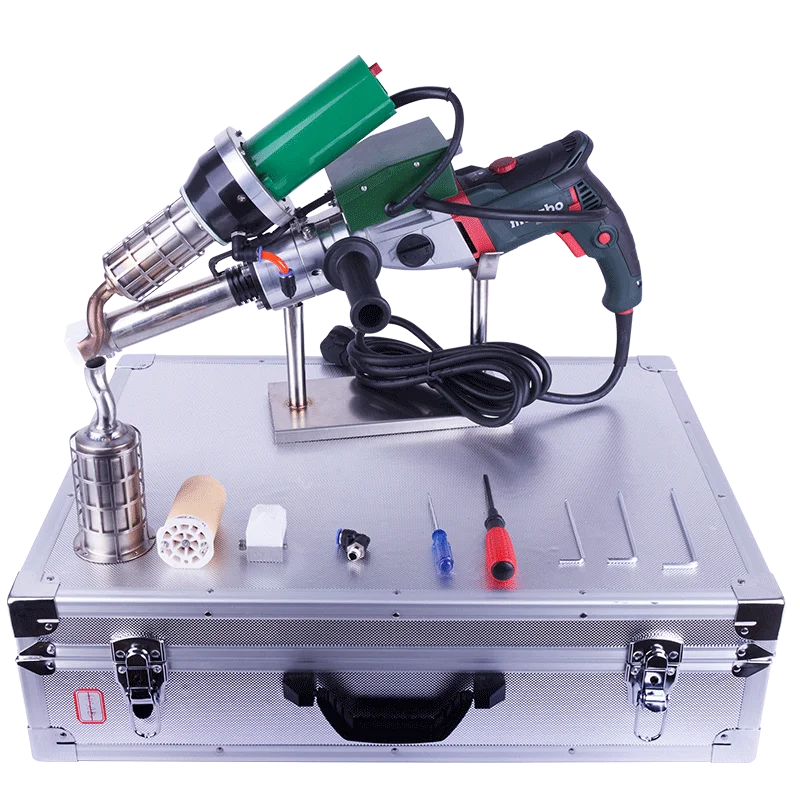
Extrusion welding machines are thermoplastic joining machines that melt a compatible filler rod or strand and deposit it into a prepared joint, producing a continuous, high-strength seam. They are used most often on thick-section fabrications such as tanks, pipes, ducts, geomembranes, and industrial liners, where a single-pass, high-volume weld is preferred over repeated hot-gas passes.
The technology evolved in the 1960s from hot-gas welding and remains especially important where leak-tightness, chemical resistance, and field repairability are critical. Modern machines range from manual handheld extruders to automated site welding systems, and they are commonly designed for HDPE, PP, PVC, and PVDF processing. Energy efficiency, operator skill, and seam-quality control are now central themes, particularly as containment systems, infrastructure linings, and chemical equipment face tighter performance and sustainability requirements.
History and Development
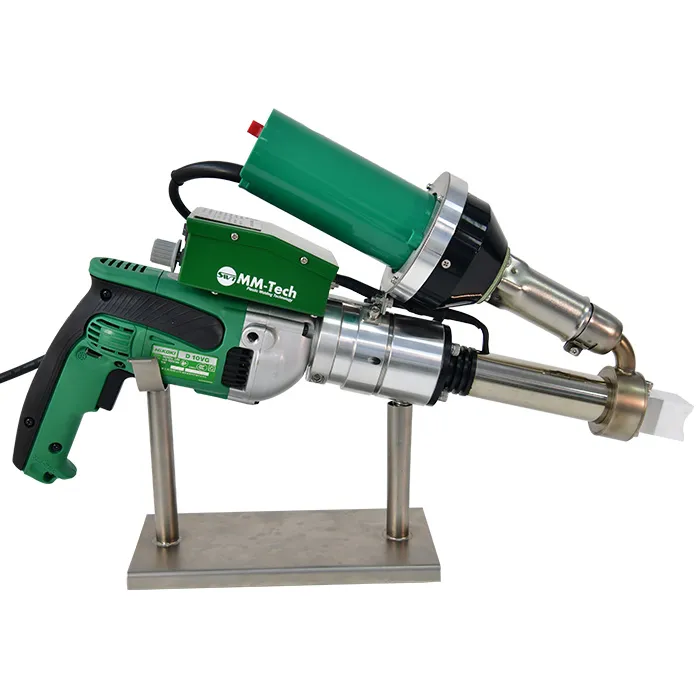
Extrusion welding developed as an extension of hot-gas welding during the 1960s, when fabricators needed a faster method for producing larger thermoplastic seams with better volumetric deposition. The key advance was the addition of a plasticating screw or similar extrusion mechanism that delivered molten filler to the weld zone in a controlled flow.
Several practical milestones shaped the modern machine class:
- Manual extrusion guns became established for tank fabrication and geomembrane work, enabling on-site joining of thick thermoplastic sheets with portable equipment.
- Screw-based extruders with preheating systems improved melt homogeneity and seam consistency, reducing dependence on repeated hand passes.
- Automated and high-output units expanded use in construction and containment projects, where travel speed, repeatability, and seam geometry control became more important.
As thermoplastic infrastructure expanded, extrusion welding became a standard method for geomembrane repair, industrial tank building, pipe fabrication, and liner installation.
Working Principle and Technical Overview
An extrusion welding machine combines joint preheating, filler plasticization, controlled deposition, and pressure consolidation. The process is based on thermoplastic fusion: the base material and filler are heated above their welding range, then pressed together so polymer chains interdiffuse across the interface.
A typical machine includes:
- Feed system for welding rod or wire, usually of the same polymer family as the substrate.
- Heated barrel or extrusion chamber that plasticizes the filler material.
- Screw or auger assembly that meters the molten material and creates extrusion pressure.
- Hot-air preheater that warms the joint surfaces immediately before deposition.
- Welding shoe or nozzle that shapes the bead and applies it into the seam.
Typical process parameters reported in technical and manufacturer sources include:
- Hot-air temperature: about 400–600°C at the torch, adjusted to the polymer and ambient conditions.
- Rod diameter: commonly 3–5 mm, with 4 mm frequently cited for HDPE work.
- Preheat and base-material temperatures: varied by polymer; for example, PE is often welded at lower temperatures than PP because PP requires a higher melting range.
- Pressure application: around 50–100 N vertical pressure in some manual systems, supplemented by the weight and geometry of the shoe.
- Compressed air assist: roughly 0.2–0.5 MPa in some designs for surface preparation or oxidation removal.
- Extrusion output: small hand units may be around 2.4–3.4 kg/h, while high-output production machines deliver substantially more.
In the melt zone, the filler strand is plasticized and forced through the die into a seam that has already been softened by hot air. The result is a homogeneous bead with a heat-affected interface whose quality depends on cleanliness, temperature control, travel speed, and matching polymer chemistry.
Types and Variations
Extrusion welding machines are commonly grouped by portability, output, and automation level.
| Type | Main characteristics | Typical uses |
|---|---|---|
| Handheld extrusion welders | Portable, manually guided, often screw-based, suitable for on-site work | Geomembrane repair, tank fabrication, ducts, sheet fabrication |
| High-output manual extruders | Larger motor and higher deposition rate, intended for long seams and thick sections | Heavy liners, pipe fabrication, industrial vessels |
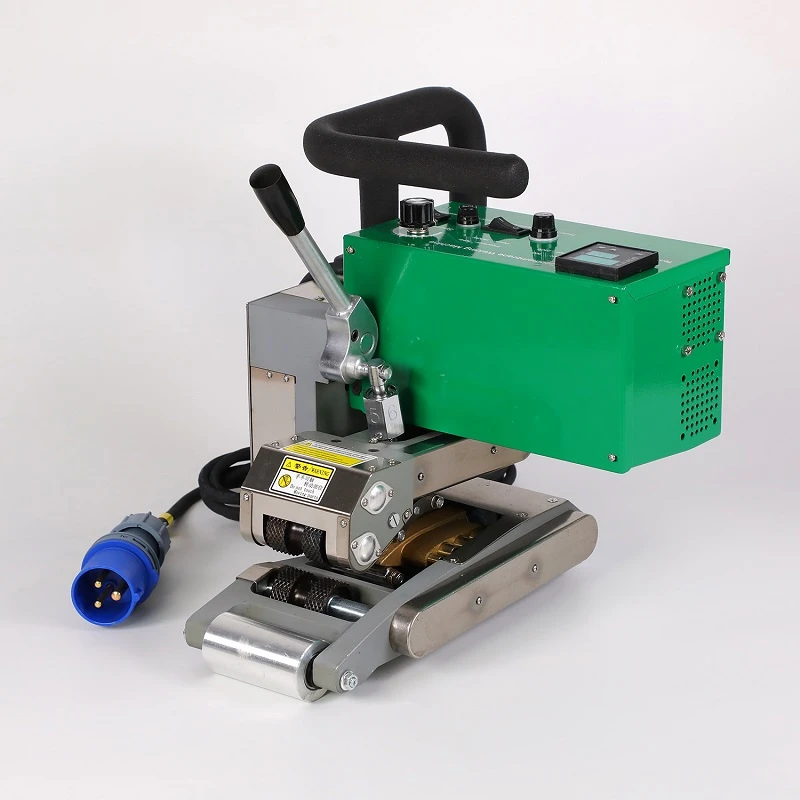
| Automated extrusion welders | Mechanized travel and steadier seam control | Construction-site PE pipe work and repetitive field seams |
| Specialized nozzle systems | Shaped shoes for corner, fillet, and lap welds | Details, penetrations, transitions, and repair zones |
Material specialization is also important. Most machines are configured for HDPE and PP, with many also supporting PVC, PVDF, and LLDPE depending on the manufacturer and application.
Applications and Uses
Extrusion welding machines are strongest in applications that require thick-section thermoplastic seams, chemical resistance, and field repair capability.
Common sectors include:
- Geomembranes and environmental containment: landfill liners, pond liners, wastewater basins, canal linings, and mining containment systems.
- Chemical processing: storage tanks, reactor linings, scrubbers, and corrosion-resistant ductwork.
- Water and infrastructure: pipes, fittings, tunnels, reservoirs, and underground waterproofing systems.
- Industrial fabrication: tanks, vessels, trays, containment bunds, and custom sheet assemblies.
- Aquaculture and agriculture: tanks, irrigation reservoirs, and biogas-related containment systems.
A comparatively poor-fit use is thin decorative plastics, where the process is usually too heavy, too hot, and too deposition-intensive relative to the part geometry and required finish.
Seam Quality, Materials, and Process Control
Weld quality depends on a narrow set of variables that must be balanced together: heat, pressure, and time. Because extrusion welding deposits molten filler onto a softened base material, defects often arise from contamination, poor preheat, excessive speed, or mismatch between rod and substrate polymer.
Important quality factors include:
- Material compatibility: filler rod should match the base polymer family whenever possible.
- Surface preparation: oxidation, dirt, moisture, and grease reduce bonding reliability.
- Travel speed and output matching: weld speed must remain synchronized with heating and deposition rate.
- Root support and bead geometry: for thick joints, a backing bead or suitable root preparation can improve crack resistance.
Properly executed seams are valued for leak resistance, chemical durability, and high structural continuity, especially in thick thermoplastic assemblies.
Technological Innovations and Automation
Recent product development has focused on temperature stabilization, digital controls, improved ergonomics, and automated guidance. These improvements reduce operator dependence and improve seam repeatability, particularly on long production runs or remote construction sites.
Notable directions include:
- Electronically controlled heating zones that stabilize melt quality.
- Automated site welders for repetitive field seams on PE pipe or liner systems.
- Higher-output portable units for thick-sheet fabrication and faster deposition.
- Specialized shoes and dies optimized for joint geometry and material thickness.
Automation improves uniformity, but it also increases equipment cost and can reduce flexibility in highly variable repair work. In practice, many projects still rely on skilled manual operators for corners, penetrations, and irregular geometry.
Environmental and Sustainability Aspects
Extrusion welding supports circular-economy goals in several ways. It enables repair, refurbishment, and life-extension of thermoplastic assets that would otherwise be replaced, especially liners, tanks, and ducting systems.
Sustainability advantages include:
- Reduced replacement waste through localized repair of damaged thermoplastic components.
- Long service life in chemically aggressive environments where corrosion-resistant plastics outperform metals.
- Compatibility with durable containment systems used in environmental protection and water management.
At the same time, the process is energy-intensive at the point of use because it relies on electrically heated barrels and hot-air preheating. The sustainability balance therefore depends on long component life, low scrap rates, and the avoidance of full asset replacement.
Economic and Global Market Impact
Extrusion welding machines occupy a specialized but important niche in plastics fabrication and civil containment. Demand is driven by water infrastructure, environmental engineering, chemical storage, and industrial maintenance, with particular strength in projects where leak-tight seams are essential.
The market is characterized by:
- Portable equipment demand for field installation and repair.
- High-output industrial units for fabrication shops and liner production.
- Regional specialization in geomembrane installation, tank building, and pipeline work.
Manufacturers and brands associated with the segment include Leister, Weldy, Wegener, Munsch, HSK, PF Schweißtechnologie, and DEMTECH, each serving specific niches such as handheld welding, field automation, or high-output fabrication.
Current Challenges and Innovations
The main technical challenges are operator sensitivity, seam consistency, and material compatibility. Unlike fully automated joining systems, extrusion welding still depends heavily on the operator’s control of angle, speed, temperature, and pressure.
Current innovation priorities include:
- Better process monitoring and digitally assisted temperature control.
- Improved ergonomics to reduce fatigue during long seams.
- More compact high-output designs for site work.
- Expanded suitability for special polymers and complex joint geometries.
Because many applications occur outdoors, machines must also perform reliably under changing ambient temperature, wind, and moisture conditions, which complicates process stability.
Future Outlook
Extrusion welding machines are likely to remain essential wherever thick thermoplastic structures must be joined on site or in fabrication shops. Future growth is expected to come from infrastructure renewal, containment systems, and the continued adoption of polymer liners and chemical-resistant thermoplastic assemblies.
Likely technical directions include:
- Greater automation for long linear seams and repeatable field work.
- Improved digital control of heat and extrusion rate.
- More efficient machines with lower specific energy use per kilogram of deposited material.
- Broader integration with quality documentation and inspection workflows for critical containment projects.
Summary
Extrusion welding machines are specialized thermoplastic joining systems that combine hot-air preheating with controlled molten deposition to create durable seams in thick plastics. Their strongest roles are in geomembranes, tanks, pipes, liners, and industrial containment, where portability, chemical resistance, and leak-tight performance are more important than speed alone.
References
- •
How does an extrusion welder work? (2025, April 30). Weissenberg Store. https://www.weissenbergstore.com/blogs/article/how-does-an-extrusion-welder-workLink
- •
Extrusion welding. (2018, April 1). Wikipedia. https://en.wikipedia.org/wiki/Extrusion_weldingLink
- •
Extrusion welders for plastic welding. (2025). Leister. https://www.leister.com/en-us/Extrusion-WeldersLink
- •
What is an extrusion welder used for? (2025, April 14). Weissenberg Store. https://www.weissenbergstore.com/blogs/article/what-is-an-extrusion-welder-used-forLink
- •
Extrusion welding is the main finishing technique for HDPE. (n.d.). Kwerk. https://en.kwerk.de/technical-information-on-extrusion-welding/Link
- •
Extrusion welding of thermoplastics. (2015, October 19). TWI. https://www.twi-global.com/technical-knowledge/job-knowledge/extrusion-welding-of-thermoplastics-057Link
- •
Extruder overview - Extrusion welding. (n.d.). Wegener Welding. https://wegenerwelding.com/EN/products/schweissen/extruder/Extruder-uebersicht.htmlLink
- •
Extrusion welder in the real world: 5 uses you'll actually.... (2025, October 3). LinkedIn. https://www.linkedin.com/pulse/extrusion-welder-real-world-5-uses-youll-actually-8fzafLink
- •
Automated extrusion welder. (2019, October 1). PF Schweißtechnologie GmbH. https://www.pfs-gmbh.com/en/product-group/special-machinery/Link
- •
Pro-X extrusion welder. (2026, March 23). Demtech Services, Inc. https://demtech.com/product/pro-x-extrusion-welder/Link
- •
Extrusion welders | Plastic welding machines. (n.d.). Riyang Welding. https://www.riyang-welding.com/products2115532/Extrusion-Welders.htmLink
- •
Facsimile cover sheet. (n.d.). Varitech. https://www.varitech.com/pdf/wagener_extrusion.pdfLink
- •
How screw extruders work. (n.d.). STANMECH Technologies Inc. https://www.stanmech.com/articles/how-screw-extruders-workLink
- •
1600W hand extrusion welder gun plastic handheld extruder.... (2020, March 5). Amazon. https://www.amazon.com/Extrusion-Plastic-Handheld-Extruder-Welding/dp/B0833V2SRCLink
- •
Extrusion welder machine. (2025, March 18). Weissenberg Store. https://www.weissenbergstore.com/collections/extrusion-welderLink
- •
Extrusion welder | Professional geomembrane welding.... (n.d.). Geo Khanjani. https://geokhanjani.com/en/product/geomembrane-extrusion-welderLink
- •
Extrusion welders. (2008). Weldy. https://www.weldy.com/en/Extrusion-WeldersLink
- •
Extrusion welder | Plastic extrusion welding. (2015). http://pipe-weldingmachine.com/2-2-extrusion-welder.htmlLink
- •
What is extrusion welding | HDPE welding process explained. (2025, December 1). Wedge Welding Machine. https://wedgeweldingmachine.com/what-is-extrusion-welding/Link
- •
HDPE geomembrane extrusion welder. (2026, March 20). Liaoning Hengyu. https://www.hengyugeo.com/hdpe-geomembrane-extrusion-welder/Link
- •
Extrusion welding. (2024, May 13). TS Marine. https://tsmarine.ee/facilities/extrusion-welding/Link
- •
China extrusion welder manufacturers, suppliers, factory.... (2024, November 23). Fusion HDPE. https://www.fusionhdpe.com/extrusion-welder/Link
- •
Extrusion welders - Welding extruder from Munsch, HSK and Wegener. (2015, October 1). Plastic Welding. https://plasticwelding.dk/en/plastic-welding-equipment/extruder-welding/Link
- •
Hand extruders. (2025). DirectIndustry. https://www.directindustry.com/industrial-manufacturer/hand-extruder-80195.htmlLink
- •
HDPE extrusion welding machine. (2025). Riyang Welding. https://www.riyang-welding.com/products/HDPE-Extrusion-Welding-Machine.htmLink
- •
Plastic extruders & extrusion machines. (n.d.). Hot Air Tools. https://www.hotairtools.com/hot-air-tools/plastic-welding/extrudersLink
- •
Products. (2026, February 13). Bond Technologies. https://bondtechnologies.net/products/Link
- •
WELDY extrusion welder booster EX3 230V/3000W plastic extrusion welding machine. (2025, February 8). eBay. https://www.ebay.com/itm/285908856956Link
- •
Using an extrusion welder. (n.d.). STANMECH Technologies Inc. https://www.stanmech.com/articles/using-an-extrusion-welderLink
- •
Extruder_englisch_Extruder_deutsch.qxd. (n.d.). Wegener Welding. https://wegenerwelding.com/PDFs/extruder/extruder-en.pdfLink
- •
What is extrusion welder? Uses, how it works & top.... (2025, October 5). LinkedIn. https://www.linkedin.com/pulse/what-extrusion-welder-uses-how-works-top-companies-vscfcLink
- •
Extrusion welding welding extruder PEHD PP PVDF PVC.... (2024, May 24). Akuplastics. https://www.akuplastics.com/en/machines-appliances-plastics-locksmiths-fabricators-tank-builders/welding-extruder-hsk60-de/Link
- •
Weldy extrusion welder, extruder welder, plastic butt.... (n.d.). Weissenberg Welder. https://www.weissenbergwelder.com/comm25/Extrusion-Welder.htmLink
- •
Extrusion welder. (2025). eBay. https://www.ebay.com/shop/extrusion-welder?_nkw=extrusion+welderLink
- •
Complete guide to extrusion welding of thermoplastics. (2025, December 1). Hot Air Tools. https://www.hotairtools.com/blog/guide-extrusion-welding-thermoplastics/Link
- •
Welding large section plastics with extruder welders. (2017, September 19). Plastic Welding Tools NZ. https://www.plasticweldingtools.co.nz/welding-large-section-plastics-extruder-welders/Link
- •
Extrusion welders. (2016, November 8). Polyweld USA. https://polyweldusa.com/extrusion-welders/Link
- •
Extrusion welding is used in the manufacture tanks and pipes. (n.d.). Thermoweld. https://thermoweld.co.za/extrusion-welding/Link
- •
What you need to know about extrusion welding. (2021, February 3). Plastic Design. https://www.plasticdesignind.com/blog/extrusion-welding-basics/Link
- •
10 welding of HDPE geomembranes. (n.d.). D-NB. https://d-nb.info/980561612/04Link
- •
What is extrusion welding? (2025, March 18). Weissenberg Store. https://www.weissenbergstore.com/blogs/article/what-is-extrusion-weldingLink
- •
What is extrusion welding? (2026, March 11). FHS. https://fhs.com.au/what-is-extrusion-welding/Link
- •
Plastic extrusion welding: Benefits, applications, and why.... (2025, October 16). Bortte. https://bortte.com/plastic-extrusion-welding-benefits-applications-and-why-borttes-welders-are-the-best-choice/Link
- •
Extrusion. (2004, July 25). Wikipedia. https://en.wikipedia.org/wiki/ExtrusionLink
- •
Extrusion and hot-air hand welders. (n.d.). Leister. https://www.leister.com/en-us/Services/myAcademy/Know-How-PlastFabLink
- •
Top tips for successful HDPE extrusion welding in 2025. (2025, July 21). Welping Fusion. https://welpingfusion.com/Top-Tips-for-Successful-HDPE-Extrusion-Welding-in-2025-id42737796.htmlLink