

Introduction
Stretching lines for film, filament, etc. are continuous processing systems that orient polymer products by drawing them under controlled heat and tension to improve strength, stiffness, dimensional stability, optical properties, and barrier performance. In plastics processing, the term covers a family of equipment for film stretching, tape stretching, monofilament and multifilament drawing, and related orientation processes used in packaging, textiles, technical films, and industrial yarns.
These lines are central to the manufacture of oriented films such as BOPP and BOPET, as well as stretched tapes, raffia, and monofilaments, with machine configurations ranging from machine-direction orientation (MDO) systems to sequential and simultaneous biaxial stretching lines. Their design has evolved from mechanically simple roll-drawing concepts to highly automated systems with precise temperature zoning, edge control, web handling, inline quality monitoring, and increasingly energy-efficient heating and drive technology.
History and Development
Early stretching technology grew out of industrial film orientation methods developed to improve the properties of polyethylene terephthalate and polyolefins, with patents in the mid-20th century already describing controlled transverse and longitudinal stretching of polymer films at temperatures that permit molecular orientation. These early systems established the key principle still used today: polymer chains become more aligned when a heated web is drawn above its relaxation threshold but below its melting point.
A major milestone was the industrialization of biaxially oriented polypropylene (BOPP) and biaxially oriented polyester (BOPET) film lines, which enabled high-volume packaging and capacitor films with superior clarity, stiffness, and shrink control. Later developments introduced more precise sequential stretching, better temperature uniformity, and wider process windows for specialty films such as barrier, synthetic paper, tobacco, and technical packaging grades.
Another important step was the growth of laboratory and pilot stretching lines for product development and quality control, such as compact MDO systems and lab stretch frames used to evaluate new formulations, thickness profiles, and orientation behavior before full-scale commercialization. Recent industry developments emphasize higher output, shorter production times, and lower energy intensity, including new-generation biaxial film stretching concepts and improved automation in web transport and control.
Technical Overview
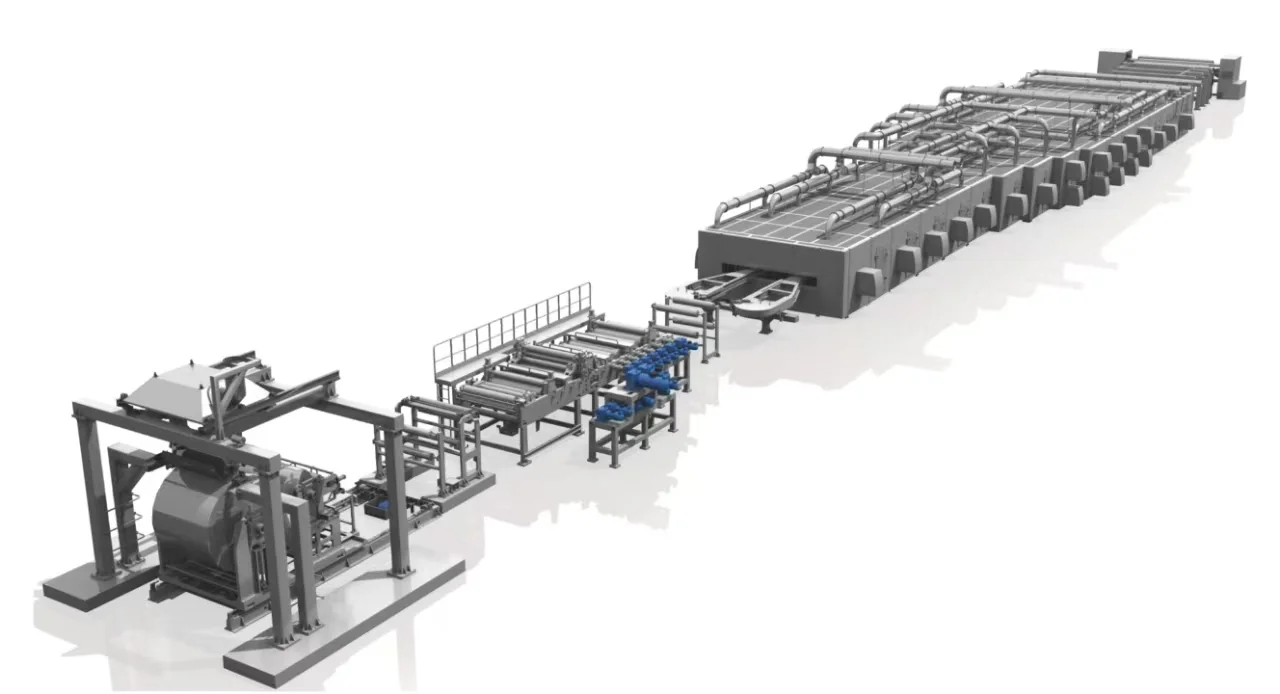
Stretching lines typically combine feed, preheating, stretching, annealing, cooling, and winding sections, with the specific layout determined by the product form and material. For films, the web is often heated to an orientation window and then stretched by speed differentials between roller groups or by clip/chain systems that widen the web in the transverse direction.
Core process principles
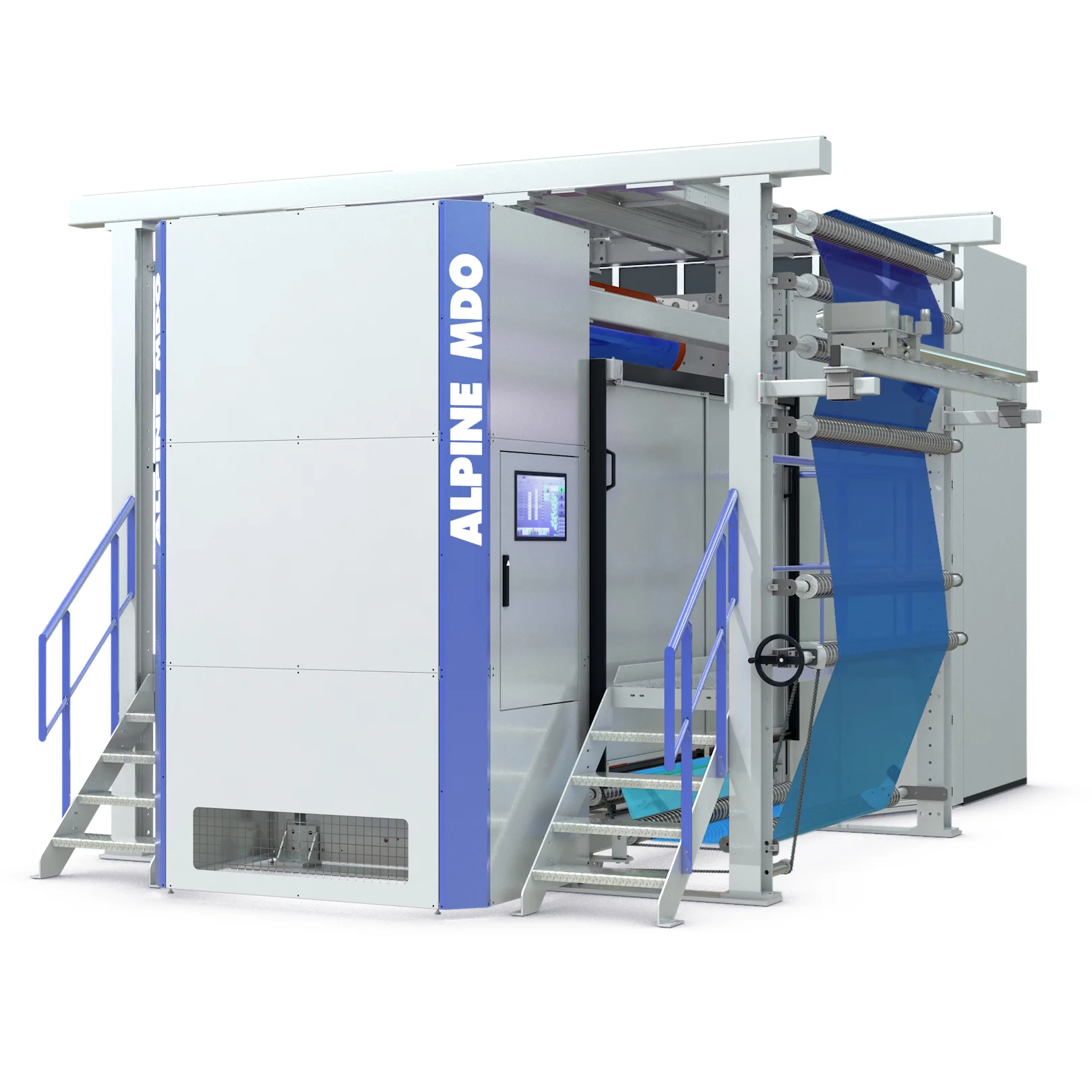
- Machine-direction orientation (MDO) stretches film lengthwise by running it over rollers at progressively higher speeds.
- Transverse-direction stretching uses clip or tenter systems to pull the film sideways, typically in sequential or simultaneous biaxial lines.
- Filament and tape drawing applies controlled tension through godet rollers or hot-air channels to increase molecular alignment and tensile properties.
- Thermal conditioning is critical because the stretch window must be high enough for chain mobility but low enough to avoid melting, necking instability, or breakage.
Typical operating ranges
For MDO film stretching, published technical descriptions place the heating zone around 60 to 150 °C, depending on the polymer, with stretch ratios commonly around 1:3 to 1:10. In some specialty MDO applications, higher stretch temperatures have been reported, including around 150 to 400 °C for certain expander configurations, although this is material- and machine-specific rather than universal.
For monofilaments and tapes, stretching is commonly conducted in a hot-air channel or over a heated plate, while PP and PE films are often processed in short-gap systems and PET in long-gap systems with infrared preheating or similar heating assistance. Commercial filament and tape lines may run at outputs from laboratory scale to industrial capacities such as 160 kg/h in cited equipment examples, depending on denier, line speed, and product specification.
Product quality effects
Stretching changes the polymer morphology by increasing orientation and often inducing strain hardening and, in some polymers, partial crystallization. This generally improves:
- Tensile strength
- Modulus
- Dimensional stability
- Tear resistance
- Barrier performance
- Clarity or haze profile, depending on formulation and process route
Practical benchmarks
For film-oriented lines, the thickness reduction and orientation are closely linked to draw ratio and temperature control, and film manufacturers commonly tune shrink behavior through controlled annealing after stretching. In tensile-oriented filament systems, multi-stage drawing is widely used to reduce breakage and improve uniformity, with primary and secondary draw stages selected according to polymer type and target tenacity.
Types and Variations
| Type of stretching line | Main product forms | Typical orientation mode | Notes |
|---|---|---|---|
| MDO film lines | Cast or blown films | Longitudinal only | Used for PE, PP, and specialty films; common in packaging and barrier structures. |
| Biaxial film stretching lines | BOPP, BOPET, technical films | Sequential or simultaneous | Used for high-performance packaging, capacitor films, synthetic paper, and barrier films. |
| Tape stretching lines | Raffia tapes, slit tapes | Monoaxial | Common in woven sacks, ropes, and industrial packaging materials. |
| Monofilament drawing lines | Monofilaments | Monoaxial | Used for brush filaments, fishing line, technical yarns, and reinforcement applications. |
| Multifilament drawing lines | Textile filaments, industrial yarns | Monoaxial or staged drawing | Often integrated with spinning and heat-setting sections. |
| Laboratory stretching frames | Film samples, formulation trials | Monoaxial or biaxial | Used for R&D, process development, and quality control. |
Applications and Uses
Stretching lines are used wherever oriented polymer structures deliver a performance advantage over unoriented film, tape, or filament.
- Packaging films: BOPP and BOPET lines produce printable, stiff, and dimensionally stable films for food and consumer packaging.
- Capacitor films and electrical insulation: High-uniformity oriented films are used where dielectric consistency and thickness control matter.
- Synthetic paper and labelstock: Specialty film stretching can create paper-like opacity, stiffness, and converting behavior.
- Woven sacks and bulk packaging: Tape stretching lines produce raffia tapes for woven polypropylene bags and related industrial textiles.
- Textiles, ropes, belts, and nets: Filament and tape drawing lines provide oriented strands with high tensile strength and low fibrillation tendency.
- Technical and barrier films: MDO and biaxial systems are used to tailor oxygen, moisture, and puncture resistance.
A weaker fit is highly thermally unstable or heavily filled materials, which may not tolerate the required orientation window without breakage, excessive shrinkage, or loss of optical quality; in such cases, stretching may be technically possible but economically unattractive or process-limited.
Process Engineering and Product Design
The performance of a stretching line depends on the interaction of rheology, thermal history, web tension, and draw ratio. If the film is heated too little, it may crack or exhibit unstable necking; if overheated, it may relax excessively or lose orientation before winding. This is why industrial lines use precise control of roller temperatures, nip pressure, clip spacing, residence time, and tension profiles.
In biaxial orientation, sequential stretching often offers easier control and lower mechanical complexity, while simultaneous stretching can improve symmetry, thickness uniformity, and certain optical properties, but usually requires more sophisticated equipment and control systems. Patent literature and industrial practice also show that controlled preconditioning, localized heating, and edge management can improve thickness uniformity and reduce defects during draw.
Technological Innovations and Automation
Modern stretching lines increasingly integrate:
- Servo-driven roll trains and linear-motor systems for precise speed control.
- Infrared and hot-air heating modules to stabilize the stretch window and shorten heat-up time.
- Inline thickness and defect monitoring to reduce waste and improve roll consistency.
- Recipe-based automation for rapid product changeover between film grades and gauge ranges.
- Advanced web handling and edge control to limit neck-in, flutter, and web breaks.
Laboratory systems have also become more versatile, allowing manufacturers to simulate industrial stretching conditions at smaller scale for formulation work and process optimization. This has strategic value for product development because orientation behavior is strongly dependent on resin grade, additive package, and prior extrusion history.
Environmental and Sustainability Aspects
Stretching lines can support sustainability by enabling lightweighting, because oriented films often achieve required performance at lower thickness than unoriented alternatives. They also help reduce packaging material consumption when converted films deliver higher stiffness, strength, or barrier performance at reduced gauge.
At the same time, stretching is energy-intensive because the web must be heated and moved under tightly controlled conditions. Recent equipment development therefore emphasizes higher thermal efficiency, shorter production times, improved heat recovery, and lower scrap generation through better process stability. In practice, sustainability gains depend on the balance between lower material use and the energy required to orient the polymer.
Compatibility with circular-economy strategies is mixed. Stretching lines can process certain recycled-content formulations, but recycled polymers often have narrower process windows and more variable melt behavior, which can complicate orientation and raise breakage risk. As a result, successful integration with recycling usually requires tight resin specification, additive control, and robust filtration upstream.
Economic and Global Market Impact
Stretching lines occupy a strategically important niche in the plastics machinery sector because they convert commodity polymers into higher-value, performance-oriented products for packaging, industrial, and technical markets. Demand is closely linked to packaging conversion, electrical materials, industrial textiles, and the replacement of heavier substrates with lightweight oriented films.
Global competition is characterized by specialized machine builders with strong positions in distinct product families. For example, Lindauer DORNIER is strongly associated with film stretching lines for BOPP and related biaxial film applications, while COLLIN is active in laboratory and pilot stretching systems for films, tapes, and monofilaments. Market differentiation is driven less by raw throughput alone than by precision, energy efficiency, defect control, and the ability to handle specialty materials.
Current Challenges and Innovations
Key technical challenges include:
- Web breaks and edge instability during high-ratio stretching.
- Thickness nonuniformity and local orientation variation.
- Narrow process windows for specialty polymers and recycled-content blends.
- Energy consumption in long heated sections and high-speed drive trains.
- Quality sensitivity to extrusion history, additive package, and moisture control upstream.
Current innovations focus on improving thermal management, automating process setup, and expanding the range of stretchable formulations. In film stretching, process concepts such as controlled initiation points, localized heating, and improved draw path geometry are being used to improve uniformity and reduce defects. In filament and tape systems, staged drawing and better godet synchronization are used to raise throughput while limiting strand breakage.
Future Outlook
The future of stretching lines is likely to be shaped by three broad trends. First, higher-performance packaging will continue to support demand for oriented films with better barrier, stiffness, and downgauging potential. Second, automation and digital control will keep reducing changeover time, scrap, and operator dependence, especially on high-output biaxial lines. Third, sustainability pressure will push machine builders to improve energy efficiency and broaden the processability of recycled and bio-based polymers without sacrificing orientation quality.
In the film sector, development is likely to continue toward lines that combine stronger automation, faster heating response, and tighter thickness control across wider web widths. In filament and tape applications, incremental gains will come from better draw stability, improved yarn properties, and more compact, energy-conscious line layouts.
Summary
Stretching lines for film, filament, etc. are essential plastics processing systems that transform extruded polymer products into higher-performance oriented materials through controlled drawing and heat treatment. Their importance lies in the combination of engineering precision, product-property enhancement, and broad industrial relevance across packaging, textiles, electrical materials, and technical applications.
References
- •
Teach Line Stretching Lines MDO. (2024, November 4). Collin Solutions. https://www.collin-solutions.com/en/product/teach-line-stretching-lines-mdo/Link
- •
BOPP film stretching line. (n.d.). Lindauer DORNIER GmbH. https://www.lindauerdornier.com/en/film-stretching-lines/film-stretching-lines-bopp/Link
- •
Stretching lines. (n.d.). Collin Lab & Pilot Solutions. https://www.ruydelacerda-plastico.pt/wp-content/uploads/sites/10/2022/05/Collin_LabLine_en.pdfLink
- •
Dornier Film Stretching Lines GB. (2025, August 14). Scribd. https://www.scribd.com/document/854163138/dornier-film-stretching-lines-gbLink
- •
Innovation in biaxial film stretching. (2025, September 25). Lindauer DORNIER GmbH. https://www.lindauerdornier.com/en/about-us/news/innovation-in-biaxial-film-stretching/Link
- •
Drawing for Package Material Elongation. (2025, April 25). GreyB. https://xray.greyb.com/packaging/drawingLink
- •
Our products. (2024, October 23). COLLIN Lab & Pilot Solutions. https://www.collin-solutions.com/en/our-products/Link
- •
MDO-Technology-Defined-Stretching. (n.d.). Sternwald Systems. https://res.cloudinary.com/sternwald-systems/raw/upload/v1/hugoprd/ARTIKEL_ATTACH/00243402_E83EA27E891A/4c31f74190c420413b838612adff2a3120efec8e/PE_2006_09_MDO-Technology-Defined-Stretching.pdfLink
- •
Fourwents Engineering Company - BOPP, BOPET, BLOWN. (n.d.). Fourpackaging. https://fourpackaging.com/bopp.htmlLink
- •
Stretching-the-Limits. (n.d.). Sternwald Systems. https://res.cloudinary.com/sternwald-systems/raw/upload/v1/hugoprd/ARTIKEL_ATTACH/002442C8_795F97B8A684/868577e671f5411239430aa2ba2c1652a62351f8/KUint_2014_10_Stretching-the-Limits-.pdfLink
- •
Biaxially Oriented Polyethylene Terephthalate Film. (2021, November 8). Kingchuan Packaging. https://www.kingchuanpackaging.com/bopet-films-current-trends-and-technology-innovation/Link
- •
Filament Stretching Rheology: Basic Concepts. (n.d.). Dodynet. https://www.dodynet.eu/wp-content/uploads/2019/04/BasicPrinciplesExtensionalRheometry-Ole-Hassager.pdfLink
- •
Plastic Rubber Processing - Sales in Japan. (n.d.). Correns. https://www.correns.co.jp/product-areas/plastic-and-rubber-processing/Link
- •
Textile and fiber. (n.d.). Comitalplastspa. https://www.comitalplastspa.it/wp-content/uploads/2021/05/Textile_and_fiber.pdfLink
- •
Coperion wins repeat deal with Brückner. (2025, August 21). Eco-plastics in Packaging. https://ecoplasticsinpackaging.com/processes/extrusion/coperion-wins-repeat-deal-with-bruckner/Link
- •
Blown Film Plant - Blown Film Extrusion Lines, Recycling Lines. (n.d.). Konark Plastomech. http://www.konarkplastomech.com/products/Link
- •
Methods for stretching polymer films. (n.d.). European Patent Office. https://data.epo.org/publication-server/rest/v1.2/patents/EP2572857NWB1/document.pdfLink
- •
Machine Direction Orientation. (2010, November 2). ScienceDirect. https://www.sciencedirect.com/topics/engineering/machine-direction-orientationLink
- •
Polymer testers and analyzers, Torque Rheometer, Capillary Rheometer, Filter Pressure Value(FPV) Tester, Laboratory Biaxial Stretching Machine, Blow Film Lines, 3D Printing Filament Extrusion Lines, Cast Film Lines, Calenders, polymer laboratory testing and analyzing. (2019, May 23). Potop. https://www.en.potop.com.cn/product/Link
- •
Special Film. (n.d.). Brückner Maschinenbau. https://www.brueckner-maschinenbau.com/en/solutions/special-filmLink
- •
ON THE STRETCHING WORK DURING UNIAXIAL STRETCHING IN WATER BY WET PROCESS FOR NYLON-6 FILMS. (2008, November 28). J-STAGE. https://www.jstage.jst.go.jp/article/fiber1944/41/11/41_11_T455/_article/-char/enLink
- •
INSTRUCTION FOR THE PREPARATION AND. (n.d.). KTPolymer. https://ktpolymer.sakura.ne.jp/kokusai/70AWPP2017-KanaiPA6.pdfLink
- •
Stretch Wrap 101 - A Guide to Stretch Film. (n.d.). US Packaging and Wrapping. https://uspackagingandwrapping.com/stretch-wrap-101.htmlLink
- •
Process for producing stretched filaments of ultrahigh-molecular-. (n.d.). European Patent Office. https://data.epo.org/publication-server/rest/v1.2/patents/EP0115192NWB2/document.pdfLink
- •
Mastering the Art of Stretch Film Wrapping: Best Practices and Tips. (n.d.). Inkjetinc. https://inkjetinc.com/blogs/default-blog/mastering-the-art-of-stretch-film-wrapping-best-practices-and-tipsLink
- •
US20020098372A1 - Methods of stretching films and such films. (2002, January 17). Google Patents. https://patents.google.com/patent/US20020098372A1/fiLink
- •
Stretched Film - an overview. (n.d.). ScienceDirect. https://www.sciencedirect.com/topics/engineering/stretched-filmLink
- •
austrofil HT/MT version. (n.d.). SML Maschinengesellschaft. https://pdf.directindustry.com/pdf/sml-maschinengesellschaft/austrofil-ht-mt-version/77554-672275.htmlLink
- •
Filament Stretching Process: The Engineering Guide to Monofilament Drawing and Orientation. (2026, August 14). NLY Extruder. https://nlyextruder.com/filament-stretching-process-the-engineering-guide-to-monofilament-drawing-and-orientation/Link
- •
Guide to Making Stretch Film. (2025, March 12). Zhiteng Packing. https://www.zhitengpacking.com/Industry_news/2025/0312/700.htmlLink
- •
Stretch-Orientation of LaRC™ RP 50 Polyimide Film. (n.d.). NASA. https://ntrs.nasa.gov/api/citations/20080015515/downloads/20080015515.pdfLink
- •
Sequential Stretching - an overview. (n.d.). ScienceDirect. https://www.sciencedirect.com/topics/engineering/sequential-stretchingLink
- •
Filament Stretching Rheometry and the Extensional Viscosity. (n.d.). MIT. https://web.mit.edu/nnf/publications/ARC_Korea.pdfLink
- •
Process for stretching polyester films. (1995, November 15). Google Patents. https://patents.google.com/patent/US3256379A/enLink
- •
An automated multidimensional thin film stretching device. (2015, February 24). PMC. https://pmc.ncbi.nlm.nih.gov/articles/PMC4535820/Link
- •
(47). (n.d.). J-STAGE. https://www.jstage.jst.go.jp/article/fiber1944/31/6/31_6_T213/_pdfLink
- •
Filament stretching during micro-extrusion of silver pastes. (2022, July 19). PMC. https://pmc.ncbi.nlm.nih.gov/articles/PMC9296656/Link
- •
FILAMENT-STRETCHING RHEOMETRY. (n.d.). MIT. https://web.mit.edu/nnf/publications/ghm_rev1.pdfLink
- •
"Stretching lines for film, filament, etc." Relat.... (2026, March 17). Chinaplas. https://www.chinaplasonline.com/eMarketplace/AllExhibitors/?SearchType=all&SearchBy=Prod&page=1&Products=139&SProds=139&Tags=1099Link
- •
Method of transverse stretching orientable sheet material. (1996, June 4). Google Patents. https://patents.google.com/patent/US3501565Link
- •
Standard vs. pre-stretched stretch film. (n.d.). Enviro-group. https://enviro-group.de/en/standard-stretchfolie-vs-vorgedehnte-stretchfolie/Link
- •
An overview of molten polymer drawing instabilities. (n.d.). Mines Paris-PSL. https://minesparis-psl.hal.science/hal-00961422/file/demay-IPP2014.pdfLink
- •
Film stretching method, film stretching device and solution casting method. (2008, September 27). Google Patents. https://patents.google.com/patent/CN101402741A/enLink
- •
Method of stretching film and such film. (2005, December 2). Google Patents. https://patents.google.com/patent/US20060082022A1/enLink
- •
Method for Multi-Stage Expansion and Stretching of Film and Filter. (2009, June 12). Justia. https://patents.justia.com/patent/20140367325Link
- •
"CHINA, Stretching lines for film, filament, etc.... - Chinaplas 2026. (n.d.). Chinaplas. https://www.chinaplasonline.com/eMarketplace/AllExhibitors/?SearchType=all&SearchBy=Prod&page=1&Products=139&SProds=139&Regions=44&src=31Link
- •
Method for longitudinal stretching a film in solid state and apparatus to carry out the method. (2010, May 6). Google Patents. https://patents.google.com/patent/WO2010128124A1/en17Link
- •
α-helical protein based materials and methods for making same. (2004, August 13). Google Patents. https://patents.google.com/patent/US7049405B2/enLink
- •
How Stretch Films are Made? (n.d.). Sinyar Packing Film. https://www.plasticwraproll.com/how-stretch-films-are-made/Link
- •
How to Use Stretch Film: A Step-by-Step Guide for Beginners. (2026, March 27). Biopakwell. https://biopakwell.com/how-to-use-stretch-film-a-step-by-step-guide-for-beginners/Link
- •
Raffia Tape Line Process. (2025, May 1). Scribd. https://www.scribd.com/document/94874356/Raffia-Tape-Line-ProcessLink
- •
Understanding the Methods of Stretch Wrapping. (2025, June 26). Robopac USA. https://robopacusa.com/understanding-the-methods-of-stretch-wrapping/Link
- •
The Complete Guide to Stretch Film. (2025, September 12). Benchmark. https://www.benchmarkinc.com/blog/320/the-complete-guide-to-stretch-filmLink
- •
How much does stretch wrap stretch? Is more better? (2016, June 28). Lantech. https://www.lantech.com/how-much-does-stretch-wrap-stretch-is-more-better/Link
- •
중합체 필름 연신 방법 및 장치. (2003, October 21). Google Patents. https://patents.google.com/patent/KR20100092056A/koLink
- •
Stretch Film 101. (2018, December 11). Murphy Packaging. https://www.murphypackaging.com/stretch-film-101Link
- •
Stretch Film Guide: Tips for Effective Wrapping. (2021, October 4). Morrisette. https://morrisette.com/stretch-film-guide/Link