
Introduction
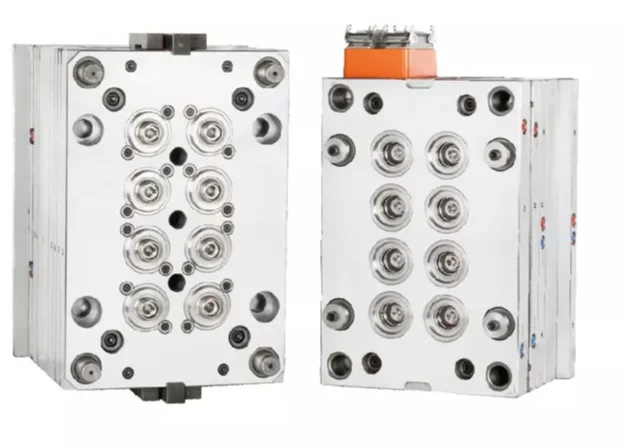
Cold runner systems are unheated runner networks in injection molds that convey molten polymer from the machine nozzle to the cavity and then solidify with the part each cycle. They remain widely used because they are mechanically simple, comparatively low-cost, tolerant of frequent color or material changes, and suitable for many low- to medium-volume programs, even though they generate runner scrap and usually run slower than hot runner alternatives.
In practical mold design, a cold runner system is typically built into a two-plate or three-plate tool, with the sprue, runners, and gates arranged to balance fill, pressure drop, and degating behavior. The system is closely tied to material behavior: it is often favored for heat-sensitive polymers and short-run tooling, while regrind handling, gate vestige, and cycle-time efficiency remain central engineering considerations.
History and Development
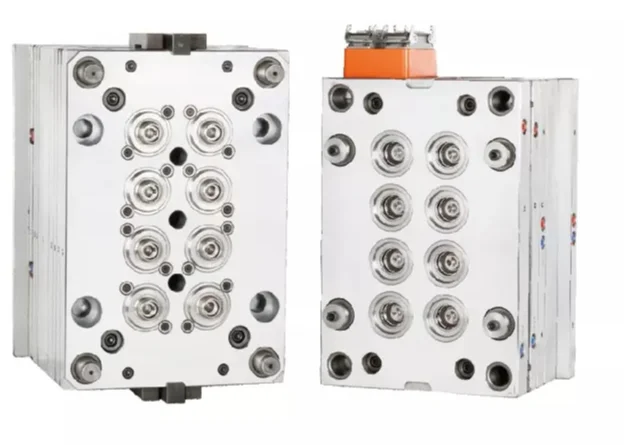
Cold runner molding predates widespread hot runner adoption and formed the baseline architecture of injection molding for decades. Its early dominance came from the simplicity of machining flow channels directly into mold steel, which reduced tooling complexity and maintenance burden.
A major development milestone was the refinement of three-plate molds, which enabled automatic separation of the runner from the part during ejection and improved production efficiency compared with manual degating. This design became especially useful for multi-cavity tools and applications where part appearance or automated handling mattered.
A second milestone was the growing use of regrind loops, in which solidified runners are granulated and fed back into the process when material and quality requirements allow. This reduced waste penalties and helped extend the economic viability of cold runner tooling in cost-sensitive production.
A third development was the emergence of more sophisticated runner geometry, including progressive cross-sectional sizing from sprue to gate, which reduces pressure loss and improves cavity balance in multi-cavity molds. Even with hot runner growth, cold runners have remained relevant because of their robustness, lower capital cost, and compatibility with frequent changeovers.
Key Characteristics and Technical Overview
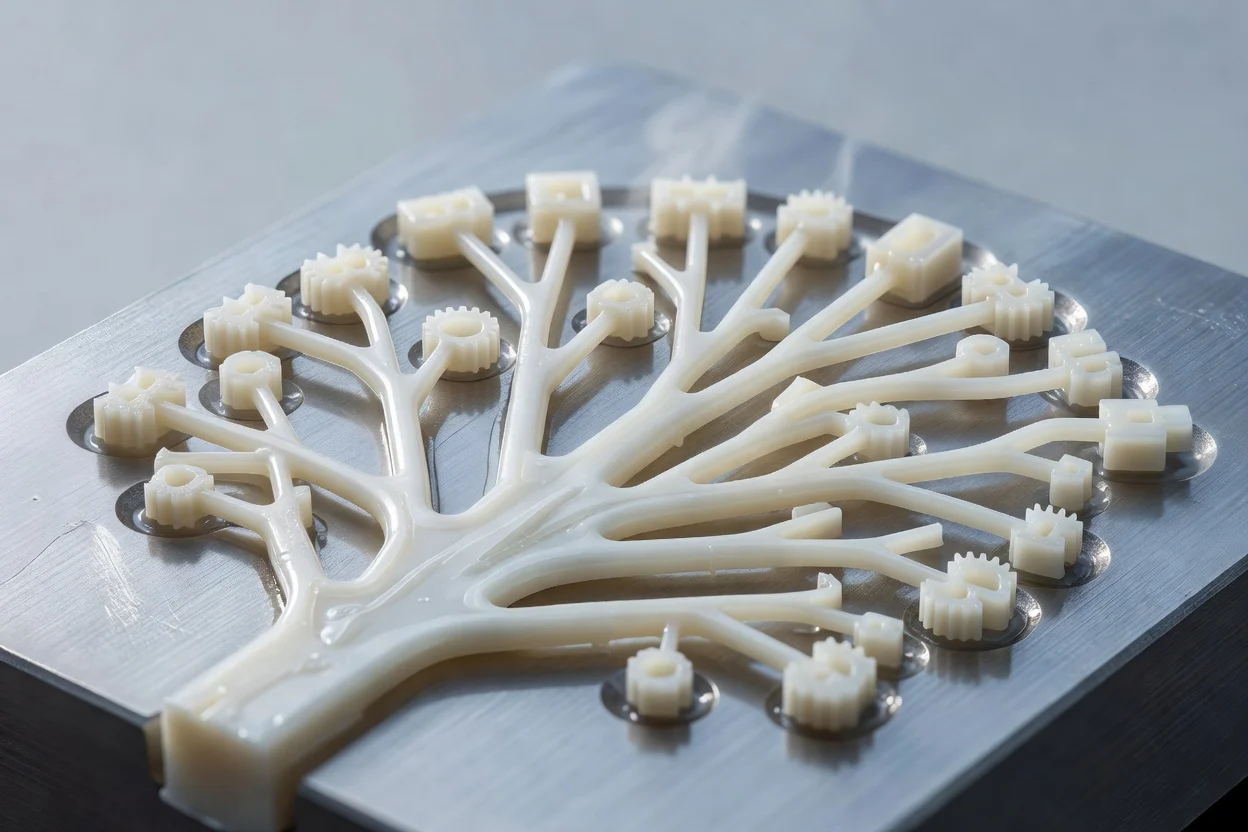
A cold runner system consists of the sprue, runner, and gate sections machined into the mold, all of which cool together with the cavity during the cycle. The runner channels are not actively heated, so the polymer in the feed path solidifies and is ejected with the molded part or separated in the mold, depending on the mold layout.
Working principle
- Molten polymer exits the injection unit nozzle and enters the sprue.
- The melt flows through runner channels to one or more gates.
- The cavity fills, packs, and cools while the runner also freezes.
- The mold opens and the part is ejected together with the solidified runner, or the runner is separated automatically in a three-plate design.
- The runner is either discarded or reground for reuse, depending on material and quality constraints.
Typical engineering features
- Two-plate cold runner molds are the simplest configuration, with the runner typically located on the parting line.
- Three-plate molds separate the runner from the part during opening, allowing more flexible gate placement but increasing tooling complexity and cost.
- Insulated runner molds are sometimes grouped with cold runner concepts, using a thermally managed channel that remains partly molten between shots, though they are more specialized than conventional cold runners.
Practical performance characteristics
- Runner scrap: solidified runner is generated on every cycle unless regrind is reused.
- Cycle time: generally longer than hot runner systems because runner freeze time can become the cooling bottleneck.
- Tooling cost: typically lower than hot runner tooling because no heaters, controllers, or heated manifolds are required.
- Maintenance: simpler and usually easier to service than hot runner systems.
- Gate vestige: a small mark or remnant can remain after degating, especially where shear degating is used.
Useful technical benchmarks
- In many production tools, runner systems are designed so the runner cross-section is larger than the part thickness to maintain flow consistency and avoid premature freeze-off.
- In multi-cavity molds, progressive runner sizing is commonly used to reduce pressure imbalance between cavities.
- Typical cold-runner production is often selected for lower- to medium-volume programs rather than very high annual shot counts, because the economic penalty of runner waste rises with volume.
- Industry discussions commonly cite 5–15% of each shot as runner material in many cold-runner programs, although the actual figure varies widely with part size, layout, and cavity count.
- In well-designed automation cells, robot-assisted runner removal can reduce handling time and narrow the gap in cycle efficiency relative to manual degating.
Types and Variations
| Type | Main feature | Typical advantage | Typical limitation |
|---|---|---|---|
| Two-plate cold runner | Runner is formed in the parting line and usually ejects with the part | Lowest tooling complexity and cost | Runner often requires separate trimming or recycling |
| Three-plate cold runner | Runner is separated from the part during mold opening | Automatic degating and more flexible gate positioning | Higher tool cost and greater mold complexity |
| Insulated runner variant | Runner channel is thermally managed so a molten core can persist between shots | Can reduce runner freeze losses in certain applications | More specialized design and process tuning |
Applications and Uses
Cold runner systems are used across much of injection molding where tooling economy, material change flexibility, or heat sensitivity are important. They are common in prototyping, short- to medium-run consumer products, industrial components, and many multi-color or frequent-changeover operations.
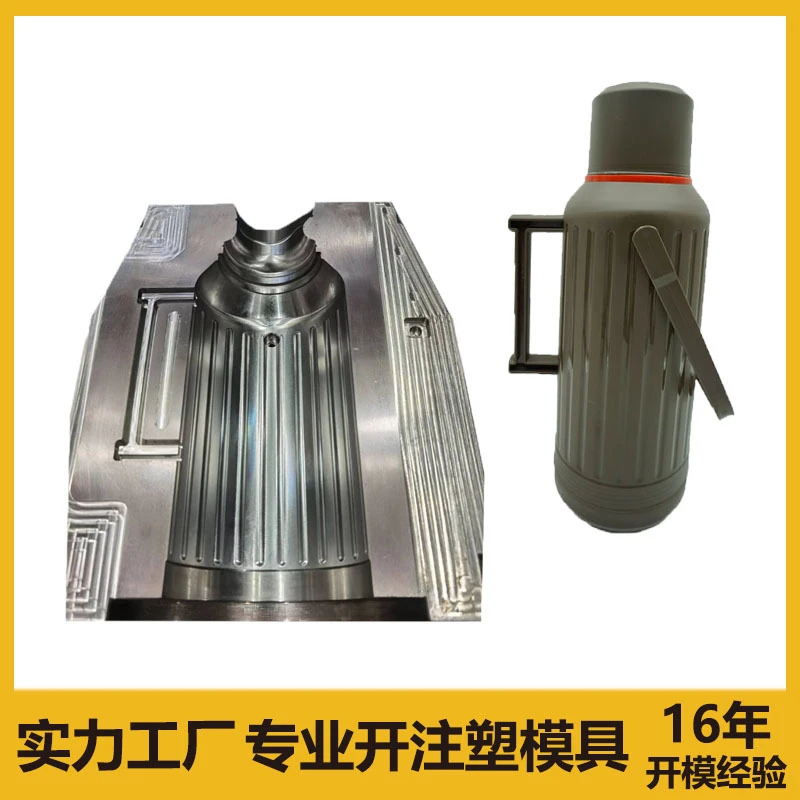
- Consumer goods: caps, closures, housings, small appliance parts, and utility items where lower tooling cost is important.
- Medical and laboratory items: parts requiring simpler tooling and careful control of gate location, especially in lower-volume formats.
- Electrical and electronic components: enclosures, connectors, and structural inserts where mold simplicity and maintenance ease matter.
- Automotive trim and interior parts: short-run, service-part, or platform-variant programs where tooling flexibility is valued.
- Industrial parts: brackets, covers, and functional components where moderate throughput is acceptable.
A poor-fit use is very high-volume, resin-expensive, cosmetically sensitive production, where runner scrap and longer cycle time can outweigh the lower tooling cost.
Material Compatibility and Process Considerations
Cold runners are generally compatible with a wide range of thermoplastics, including materials that are more sensitive to thermal residence time. This is one reason they remain attractive when material degradation risk is a concern or when frequent purge cycles would be costly.
Process design must account for:
- Pressure loss: runner length and cross-section strongly affect fill balance and cavity pressure.
- Cooling balance: uneven cooling can increase warpage or dimensional variation.
- Regrind quality: repeated reprocessing can alter molecular weight, color, or mechanical performance, depending on polymer type and contamination control.
- Gate design: gate size and location affect vestige, shear heating, and fill pattern.
- Automation strategy: robot take-out and degating can significantly improve throughput and consistency.
Technological Innovations and Automation
Recent cold-runner development has focused less on eliminating the runner than on reducing its cost impact through better mold design and automated handling. Common innovations include:
- Optimized runner balancing for more uniform cavity fill in multi-cavity molds.
- Robot-assisted degating to reduce labor and cycle variability.
- Integrated regrind systems that feed trimmed runners back into the process when permitted by product specifications.
- Process monitoring and simulation to predict freeze-off, pressure drop, and warpage before tooling is cut.
- Hybrid layouts that combine cold-runner simplicity with selective thermal control in specialized molds.
Environmental and Sustainability Aspects
Cold runner systems are often viewed as less material-efficient than hot runners because every cycle produces a solidified runner. From a sustainability perspective, the main issue is not only waste generation but also the energy and logistics associated with collecting, grinding, and reprocessing runner material.
At the same time, cold runners can support sustainability goals in specific ways:
- Lower tooling complexity can reduce manufacturing and maintenance burdens over a mold’s life.
- Regrind reuse can reduce virgin resin demand if the polymer and end-use specification allow it.
- Long mold life and simple repairability can improve the lifecycle economics of tooling in stable but moderate-volume programs.
- Heat-sensitive materials may process more reliably in cold runners, reducing scrap from thermal degradation.
The sustainability trade-off is therefore contextual: the best choice depends on resin cost, regrind acceptability, production volume, and scrap management infrastructure.
Economic and Global Market Impact
Cold runner systems remain commercially important because they offer a low entry cost for molders, especially in markets where tooling budgets are constrained or product demand is uncertain. Their economic attractiveness is strongest when annual volumes are modest, designs are still evolving, or material and color changes are frequent.
By contrast, as production volume rises, the cost of runner scrap and longer cycle times increasingly favor hot runner systems. This is why cold runners continue to dominate many low- to medium-volume applications, while hot runners often gain share in high-throughput, high-material-value production.
Current Challenges and Innovations
The main technical challenges for cold runner systems are material waste, runner removal labor, cycle-time penalty, and gate vestige. In addition, tight dimensional tolerances can be harder to hold when runner cooling and ejection dominate the cycle’s thermal behavior.
Current innovation efforts are concentrated on:
- reducing the runner-to-part weight ratio through smarter layout design;
- improving automatic degating and part handling;
- optimizing cooling circuits to shorten the bottleneck phase;
- increasing the allowable and stable use of regrind;
- using simulation to improve balance in complex multi-cavity tools.
Future Outlook
Cold runner systems are unlikely to disappear, because they solve a persistent industrial problem: delivering acceptable molded parts with minimal tooling complexity and low upfront investment. Their future is likely to be strongest in short-run manufacturing, specialty materials, frequent-changeover production, and applications where mold simplicity outweighs maximum material efficiency.
Further progress will likely come from better runner balancing, improved automation, and more sophisticated material-data integration that helps manufacturers decide when cold runner economics remain superior to hot runner alternatives.
References
- •
Injection Molding Basics: Cold Runner Systems. (2020, October 12). https://www.echosupply.com/blog/injection-molding-basics-cold-runner-systems/Link
- •
Cold Runner vs Hot Runner Injection Molding. (2023, October 5). https://aptyx.com/blog/differences-in-hot-and-cold-runner-injection-molding/Link
- •
Cold Runner Molding - Process, advantages and .... (2024, September 3). https://www.cindre.com/molding-methods/cold-runner-molding/Link
- •
Cold runner system: “classic choice” of injection molding. (2025, May 15). https://gudmould.wordpress.com/2025/05/15/cold-runner-system-classic-choice-of-injection-molding/Link
- •
A Guide to Hot and Cold Runner Systems - Basilius Inc. (2021, September 15). https://www.basilius.com/blog/a-guide-to-hot-and-cold-runner-systems/Link
- •
Hot Runner vs Cold Runner Injection Molding Comparison Guide. (2026, April 13). https://firstmold.com/tips/hot-runner-vs-cold-runner/Link
- •
What Are Cold Runner Systems? | Dienamics. (2022, March 29). https://dienamics.com.au/blog/what-are-cold-runner-systems/Link
- •
Hot Runner vs Cold Runner Systems: Pros and Cons Explained. (2026, January 13). https://advancedinjectionmolding.com/hot-runner-vs-cold-runner-systems/Link
- •
Hot-Runner vs. Cold-Runner Systems. (2025, April 19). https://vitalplastics.com/resources/runner-systems-comparison/Link
- •
Injection Molds: Hot Runner vs. Cold Runner Molds. (2021, April 23). https://www.simtec-silicone.com/blogs/injection-molds-hot-runner-vs-cold-runner-molds/Link
- •
Cold Runner and Hot Runner Injection Molds. (2019, February 13). https://nbplastics.com/resources/cold-runner-and-hot-runner-injection-molding-benefits-drawbacks-and-applications/Link
- •
Cold Runner | Injection Molding. (2016, May 1). https://www.plastopialtd.com/cold-runner/Link
- •
Why We Stayed Cold-Runner for 30 Years. (2026, May 3). https://weilinplastic.com/hot-runner-vs-cold-runner/Link
- •
Types Of Cold Runner Systems.... (2023, August 7). https://www.acomold.com/hot-runner-vs-cold-runner-exploring-the-pros-and-cons.htmlLink
- •
Hot Runner vs Cold Runner Injection Mold: Key Differences. (2022, October 17). https://www.rapiddirect.com/blog/hot-runner-vs-cold-runner-injection-mold/Link
- •
Runner - Injection Molding. (2023, June 13). https://www.beaumontinc.com/injection-molding-glossary/runner/Link
- •
Rubber Cold Runner System: Design, Benefits and Process .... (2026, August 14). https://tasuinjection.com/blog/rubber-cold-runner-system/Link
- •
Hot Runner vs. Cold Running Molds: Differences and .... (2022, August 30). https://www.xometry.com/resources/injection-molding/hot-runner-vs-cold-runner/Link
- •
Hot runner vs cold runner. (2026, June 20). https://www.carmo.dk/en/faq/hot-runner-vs-cold-runner/Link
- •
Cold Runner vs Hot Runner: Cost, Scrap, Cycle Time & Mold Design .... (2026, January 27). https://super-ingenuity.cn/cold-runner-vs-hot-runner/Link
- •
Runners for Injection Molding: Cold vs Hot. (2023, July 12). https://madisongroup.com/video-series-introduction-to-hot-and-cold-runners-for-injection-molded-parts/Link
- •
Hot vs Cold Runner Molds: Key Differences Explained. (2024, December 31). https://zetarmold.com/differences-hot-runner-cold-runner-injection-molds/Link
- •
What is a hot runner? (2020, August 25). https://www.moldmasters.com/blog/what-is-a-hot-runnerLink
- •
How Hot Runner Systems Operate in Plastic Injection .... (2022, June 14). https://www.midstatemold.com/how-hot-runner-systems-operate-in-plastic-injection-molding/Link
- •
Hot Runner vs Cold Runner Injection Mold: Key .... (2022, December 14). https://www.reddit.com/r/InjectionMolding/comments/zlkdar/hot_runner_vs_cold_runner_injection_mold_key/Link