
Introduction
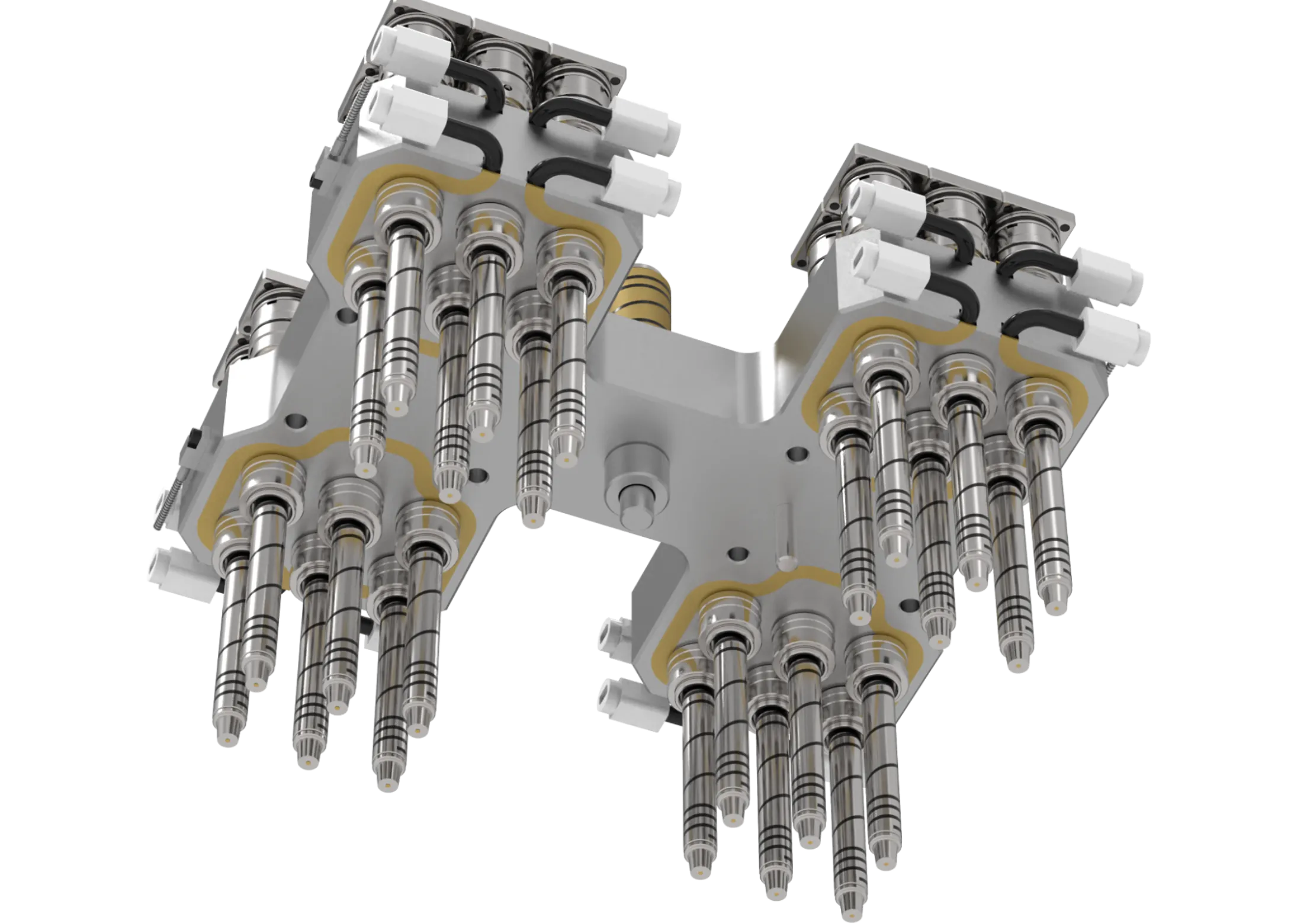
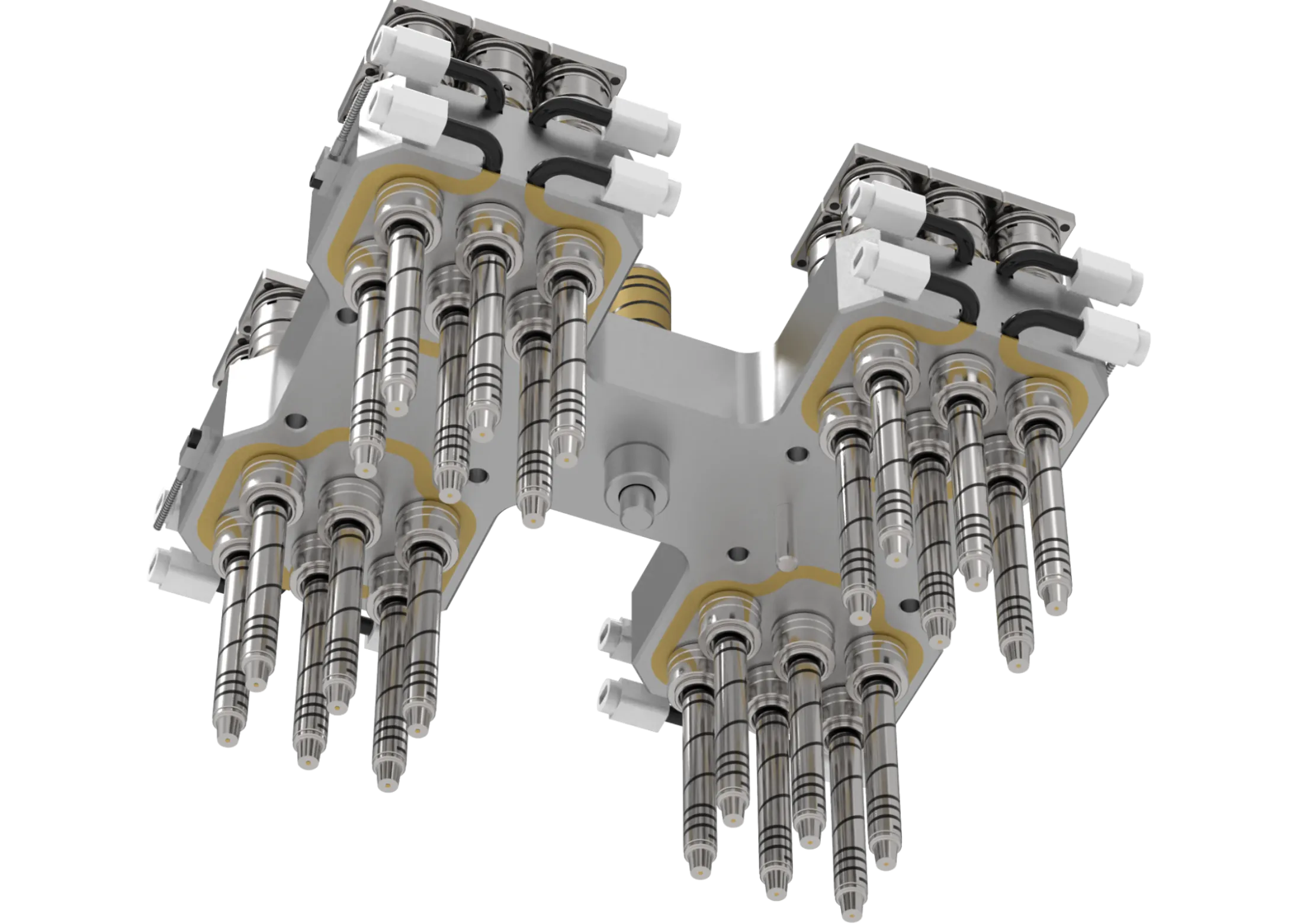
Hot runner systems are heated melt-delivery assemblies used in injection molding to keep polymer melt fluid from the machine nozzle to the gate, eliminating the need to freeze and eject a solid runner after each cycle. By reducing runner scrap, shortening cycle time, and improving cavity-to-cavity balance, they are widely used in high-volume and high-precision molding, especially where part quality, material cost, and process stability are critical.
In practical terms, a hot runner system extends the plastication path into the mold itself through a heated manifold and one or more heated nozzles or “drops,” with temperature control and feedback maintaining the melt above its freezing point. Modern systems range from simple open-gate or thermal gate layouts to valve-gate and sequential systems that offer tighter control over gate vestige, filling sequence, and appearance-critical parts.
The technology emerged as a major advance over cold-runner tooling and is commonly associated with the commercial development of runnerless molding in the early 1960s. Since then, hot runner design has evolved toward more precise thermal management, better balance across multi-cavity molds, cleaner color change behavior, and deeper integration with digital temperature control and process monitoring.
Sustainability is one of the clearest advantages of hot runner adoption: because the runner remains molten and does not become discard material each cycle, resin waste is reduced and part cost can fall in production programs with substantial shot counts. At the same time, the systems are technically more complex than cold runners, requiring careful maintenance, accurate temperature zoning, and thoughtful material selection to avoid degradation, drool, or residence-time problems.
History and Development
Hot runner technology developed from the need to eliminate the waste and cycle-time penalty inherent in cold-runner injection molds. Early commercial systems established the basic architecture still used today: a heated manifold distributing melt to heated nozzles, with thermal control preventing premature solidification.
A few milestones shaped the segment:
- 1963 commercialization: Mold-Masters is widely cited in industry sources as the first company to manufacture and commercialize a hot runner system, marking the transition from experimental runnerless concepts to production tooling.
- Multi-cavity expansion: As packaging, closures, automotive, and consumer goods moved toward higher output and tighter tolerances, hot runners became increasingly important for balanced filling across many cavities, making them central to mass production tooling.
- Valve-gate and control integration: Later development emphasized precision gating, sequenced filling, and better monitoring, allowing improved cosmetic quality, lower gate witness, and more reliable processing of difficult resins and complex geometries.
Key Characteristics and Technical Overview
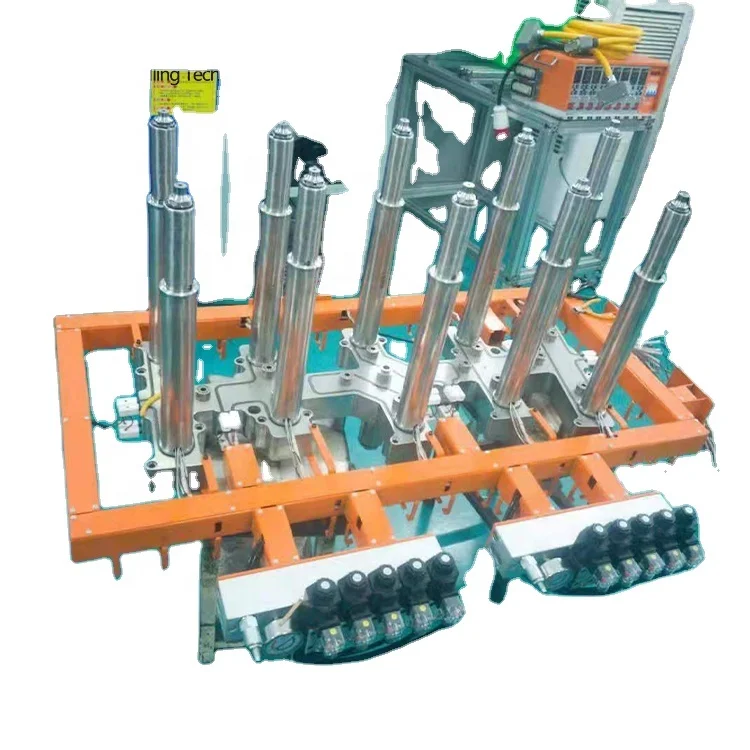
A hot runner system is fundamentally a heated flow path inside the mold, connecting the injection machine nozzle to one or more cavity gates while keeping the resin molten throughout the cycle. The core objective is to maintain a stable melt temperature and pressure distribution so that each cavity receives material consistently.
Main components
- Manifold: the heated distribution block that splits melt flow to multiple nozzles.
- Nozzles or drops: heated passages that convey melt from the manifold to each gate.
- Heaters and thermocouples: the thermal-control elements used to regulate zone temperature.
- Gate interface: the cavity entry point, often configured as an open gate, hot tip, or valve gate depending on the application.
Working principle
The injection screw plasticizes the resin in the machine barrel, then the melt enters the heated manifold and flows through the nozzles into the cavities. Continuous heating prevents solidification in the runner network, so the molded part is ejected without a solid runner attached. In valve-gate systems, a mechanical pin opens and closes the gate, which improves control of vestige, reduces drool, and can enhance sequence management in large molds.
Typical technical benchmarks
Although specifications vary by mold size, resin, and design philosophy, industry descriptions commonly cite the following practical ranges and performance characteristics:
- Temperatures: zone control is often maintained tightly around the resin process window, with many systems using multi-zone temperature controllers and thermocouple feedback; some suppliers describe control accuracy on the order of a few degrees Celsius.
- Rotor speed: not applicable, as hot runner systems are mold assemblies rather than rotating machines.
- Throughput: multi-cavity hot runner molds are used in production from modest part outputs to very high-volume packaging and closure programs; actual throughput is application-specific and often limited by the molding machine, cavity count, and cooling time rather than the runner itself.
- Runner waste: effectively eliminated in runnerless configurations, which is one of the main economic and environmental advantages.
- Cycle time: generally shorter than comparable cold-runner molds because the runner does not need to be cooled and ejected.
Material behavior and process sensitivity
Hot runners are especially sensitive to residence time, thermal degradation, and shear heating, because melt remains inside the heated distribution network for the duration of production. This makes material selection and thermal design especially important for heat-sensitive resins, filled compounds, color-critical products, and applications requiring frequent start-stop operation.
Types and Variations
Hot runner systems are often classified by gate and flow-control architecture rather than by the generic “hot runner” label.
| Type | Main feature | Typical strengths | Common trade-offs |
|---|---|---|---|
| Open-gate / thermal gate | Melt flows continuously through the gate | Simpler design, lower tooling complexity | Less control over drool and vestige |
| Valve-gate | Mechanical pin controls gate opening | Excellent cosmetic quality, precise sequencing, reduced stringing | Higher complexity and maintenance |
| Sequential hot runner | Cavities are filled in a controlled sequence | Better balance for large or complex molds | More sophisticated control system |
| Single-drop / point nozzle | One heated nozzle feeds one cavity | Compact, simpler for single-cavity molds | Limited scalability |
| Manifold multi-drop | One manifold feeds many nozzles | High-volume multi-cavity efficiency | Requires careful balancing and thermal management |
Another useful distinction is between heated and insulated hot runner concepts. Heated systems are the dominant industrial form and use active thermal control, while insulated systems rely more on thick-flow-channel geometry and melt insulation effects; the latter are generally simpler but less flexible and less widely applicable in demanding production.
Applications and Uses
Hot runner systems are used wherever mold productivity, material savings, and appearance quality justify the added tooling cost and technical complexity.
- Packaging: closures, caps, thin-wall containers, and other high-cavity-count products, where cycle time and resin efficiency are decisive.
- Automotive: interior and exterior components that need consistent filling, reduced gate witness, and stable part-to-part quality.
- Medical and healthcare: precision housings and disposables, where repeatability and reduced contamination from regrind can be valuable.
- Consumer goods and electronics: cosmetic parts, enclosures, and appliances that benefit from cleaner gates and better surface appearance.
- Multi-material or multi-color molding: where manifold and valve-gate architecture can support complex shot sequences.
A poorer-fit use is very short-run, low-volume tooling with frequent resin or color changes, because the higher capital cost, thermal setup effort, and maintenance burden may outweigh the scrap savings.
Technological Innovations and Automation
Hot runner systems have become increasingly integrated with digital temperature controllers, cavity-pressure sensing, and mold monitoring software. This improves thermal stability, supports faster setup, and helps identify imbalance, blocked gates, or heater failure before parts drift out of specification.
Current technical trends include:
- More zones and finer control for difficult multi-drop molds.
- Sequential valve gating to reduce flow marks and internal stress in large parts.
- Improved heater and sensor packaging to shorten warm-up time and improve reliability.
- Compatibility with Industry 4.0 monitoring, including predictive maintenance and alarm-based diagnostics.
Automation creates benefits but also raises the technical bar: a highly integrated hot runner can improve uptime and repeatability, yet faults in sensors, heaters, or wiring can affect the entire mold rather than a single cavity.
Environmental and Sustainability Aspects
The strongest sustainability advantage of hot runners is the elimination of solid runner scrap in standard operation. This lowers material consumption, reduces handling of regrind, and can improve energy efficiency because the system avoids repeatedly cooling and reheating runner material.
Key environmental considerations include:
- Lower polymer waste: especially valuable with expensive engineering resins and color-sensitive materials.
- Shorter cycles: less cooling time can reduce unit energy use per part in suitable applications.
- Reduced regrind dependence: which may help preserve mechanical properties in sensitive applications where regrind content is constrained.
- Design for longevity: durable manifolds and replaceable components can support long mold life and lower lifecycle impact.
The trade-off is that hot runner molds consume electricity for heater zones and require careful thermal management, so their environmental performance depends on production volume, resin value, and the efficiency of the mold design as a whole.
Economic and Global Market Impact
Hot runner systems are typically more expensive than cold runner tooling at the outset, but their economics improve sharply in high-volume production because material savings and cycle-time reductions accumulate over many shots. For this reason, they are especially influential in sectors where resin cost, cavity count, and output rate dominate total cost of ownership.
Their global impact is closely tied to the expansion of packaging, automotive, consumer electronics, and medical molding, where tight tolerances and stable aesthetics are essential. Suppliers such as Mold-Masters, Husky, HRSflow, MHS, and others are important in the segment because they have helped commercialize specific architectures, valve-gate technologies, controllers, and application-specific manifold designs.
Current Challenges and Innovations
Hot runner adoption still faces several engineering constraints:
- Higher tooling cost: the system increases mold complexity and initial investment.
- Thermal degradation risk: prolonged residence time can damage sensitive polymers if temperature control is poor.
- Maintenance demands: heaters, sensors, gates, and wiring require precise diagnosis and periodic service.
- Color-change complexity: some architectures are less suitable for frequent color changes than cold-runner molds.
Innovation is focused on reducing these disadvantages through better thermal isolation, improved nozzle design, more robust materials, and smarter controllers that stabilize process windows and reduce downtime. In practice, these improvements are pushing hot runner systems into more demanding applications that previously favored cold runners.
Future Outlook
Hot runner systems are likely to remain central to high-volume injection molding because they align well with the industry’s priorities: reduced waste, lower unit cost, tighter process control, and improved part quality. Future development is likely to emphasize faster setup, better diagnostic visibility, more efficient heating, and stronger compatibility with digital manufacturing systems.
The most important long-term trend is not simply greater adoption, but more selective application: hot runners will continue to expand where their technical and economic advantages are strongest, while cold runners will remain relevant in low-volume, highly variable, or cost-sensitive tooling.
Summary
Hot runner systems are heated mold assemblies that deliver polymer melt directly to the cavity without freezing a runner each cycle. They are technically more complex than cold runners, but they offer major advantages in material savings, cycle time, gating quality, and production consistency, which is why they are a cornerstone of modern high-volume injection molding.
References
- •
Hot Runner vs Cold Runner Injection Mold: Key Differences. (2022, October 17). RapidDirect.Link
- •
What is a hot runner? (2020, August 25). Mold-Masters.Link
- •
Overview of Hot Running Injection Molding Systems. (2023, June 7). Xometry.Link
- •
How Hot Runner Systems Work. (2025, September 22). Spectrix.Link
- •
Husky Hot Runner Systems | Injection Molding Solutions. (n.d.). Husky.Link
- •
What Is a Hot Runner: Expert Guide | Types, Benefits, and .... (2024, August 22). Polyshot.Link
- •
Hot Runner Fundamentals | What is a Hot Runner System? | Husky. (2026, June 22). Husky.Link
- •
Hot Runner Injection Molding: Advantages, Types, and Comparisons. (2024, August 26). Goldsupplier.Link
- •
Hot Runner Systems. (2025, July 4). MoldMaking Technology.Link
- •
Hot Runners. (n.d.). MHS Hot Runners.Link
- •
Hot Runner Systems - Melt Design. (2021, September 14). Melt Design.Link
- •
What is hot runner technology? - hotset explains. (2022, July 14). hotset.Link
- •
Options for Hot Runner Systems in Injection Molding. (2025, March 28). Decatur Mold.Link
- •
Hot Runner System In Plastic Injection Molding: 2026 Complete .... (2016, March 19). MyPlasticMold.Link
- •
Hot Runner in Injection Molding: Complete Guide. (2022, December 29). Zetar Mold.Link
- •
MHS Hot Runners. (n.d.). MHS Hot Runners.Link
- •
Hot runner systems - HRSflow. (n.d.). HRSflow.Link
- •
Cold Runner vs Hot Runner Injection Molding. (2023, October 5). Aptyx.Link
- •
Hot Runner Products. (n.d.). PCS Company.Link
- •
Hot Runner Systems in the Injection Molding Process. (2024, April 2). Aco Mold.Link
- •
Hot Runner Basics. (n.d.). MHS Hot Runners.Link
- •
Injection Molds: Hot Runner vs. Cold Runner Molds. (2021, April 23). SIMTEC Silicone Parts.Link
- •
Hot Runner vs. Cold Running Molds: Differences and .... (2022, August 30). Xometry.Link
- •
The Role of Hot Runners in Injection Molding. (2025, May 12). Crescent Industries.Link