
Introduction
Laminating equipment is a broad class of machinery used to bond two or more layers of material into a single composite structure through heat, pressure, adhesive chemistry, vacuum, or combinations of these methods. In the plastics-processing industry, the term covers everything from office pouch laminators and wide-format roll laminators to industrial film-lamination systems, pressure-roller laminators, vacuum laminators for solar modules and electronics, and hot presses used in PCB, CCL, and composite panel production.
Within plastics manufacturing, laminating equipment is important because it influences surface protection, barrier performance, stiffness, dimensional stability, optical appearance, electrical insulation, and long-term durability. The same basic engineering principle—bringing stacked layers into intimate contact under controlled thermal and mechanical conditions—supports applications in printed graphics, packaging, building panels, technical films, solar photovoltaic modules, multilayer circuit boards, and fiber-reinforced composites.
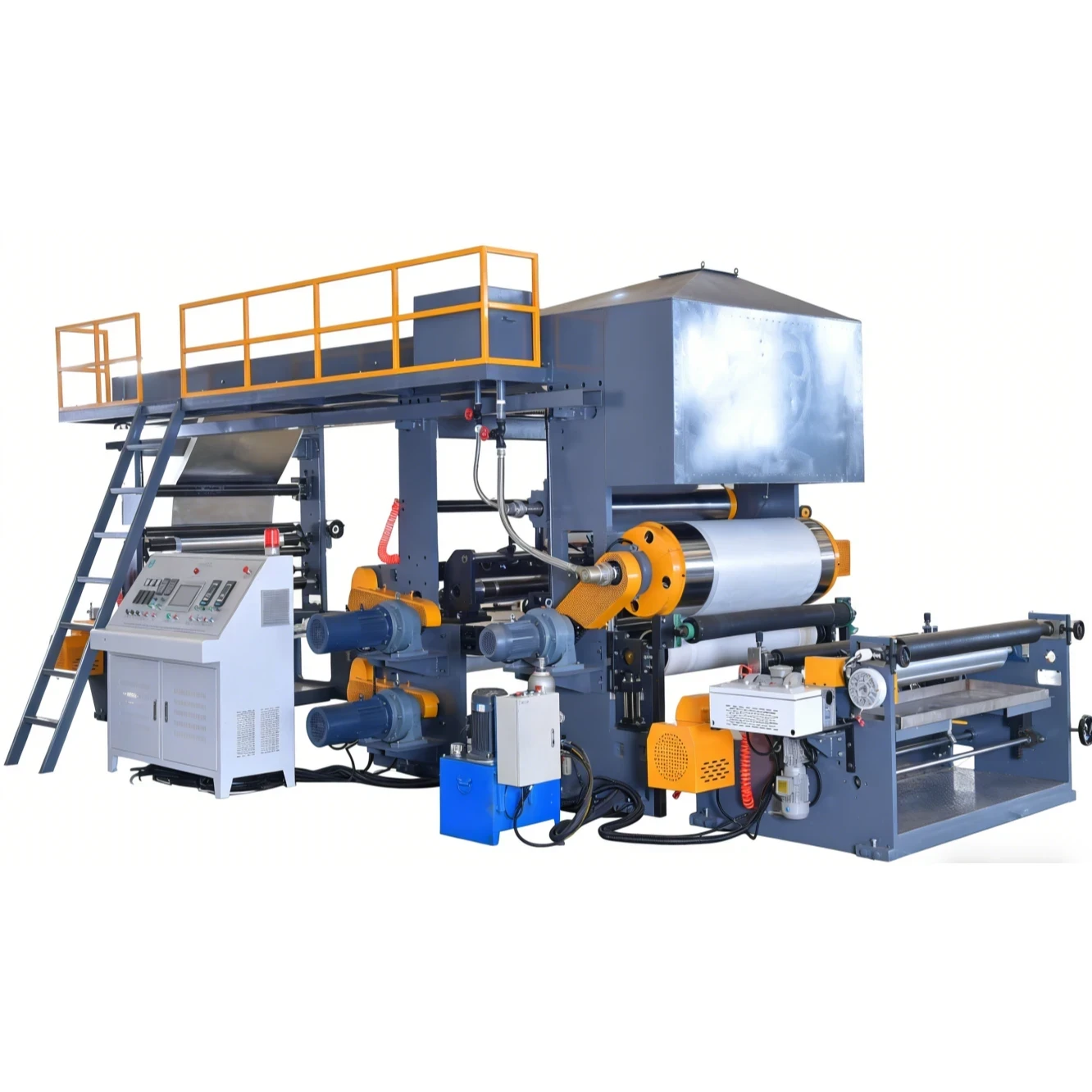
Technologically, laminating systems span a wide range of configurations: cold laminators using pressure-sensitive adhesives, hot laminators using heat-activated adhesive films or thermal bonding, cold/hot hybrid machines, roll-to-roll industrial lines, and vacuum hot-press systems designed to reduce voids, edge bubbles, and warpage in high-value laminates. Recent development has emphasized better temperature uniformity, faster cycle times, bubble-free bonding, automation, digital controls, and reduced energy consumption, especially in high-throughput sectors such as solar modules and PCB fabrication.
History and Development
Lamination predates modern plastics processing, but industrial laminating equipment expanded rapidly as polymer films, thermosetting resins, adhesives, and precision pressing technologies matured. Early systems were largely mechanical presses and roller assemblies used to bond paper, veneers, and textiles; later systems adapted those principles to plastic films, foams, composite prepregs, and electronic substrates.
Key development milestones include:
- Roller-based hot lamination became widely adopted for continuous film bonding, enabling uniform nip pressure and higher throughput than manual pressing.
- Vacuum-assisted lamination emerged as a major advance in solar-module and electronics manufacturing, where air evacuation before final pressurization reduced bubbles, edge defects, and internal stress.
- Multi-daylight and multi-opening hot presses became standard in PCB and composite lamination, allowing simultaneous processing of multiple stacks under controlled temperature and pressure.
In electronics and solar manufacturing, lamination evolved from simple heat pressing into highly controlled process equipment integrating vacuum chambers, programmable heating, pressure profiles, cooling stages, and alignment systems. In graphics and packaging, the trend moved toward more compact, faster warm-up, and easier-to-operate machines for both cold and thermal lamination.
Technical Overview
At its core, lamination requires wetting, flow, contact, and consolidation. A bonding layer—such as adhesive film, hot-melt polymer, resin-impregnated prepreg, or pressure-sensitive adhesive—is activated and pressed between substrates until the layers join into a stable laminate.
Main process principles
- Cold lamination uses pressure-sensitive adhesive and roller compression, without heating; it is fast and avoids thermal distortion.
- Hot lamination uses heat-activated adhesive or thermoplastic bonding; the machine must heat up before operation, but it often yields stronger permanent bonds.
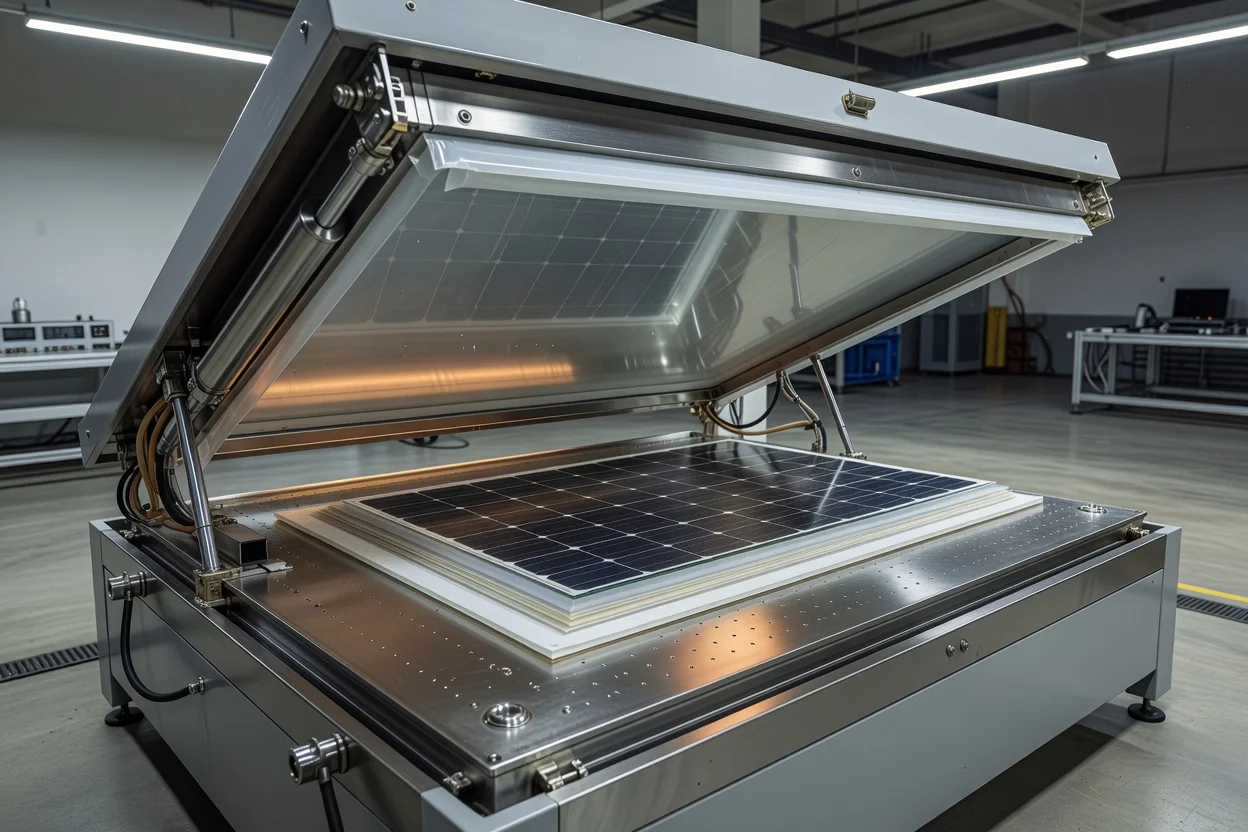
- Vacuum lamination removes entrapped air before or during pressurization, which is especially important for solar modules, PCB stacks, and optical or high-reliability laminates.
- Pressure-roller lamination is common in roll-to-roll industrial systems, where line pressure and residence time govern bond quality and surface conformity.
Typical engineering elements
- Heating system: electric heaters, thermal oil heating, or heated platens/rollers.
- Pressure system: rollers, hydraulic presses, membrane bladders, or vacuum-assisted press chambers.
- Alignment system: registration pins, templates, optical alignment, or mechanical stops for multilayer stacks.
- Cooling and cure management: controlled cooling prevents warp, residual stress, and delamination.
- Control system: PLC or computer-based temperature, pressure, and cycle profiling.
Quantitative benchmarks
Industrial laminating systems vary widely by sector, but published technical references indicate several useful benchmarks:
- Rotor or roller speeds in graphics and film-lamination equipment are often designed for continuous operation rather than discrete cycles, with line speed chosen to match adhesive cure and pressure transfer requirements.
- In composite and PCB hot pressing, unit pressure can reach about 12.5 MPa, with multi-opening presses commonly in the 2,000–3,000 t class for larger stacks and panel formats.
- Some PCB lamination systems use 10 openings with hot plates around 820 × 1,360 mm for multilayer board production.
- In vacuum lamination for solar modules, the process typically heats EVA or similar encapsulants while evacuating air and then applies membrane or chamber pressure to consolidate the stack.
Material and quality effects
Lamination quality depends on viscosity control, adhesive flow, pressure uniformity, and thermal history. Poor process control can lead to bubbles, wrinkles, edge voids, delamination, warpage, optical distortion, or thickness non-uniformity. Good process design improves adhesion, flatness, and barrier performance while preserving substrate geometry and aesthetics.
Types and Variations
| Type | Main bonding mechanism | Typical use | Key advantage | Main limitation |
|---|---|---|---|---|
| Cold laminator | Pressure-sensitive adhesive | Documents, graphics, protective films | No heat-up time; low thermal risk | Lower bond strength for some substrates |
| Hot laminator | Heat-activated adhesive or thermal film | Graphics, packaging, protective overlays | Stronger permanent bonding | Requires warm-up and thermal control |
| Cold/hot hybrid laminator | Either pressure-only or thermal bonding | Mixed production environments | Greater process flexibility | More complex machine architecture |
| Roll laminator | Continuous nip pressure and film feed | Wide-format graphics, signs, industrial film | High throughput and uniform coverage | Less suited to thick stacked parts |
| Vacuum laminator | Air removal plus heat/pressure | Solar modules, PCB, optical laminates | Bubble reduction and better consolidation | Higher capital cost |
| Multi-daylight hot press | Heated platens and simultaneous stack pressing | PCB, CCL, composites, technical laminates | High output and precise layer bonding | Large footprint and tooling complexity |
Industrial lamination also includes specialized process variants such as dry lamination, wet lamination, UV lamination, hot-melt lamination, adhesive-film lamination, and dispersion-adhesive lamination. In some manufacturing sectors, the same equipment family is described as a press, laminator, or laminating line, depending on whether the dominant function is bonding, forming, or panel consolidation.
Applications and Uses
Laminating equipment is used across a remarkably broad range of industries because it bridges surface engineering, structural bonding, and protective encapsulation.
Major sectors
- Graphics and signage: laminating printed output with clear films for abrasion resistance, moisture protection, and improved appearance.
- Packaging and labels: bonding films, barrier layers, and decorative substrates for improved shelf life and print durability.
- Electronics and PCB manufacturing: pressing multilayer boards and copper-clad laminates using hot-press or vacuum-lamination systems.
- Solar photovoltaic modules: encapsulating glass, cells, EVA, and backsheet materials under vacuum and heat.
- Construction and wood-based panels: bonding veneers, foams, rigid sheets, and decorative overlays to boards or substrates.
- Technical films and optical products: bonding films, nonwovens, and specialty layers with tight requirements on bubbles and registration.
- Composite materials: consolidating fiber-reinforced layers, prepregs, and resin systems into structural laminates.
- Document finishing and office use: small pouch laminators for identity cards, reports, photographs, and teaching materials.
Poor-fit use
A relatively poor-fit application is high-temperature structural metal joining, because standard laminating equipment is designed for thin-layer bonding and controlled adhesive consolidation rather than metallurgical joining, welding, or high-load mechanical fastening.
Performance and Process Parameters
The practical performance of laminating equipment is usually measured by:
- Throughput
- Bond strength
- Void content
- Thickness consistency
- Cycle time
- Energy use
- Surface quality
- Warp control
For office and graphics machines, manufacturers emphasize warm-up time, roll width, and ease of operation. For industrial systems, the more important parameters are heating uniformity, pressure distribution, platen size, vacuum quality, and registration accuracy.
In PCB and composite production, lamination cycles may be tuned to control resin flow before cure, because excessive flow can shift conductors or fiber architecture while insufficient flow can cause poor interlayer bonding. In solar-module encapsulation, the process window must balance melt flow of the encapsulant with vacuum removal of trapped air and final curing behavior.
Technological Innovations and Automation
Modern laminating equipment increasingly incorporates:
- PLC-based recipe control
- Servo-driven feed and alignment
- Automatic loading and unloading
- Vacuum and pressure profiling
- Touchscreen human-machine interfaces
- Inline inspection for wrinkles, bubbles, and misregistration
- Data logging for traceability and quality assurance
In industrial settings, automation reduces operator dependence and improves repeatability, especially where cycle consistency is critical. In high-volume lines, laminating equipment is often integrated with upstream coating, glue spreading, cutting, stacking, and downstream curing or trimming operations.
The most advanced systems also address process robustness: for example, vacuum systems reduce entrapped air, while programmable thermal ramps help avoid local overheating and adhesive degradation.
Environmental and Sustainability Aspects
Laminating equipment can support sustainability goals, but its net impact depends on material selection and process design.
Positive contributions
- Longer product life through abrasion and moisture protection, reducing replacement frequency.
- Material efficiency when lamination enables the use of thin films or lightweight substrates instead of thicker monolithic materials.
- Compatibility with circular design in some removable-film and protective-film applications, where temporary layers can be peeled away after processing.
Sustainability challenges
- Energy demand is significant in hot presses, vacuum laminators, and thermal roll systems because heating and cooling cycles can be intensive.
- Composite disassembly is difficult when laminates are permanently bonded, which complicates recycling.
- Adhesive and film compatibility with recycling streams remains a technical constraint in packaging and multi-material products.
A recurring engineering trade-off is that stronger and more durable lamination often makes end-of-life separation harder. As a result, many current innovations focus on lower-temperature bonding, thinner adhesive layers, faster cycles, and better selectivity between permanent and temporary bonding.
Economic and Global Market Impact
Laminating equipment occupies a dual market: a high-volume low-cost segment for office, graphics, and retail use, and a capital-intensive industrial segment for solar, PCB, electronics, composites, and panel manufacturing.
Industrial systems are especially sensitive to:
- Capital cost
- Throughput
- Automation level
- Tooling flexibility
- Uptime and maintenance
- Yield loss from defects
Published market commentary and company materials show active demand in PCB press systems, solar-module laminators, and industrial film-lamination lines, where equipment value is driven by precision and process reliability rather than simple mechanical size. In China and other manufacturing hubs, reported pricing for advanced PCB lamination equipment can vary substantially with opening count, automation, and application complexity.
Current Challenges and Innovations
Several technical challenges define the current state of laminating equipment:
- Bubble elimination in thick, multilayer, or large-format stacks
- Warp control after cooling and demolding
- Adhesive uniformity across wide substrates
- Shorter cycle times without compromising bond quality
- Lower energy consumption
- Traceability for regulated electronics and energy products
Innovation is concentrated in:
- Vacuum-assisted consolidation
- Improved platen flatness and thermal zoning
- Membrane and bladder systems with better pressure distribution
- Digital process recipes and closed-loop control
- Integration with inline inspection and MES systems
- Application-specific machine architectures for solar, PCB, and technical films.
Future Outlook
The future of laminating equipment is likely to be shaped by three forces: automation, energy efficiency, and application specialization. Equipment for solar modules and electronics will continue moving toward tighter temperature control, lower void content, and better process traceability, while graphics and general-purpose laminators will emphasize speed, usability, and reduced operating cost.
More broadly, lamination is likely to expand in areas where products require lightweight construction, multifunctional surfaces, and high durability, especially in energy technology, flexible electronics, technical textiles, and advanced packaging. At the same time, sustainability pressures will encourage designs that reduce adhesive mass, improve recyclability, and minimize thermal load during processing.
Summary
Laminating equipment is a foundational family of plastics-processing and materials-bonding machinery. It ranges from simple cold and hot laminators to highly engineered vacuum and multi-opening press systems, and it serves markets as diverse as signage, packaging, electronics, solar power, construction panels, and composites. Its continuing development is defined by the need to improve bond quality, speed, and automation while reducing energy use, defects, and end-of-life material complexity.
References
- •
USCutter. (2026, September 24). Large format laminators. https://uscutter.com/laminators/Link
- •
Grainger. (2026, July 1). Laminating machines. https://www.grainger.com/category/office-supplies/laminating-binding-equipment/laminating-machinesLink
- •
Finitura. (n.d.). Laminating machines: Pouch, roll, school & wide format laminators. https://www.finitura.com/C/6/LaminatingMachinesLink
- •
Walco. (n.d.). Industrial laminators. https://www.walcomachine.com/en/products/laminators/Link
- •
Office Depot. (n.d.). GBC Fusion 7000L 12" laminator. https://www.odpbusiness.com/b/laminating-machines/N-1505117Link
- •
Wuhan University of Technology. (n.d.). 层压工艺 [Lamination process] [PowerPoint slides]. https://jxpt.whut.edu.cn/meol/analytics/resPdfShow.do;jsessionid=49A490E6A7911D9D1557A6164B94E581?resId=409094&lid=15339Link
- •
CAS Solutions. (2026, September 1). Graphic equipment laminators cold & hot. https://premier-gs.com/laminators/Link
- •
Staples. (n.d.). Protect documents with laminating machines. https://www.staples.com/Laminating-Machines/cat_CL142540Link
- •
Just Binding. (2025, August 12). Laminating machine & roll laminators. https://www.justbinding.com/collections/laminating-machinesLink
- •
RS Components. (2025, November 5). Laminators, lamination machine, A3 & A4 laminators. https://uk.rs-online.com/web/c/office-supplies/office-equipment/laminators/Link
- •
Black Bros. (2012, July 10). Rotary laminating presses & roll laminators. https://blackbros.com/roller-coater-laminator-equipment/Link
- •
Union Tool. (n.d.). Union tool automatic laminator machines and panelizing. https://www.uniontoolcorp.com/union_tool_laminate.htmlLink
- •
Nobelus. (2026, September 23). Thermal lamination machines. https://shop.nobelus.com/equipment/Link
- •
McLogan. (2025, August 12). Hot & cold laminators – Versatile lamination equipment. https://mclogan.com/collections/laminatorsLink
- •
GBC. (n.d.). Roll laminator machines for schools & business. https://www.gbc.com/c/laminating/laminating-machines/roll-laminators/Link
- •
Amazon. (n.d.). Laminator. https://www.amazon.com/laminator/s?k=laminatorLink
- •
Menzel Maschinenbau. (n.d.). Laminating. https://menzel-maschinenbau.de/en/produkte/laminating/Link
- •
Baidu. (n.d.). 层压机 [Laminating machine]. https://baike.baidu.com/item/%E5%B1%82%E5%8E%8B%E6%9C%BA/10794573Link
- •
Office Depot. (2024, January 1). Laminating machines. https://www.officedepot.com/b/laminating-machines/N-1505117Link
- •
Cheng-Hau. (n.d.). 層壓機 [Laminating machine]. https://cheng-hau.com/product/%E5%B1%A4%E5%A3%93%E6%A9%9F/Link
- •
East Money. (n.d.). 投资建议与估值风险提示 [Investment advice and valuation risk warning] [PDF]. https://pdf.dfcfw.com/pdf/H3_AP202609181829615031_1.pdfLink
- •
Uline. (n.d.). Laminator machines in stock. https://www.uline.com/BL_7350/LaminatorsLink
- •
Viking Direct. (n.d.). Laminating machines. https://www.viking-direct.co.uk/en/en/office-equipment-machines-c-116/laminating-pouches-machines-c-116005/laminating-machines-c-116005001Link
- •
JJXXJY. (n.d.). 层压板成型工艺 [Laminated board forming process]. http://www.jjxxjy.com/news/441.htmlLink
- •
SC Solar. (2025, July 14). 层压机 [Laminator]. https://www.sc-solar.com.cn/product/laminator/Link
- •
AB Semiconductor. (2026, June 6). LTCC(低温共烧陶瓷)层压工艺及设备简介 [LTCC lamination process and equipment introduction]. https://www.ab-sm.com/a/9152Link
- •
Lauffer. (n.d.). 层压技术 [Lamination technology]. https://lauffer.de/zh-hans/%E5%B1%82%E5%8E%8B%E6%8A%80%E6%9C%AF/Link
- •
Ichikin. (2022, January 6). 層壓板覆膜機 [Laminated board laminating machine]. https://www.ichikin.net/zh-TW/eng/products/laminate/Link
- •
SZVstar. (n.d.). 实验室层压机系列 [Laboratory laminator series]. https://www.szvstar.com/product/9/Link
- •
Baidu. (n.d.). 真空层压机 [Vacuum laminator]. https://baike.baidu.com/item/%E7%9C%9F%E7%A9%BA%E5%B1%82%E5%8E%8B%E6%9C%BA/7766157Link
- •
ENF. (2025, December 24). 层压设备生产商 [Lamination equipment manufacturers]. https://www.enf.com.cn/directory/equipment/crystalline_laminatingLink
- •
Google Patents. (2009, January 15). 基板层压设备及对准系统 [Substrate lamination equipment and alignment system]. https://patents.google.com/patent/CN104765168ALink
- •
Datasheet Archive. (n.d.). 45d7dd1f3d0b8ea30c34b9c70b9a2b26 [PDF]. https://datasheet.datasheetarchive.com/originals/crawler/lpkf.cn/45d7dd1f3d0b8ea30c34b9c70b9a2b26.pdfLink
- •
East Money. (n.d.). 中信新材料:合锻智能PCB层压设备交流及近况更新一 [CITIC new materials: He forging intelligent PCB lamination equipment exchange and recent update]. https://caifuhao.eastmoney.com/news/20260611201237087145160Link
- •
Google Patents. (2017, November 24). 多功能层压机及其使用方法 [Multifunctional laminator and its use method]. https://patents.google.com/patent/CN107833942A/zhLink
- •
East Money. (n.d.). 关于生益电子股份有限公司2025年度向特定对象发行股票 [Regarding Shengyi Electronics Co., Ltd. 2025 annual issuance of shares to specific objects] [PDF]. https://pdf.dfcfw.com/pdf/H2_AN202603201820669240_1.pdf?t=1780470398650Link
- •
Hubei Longteng Electronic Technology. (n.d.). 湖北龙腾电子科技股份有限公司 [Hubei Longteng Electronic Technology Co., Ltd.] [PDF]. http://pdf.dfcfw.com/pdf/H2_AN202306301591934234_1.pdfLink