
Introduction
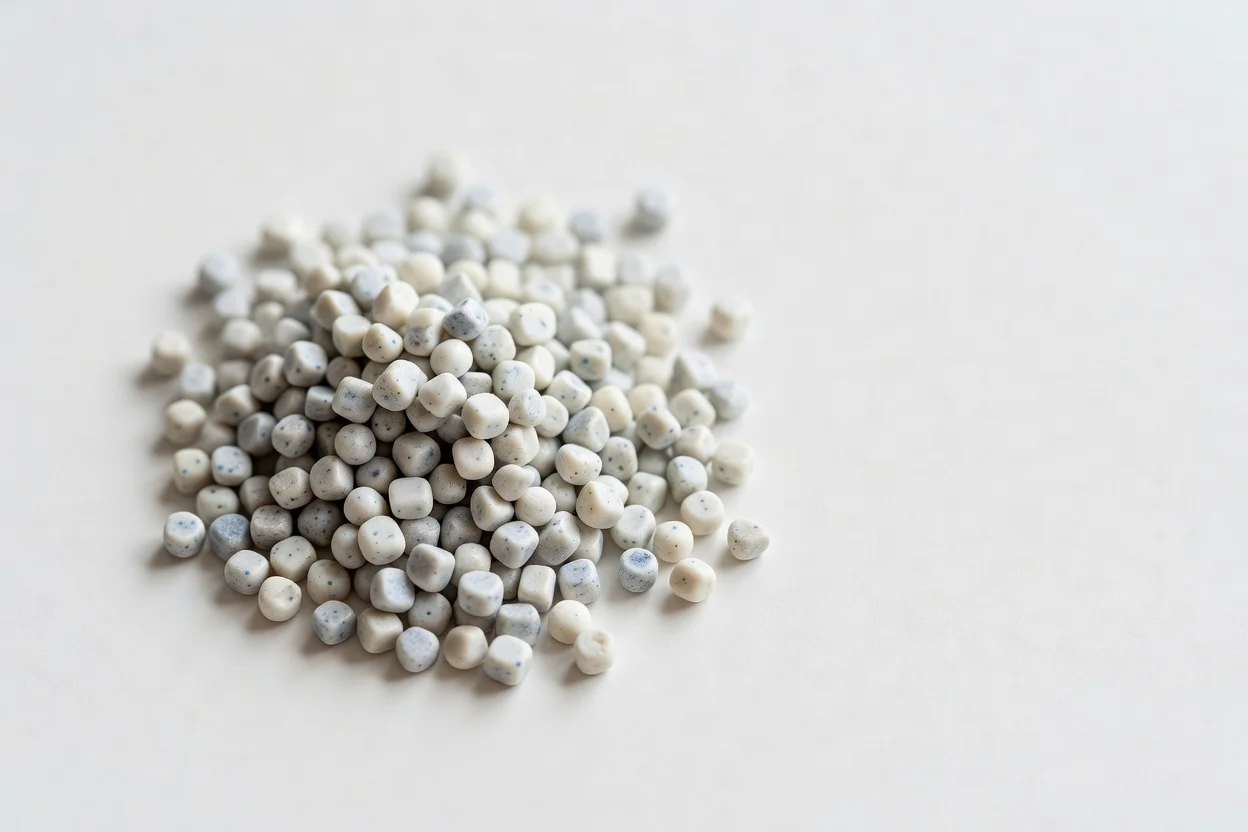
Recycled polyvinyl chloride (rPVC) is PVC waste that has been collected, sorted, cleaned, and reprocessed into a new raw material for manufacturing new products. It occupies an important position in the circular plastics economy because PVC is widely used in long-life applications such as construction products, cables, flooring, roofing membranes, and certain consumer and industrial goods, all of which generate recoverable post-consumer and post-industrial scrap.
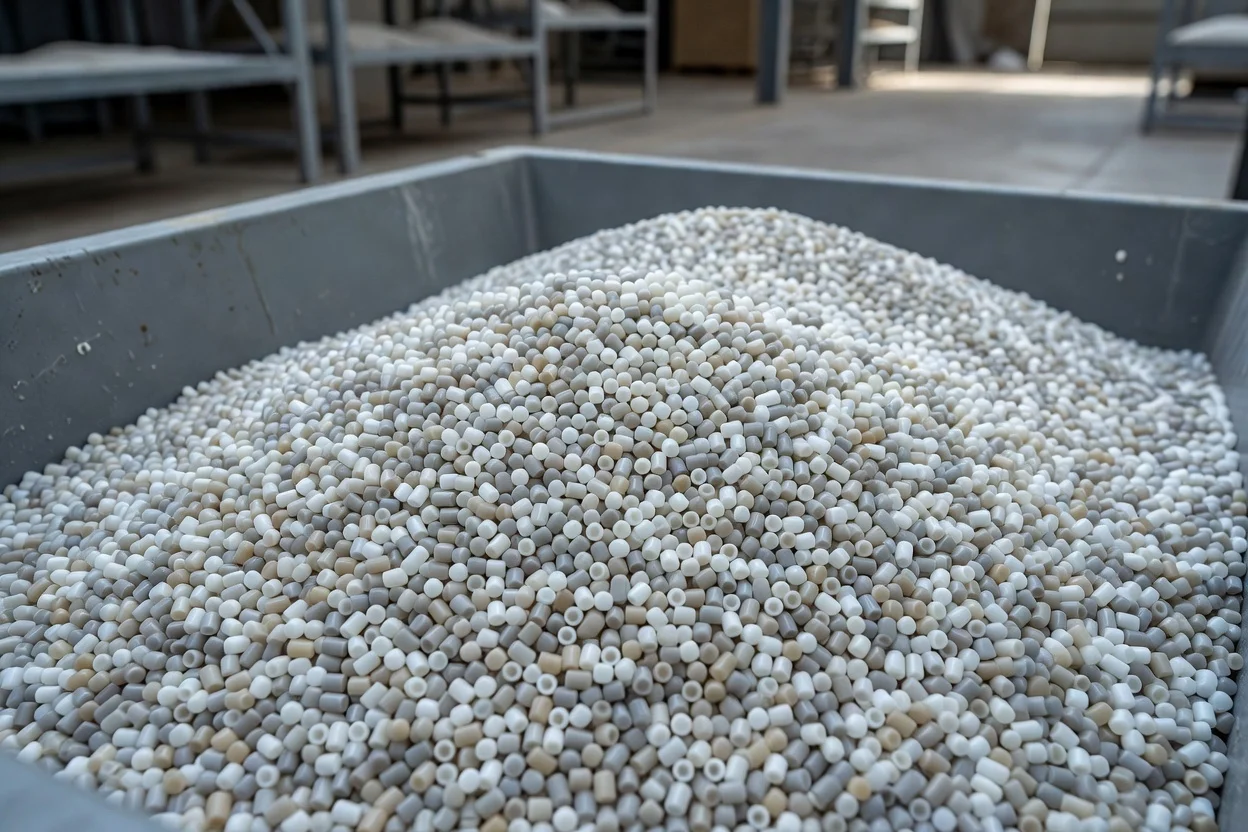
rPVC exists in both rigid and flexible forms, reflecting the diversity of feedstocks and the retained properties of the parent polymer and its additives. In practice, much of the market is dominated by rigid PVC streams from window profiles, pipes, and construction scrap, while flexible PVC recyclate is also used when collection and separation are sufficiently controlled.
From a sustainability perspective, rPVC is significant because reuse of PVC can reduce virgin resin demand, energy consumption, emissions, and waste disposal burdens, although outcomes depend heavily on sorting quality, additive management, and the specific recycling route. The material is also central to ongoing debates about legacy additives, contamination, and the technical limits of repeated recycling, making it a useful case study in both the promise and complexity of plastics circularity.
History and Development
PVC recycling developed first through mechanical recycling, in which clean production scrap and separated post-consumer waste are reprocessed into pellets, flakes, or compounds. This approach became especially established in Europe, where window profiles, pipes, and flooring created relatively concentrated waste streams suited to secondary use.
Industry initiatives such as VinylPlus helped formalize definitions, collection pathways, and end-market reporting for recycled PVC, particularly in building products and flooring. More advanced routes, including solvent-based purification and feedstock recovery concepts, have been explored to improve purity and widen the range of acceptable applications.
Over time, rPVC moved from a predominantly lower-grade recyclate used in non-critical goods toward a more engineered raw material capable of entering semi-technical and, in some cases, high-performance applications when contamination is tightly controlled. However, the industry still relies heavily on application-specific sorting, because mixed additives and legacy stabilizers remain a defining constraint of the material stream.
Chemical Structure and Key Properties
PVC is a chlorine-containing thermoplastic whose useful properties arise from its polarity, stiffness in the unplasticized state, and compatibility with a wide range of additives. rPVC retains many of these characteristics after reprocessing, including chemical resistance, weatherability, rigidity, and, in flexible grades, a degree of softness and bendability inherited from plasticizer-containing source material.
The most important practical limits of rPVC are:
- Contamination and additive carryover → mixed feedstocks can contain stabilizers, pigments, fillers, and foreign polymers → careful sorting, washing, density separation, and compounding are required.
- Thermal sensitivity → PVC can release hydrogen chloride on overheating → tight process control and stabilizer management are needed during extrusion and remelting.
- Property drift on repeated reuse → chain degradation and composition variability can reduce consistency → blending with virgin resin or use in less demanding applications is often the workaround.
A few practical property features make rPVC valuable in manufacturing:
- Dimensional stability and stiffness for profiles, sheets, and building products.
- Good weather and chemical resistance for outdoor and infrastructure uses.
- Electrical insulation performance for cable-related applications, provided the feedstock is appropriately sorted.
- Potential flame resistance relative to many other polymers, although the exact behavior depends on formulation and legacy additives.
A key comparison is that rPVC is often best understood not as a single material but as a family of recyclates with different properties depending on the feedstock source, additive history, and level of purification.
Production Processes and Raw Feedstocks
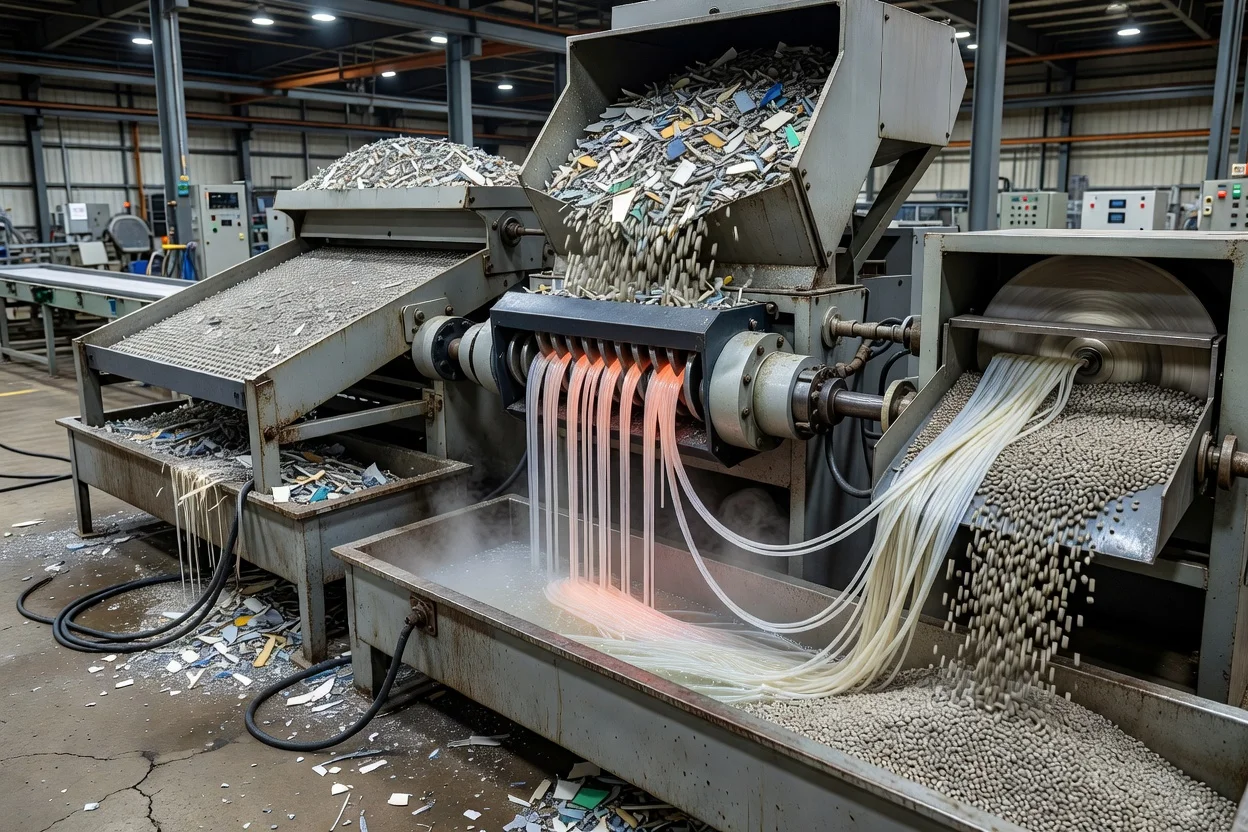
The main production route for rPVC is mechanical recycling. A typical process includes:
- Collection of PVC waste from construction, consumer, industrial, or post-production sources.
- Sorting to remove non-PVC plastics and contaminants.
- Size reduction through shredding or grinding.
- Separation steps such as magnetic separation, density separation, and removal of fines.
- Washing and drying, where needed.
- Extrusion and pelletizing into rPVC pellets or granules.
Common feedstocks include:
- Window profiles and off-cuts.
- Pipes and pipe scraps.
- Cable insulation and sheathing.
- Flooring, membranes, and coated fabrics.
- Used shoes and footwear components in specialized recycling streams.
More specialized purification technologies have been developed to recover higher-purity recyclate from mixed or heavily formulated waste, sometimes aiming to remove unwanted additives while preserving usable PVC fractions. These routes are especially important for expanding rPVC into more demanding markets where color, odor, and trace contaminant limits are strict.
Applications and End-Use Markets
rPVC is used across a wide range of markets, but the most successful applications are those that can tolerate some feedstock variability or that benefit from the intrinsic durability of PVC.
| End-use market | Typical rPVC form | Usual process or product type | Notes |
|---|---|---|---|
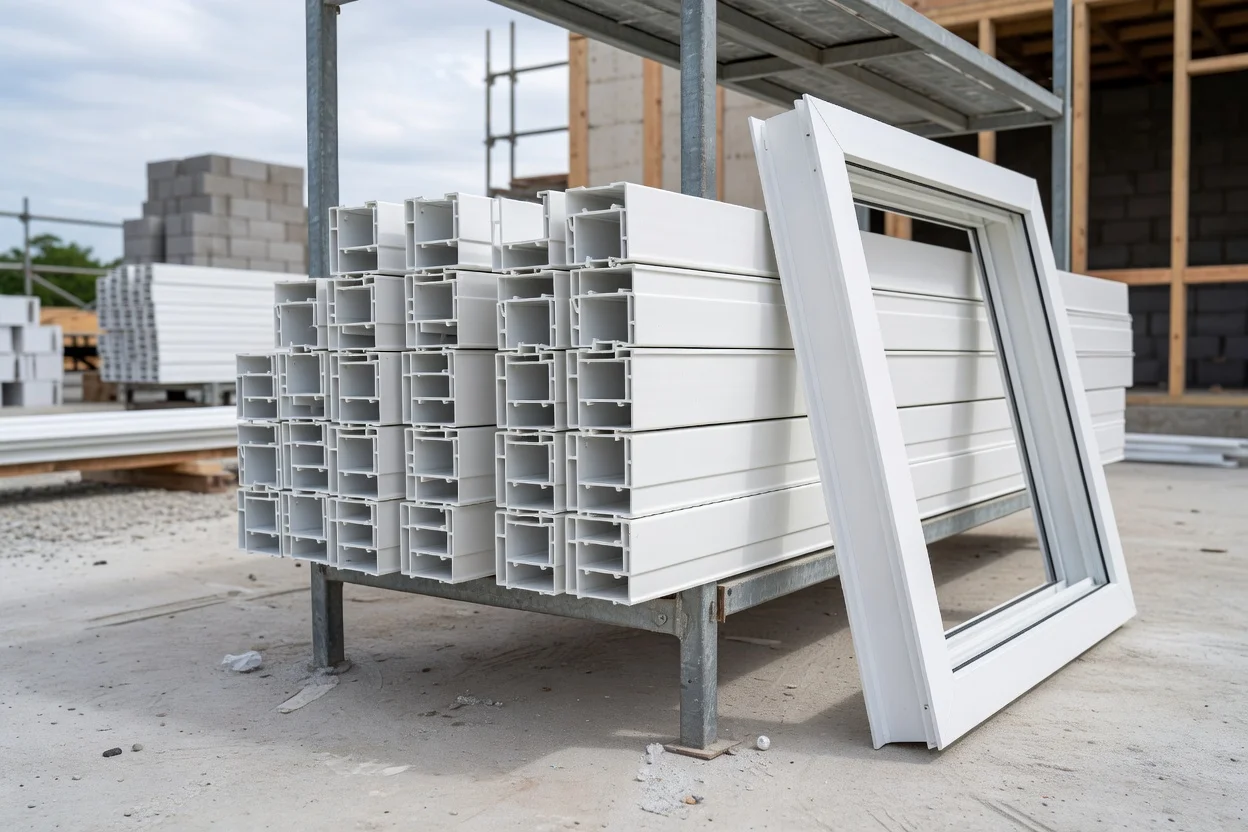
| Construction | Rigid rPVC | Extrusion, compounding, calendering | Window profiles, sheets, wall coverings, fencing, siding, gutters, and trim. |
| Pipes and drainage | Rigid rPVC | Pipe extrusion and fittings | Often used in non-pressure or selected pressure applications depending on quality and standards. |
| Flooring | Rigid or flexible rPVC blends | Sheet and tile production | One of the largest established outlet categories for recyclate in some markets. |
| Roofing and membranes | Flexible rPVC | Membrane compounding and calendering | Especially relevant for pre-consumer roofing scrap recycling. |
| Cables and electrical goods | Flexible rPVC | Cable insulation and sheathing | Requires careful control of contamination and additive history. |
| Footwear | Flexible rPVC or blends | Molding and sole production | A major outlet in some regions, especially for shoe soles. |
| Automotive | Flexible and semi-rigid rPVC | Interior trim, panels, and insulation | Typically requires tighter specifications and color consistency. |
| Packaging and cards | Rigid rPVC | Sheet conversion, lamination, card manufacture | Used in non-food packaging and payment cards. |
| Agricultural and industrial products | Mixed rPVC | Hoses, liners, cones, mats, and fencing | Often suitable when high cosmetic quality is not essential. |
One weaker-fit use is high-clarity, food-contact packaging, because color variability, odor, and legacy additive concerns make rPVC less suitable than other recycled polymers for premium transparent packaging applications.
Selected examples of rPVC product categories include shoe soles, flooring, pipes, window profiles, coated fabrics, membranes, and PVC sheets. In specialty segments such as payment cards, manufacturers have publicized substantial emissions reductions from switching to rPVC card bodies compared with virgin PVC, although results vary by feedstock and supply chain.
Environmental and Sustainability Aspects
The principal environmental advantage of rPVC is that it can replace virgin PVC and thereby reduce resource use and emissions associated with new polymer production. Industry data cited by VinylPlus indicate that recycled PVC in pipe systems can deliver 85–90% lower CO2 emissions per kilogram than virgin PVC in certain cases. Other assessments report substantial reductions in energy, air emissions, and water use when high recycled content is used in window profiles and similar products.
rPVC also supports waste diversion, keeping durable PVC products out of landfill or incineration and extending the useful life of material already in circulation. This is especially meaningful for building products, where service life is long and end-of-life recovery can generate relatively clean, high-volume streams.
At the same time, environmental performance depends on several caveats:
- Legacy additives, especially older stabilizers, can complicate recycling and raise handling concerns.
- Mixed flexible PVC streams are harder to recycle cleanly than rigid, single-origin streams.
- Mechanical recycling generally preserves value better than thermal destruction or downcycling, but only when sorting quality is high.
A useful formulation example from industry practice is 70% recycled PVC in window profiles, which VinylPlus reports can reduce energy use by up to 50%, air emissions by more than 60%, and water emissions by more than 60% compared with all-virgin PVC in that context. Another example is rPVC payment cards, where industry claims describe material and CO2 savings per card body versus virgin PVC versions.
Economic and Global Market Impact
The economic appeal of rPVC comes from the combination of cost avoidance, regulatory pressure, and brand value. For manufacturers, recycled feedstock can reduce dependence on virgin resin, improve recycled-content credentials, and support procurement targets in construction, finance, and consumer goods.
The most established markets remain Europe and selected national collection systems, where window profiles, flooring, and pipes are major recycling channels. In South Africa, for example, a review reported that footwear was the largest market for PVC recyclate, followed by building and construction, which illustrates how local collection infrastructure shapes end-use selection.
Leading industry actors and programs include:
- VinylPlus, which has played a central role in defining and tracking PVC circularity in Europe.
- Mechanical recyclers and compounders focused on rigid PVC from profiles, pipes, and siding.
- Specialty processors developing high-purity recyclate for flooring, automotive, and technical products.
Economic value is highly sensitive to feedstock purity. Clean, single-polymer streams can produce higher-value rPVC pellets, while contaminated mixed waste is more likely to be downgraded to lower-spec products or require costlier purification.
Current Challenges and Innovations
The main challenges facing rPVC are:
- Feedstock heterogeneity across rigid and flexible streams.
- Legacy additives, including older stabilizers and pigments that may limit safe or high-value reuse.
- Odor, color, and contamination control, especially for visible consumer products.
- Thermal degradation during reprocessing, which can narrow processing windows.
- Limited high-end outlets compared with virgin PVC and some other recycled polymers.
Innovation is focused on:
- Better collection and sorting systems for profile, pipe, and cable waste.
- Solvent-based and purification technologies for higher-purity recyclate.
- Design-for-recycling measures that simplify formulation and reduce incompatible additives.
- Expanded certification and chain-of-custody systems to verify recycled content.
A notable technical trend is the move from simple downcycling toward specification-grade rPVC, especially in building products and flooring where color, consistency, and compliance can be tightly controlled.
Future Outlook
The future of rPVC will depend on whether the industry can scale high-quality collection, additive management, and product design for circularity. Demand is likely to remain strongest in construction, infrastructure, flooring, and selected consumer goods because these sectors can absorb large volumes of recyclate and value durability over pristine appearance.
Longer term, the most promising opportunities include:
- More recycled content in pipes, profiles, membranes, and flooring.
- Greater use of certified high-purity rPVC in technical applications.
- Improved recyclability of new PVC formulations through better additive selection.
- Integration of mechanical recycling with complementary purification and feedstock-recovery routes for contaminated streams.
rPVC is unlikely to replace virgin PVC entirely, but it is increasingly important as a practical route to lower-carbon PVC systems and a more circular plastics value chain.
Summary
rPVC is a valuable recycled raw material with strong relevance in construction, flooring, pipes, cables, footwear, and other durable products. Its success rests on the inherent recyclability of PVC, the economic value of clean feedstocks, and growing demand for lower-carbon materials, while its limits are shaped by contamination, additive legacy issues, and processing sensitivity.
References
- •
rPVC. (n.d.). Yesileko. https://www.yesileko.com/en/recycled-raw-material/rpvcLink
- •
VinyLoop® R-PVC. (n.d.). Plasticker. https://plasticker.de/docs/news/VinyLoop_A4_ENG.pdfLink
- •
Recycled PVC – Properties, applications, and benefits. (n.d.). Ambiomaterials. https://www.ambiomaterials.com/en/materials/rpvcLink
- •
Polyvinyl chloride applications along with methods for managing its end-of-life items: A review. (n.d.). Sage Journals. https://journals.sagepub.com/doi/pdf/10.1177/14777606241308652Link
- •
Recycled Polyvinyl Chloride in the Real World: 5 Uses You’ll.... (2025, October 3). LinkedIn. https://www.linkedin.com/pulse/recycled-polyvinyl-chloride-real-world-5-uses-youll-lnhufLink
- •
https://doi.org/10.1590/0104-1428.20240064. (n.d.). SciELO. https://www.scielo.br/j/po/a/TV8BpTJqXBXKcv6dsBvJGdr/?format=pdf&lang=enLink
- •
PVC recycling technologies. (n.d.). Plastics.fi. https://plastics.fi/wp-content/uploads/2024/10/ok_brochure_pvc_14-03-2014.pdfLink
- •
A Brief Review of Poly(Vinyl Chloride) (PVC) Recycling. (2022, July 27). PMC. https://pmc.ncbi.nlm.nih.gov/articles/PMC9332854/Link
- •
Tide and Transcorp launch India’s-first Recycled PVC RuPay Card. (2023, May 23). Affairscloud. https://affairscloud.com/rpvc1-tide-and-transcorp-launch-indias-first-recycled-pvc-rupay-card/Link
- •
Recycled PVC in Pipes Delivers up to 90% CO₂ Savings. (2025, September 1). VinylPlus. https://www.vinylplus.eu/news/recycled-pvc-in-pipes-delivers-up-to-90-co2-savings/Link
- •
Polyvinyl chloride. (2001, October 24). Wikipedia. https://en.wikipedia.org/wiki/Polyvinyl_chlorideLink
- •
Polyvinyl chloride applications along with methods for managing its end-of-life items: A review. (2024, May 31). Sage Journals. https://journals.sagepub.com/doi/10.1177/14777606241308652?icid=int.sj-full-text.citing-articles.1Link
- •
PVC Windows and related Building Products using rPVC.... (n.d.). GKFP. https://www.gkfp.de/fileadmin/user_upload/Publikationen/Technische-Leitfaeden-Merkblaetter/EPPA_Design_for_recycling_202109_v12.pdfLink
- •
What Can Pvc Be Recycled Into? | From Trash to Treasure ♻️. (2023, November 26). Housevivid. https://housevivid.com/what-can-pvc-be-recycled-into/Link
- •
An Overview on Recycling of Waste Poly(Vinyl Chloride). (2023, September 18). RSC Publishing. https://pubs.rsc.org/en/content/articlelanding/2023/gc/d3gc02585cLink
- •
EcoProfile of recycled PVC pellets EU27+3, cradle-to-gate,.... (n.d.). OpenLCA Nexus. https://nexus.openlca.org/ws/files/38604Link
- •
How Recycled Polyvinyl Chloride Works — In One Simple Flow (2025). (2025, October 14). LinkedIn. https://www.linkedin.com/pulse/how-recycled-polyvinyl-chloride-works-one-simple-7dvkeLink
- •
HSBC UK | Recycled cards: a more sustainable way to pay. (2023, June 23). EACCNY. https://eaccny.com/news/member-news/hsbc-uk-recycled-cards-a-more-sustainable-way-to-pay/Link
- •
From recycled PVC and its blends to eco-friendly materials for the footwear industry in Brazil: Insight into the process and evaluation of the mechanical properties. (2025, November 19). Academia.edu. https://www.academia.edu/124844318/From_recycled_PVC_and_its_blends_to_eco_friendly_materials_for_the_footwear_industry_in_Brazil_Insight_into_the_process_and_evaluation_of_the_mechanical_propertiesLink
- •
Recycled Polyvinyl Chloride: Advanced Processing.... (n.d.). Eureka PatSnap. https://eureka.patsnap.com/materials/recycled-pvc-processingLink
- •
Recent advances in polyvinyl chloride (PVC) recycling. (n.d.). HAL. https://hal.science/hal-04267777v1/documentLink
- •
Waste Management. (n.d.). Re.Public Polimi. https://re.public.polimi.it/retrieve/66c82c8d-7c56-4b46-a090-417f12517e47/1-s2.0-S0956053X24005828-main.pdfLink
- •
100% Recycled PVC Payment Cards | PDF. (2026, April 15). Scribd. https://www.scribd.com/document/856869449/Brochure-G-D-Convego-RecycledLink
- •
Comparative study on the effect of different rubber waste as filler on recycled PVC. (2024, January 26). UTAR Eprints. http://eprints.utar.edu.my/6751/Link
- •
Process Data set: Vinyplan 6813ECO (en). (2021, November 27). OEKOBAU.DAT. https://www.oekobaudat.de/OEKOBAU.DAT/datasetdetail/process.xhtml?uuid=1247ef02-12ff-4641-863d-662164eb39f5&version=00.02.000Link
- •
Återvunnen PVC – Egenskaper, användningsområden och fördelar. (n.d.). Ambiomaterials. https://www.ambiomaterials.com/se/material/rpvcLink
- •
Circularity. (2026, May 22). VinylPlus. https://www.vinylplus.eu/commitment-in-action/circularity/Link
- •
R-PVC | High quality recicled Polyvinylchloride. (n.d.). Recycledpolymers.eu. https://recycledpolymers.eu/en/materials/r-pvcLink
- •
Pioneering a sustainable future: Embracing rPVC and paperboard cards. (2024, August 13). The Payments Association. https://thepaymentsassociation.org/article/pioneering-a-sustainable-future-embracing-rpvc-and-paperboard-cards/Link
- •
Recycled PVC Pellets for Profiles, Pipes & Flooring | Damao Tech. (n.d.). Damao Tech. https://www.damao-tech.com/materials/recycled-pvc-pelletsLink
- •
More than 30 Years of PVC Recycling in Europe—A Critical Inventory. (2024, May 4). MDPI. https://www.mdpi.com/2071-1050/16/9/3854Link
- •
Final report. (n.d.). Regulations.gov. https://downloads.regulations.gov/EPA-HQ-OLEM-2022-0971-0057/content.pdfLink
- •
PVC reutilizable, características y ventajas. (2024, June 24). Ecoembes. https://reducereutilizarecicla.org/pvc-reutilizable/Link
- •
Sustainable and Recyclable. (2022, January 25). VinylPlus. https://www.vinylplus.eu/circular-economy/pvc-a-recyclable-material/sustainable-recyclable/Link
- •
Polyvinyl Chloride. (2007, October 14). ScienceDirect. https://www.sciencedirect.com/topics/materials-science/polyvinyl-chlorideLink
- •
RPVC. (n.d.). Pycycling. https://www.pycycling.com/product-list/rpvcLink
- •
8 Reasons PVC is a Sustainable Choice. (n.d.). The Vinyl Institute. https://www.vinylinfo.org/wp-content/uploads/2021/08/8-Reasons-PVC-is-a-Sustainable-Choice.pdfLink
- •
The role of polyvinyl chloride in achieving circularity.... (n.d.). ScienceDirect. https://www.sciencedirect.com/science/article/pii/S0195925525003002Link
- •
Recycling PVC: A step towards sustainability. (2023, October 5). AIMPLAS. https://www.aimplas.net/blog/recycling-pvc-a-step-towords-sustainability/Link
- •
1. PVC Roof Membranes: A Resilient, Sustainable Solution. (n.d.). SPRI. https://www.spri.org/wp-content/uploads/2024/05/04-30-2024_clean-copy-edited-PVC-white-paper.pdfLink
- •
THE ROLE OF PVC RESINS IN SUSTAINABLE DESIGN. (n.d.). The Vinyl Institute. https://www.vinylinfo.org/wp-content/uploads/2019/01/Role-of-PVC-Resins-in-Sustainable-Design-SPE-ANTEC-2013-05-02-13.pdfLink
- •
Sustainability. (2026, January 12). ECVM. https://pvc.org/sustainability/Link
- •
PVC PIPE HAS THE LOWEST IMPACT ON THE.... (n.d.). Westlake Pipe. https://www.westlakepipe.com/sites/default/files/2026-03/pi-tb-042-us-en-0326.1_environmental-impact.pdfLink
- •
THE ENERGY AND ENVIRONMENTAL BENEFITS of PVC. (n.d.). Duradek. https://duradek.com/Downloads/PDF/EnergyBenefitsPVC.pdfLink
- •
The Growth of PVC Recycling in U.S. Plastics. (2024, February 6). Slide Products. https://www.slideproducts.com/news/the-growth-of-pvc-recycling-in-u.s.-plasticsLink
- •
Environmental Impacts of Polyvinyl Chloride Building.... (2002, March 26). Habitable Future. https://habitablefuture.org/resources/environmental-impacts-of-polyvinyl-chloride-building-materials/Link
- •
PVC Pipe: Best Choice for the Environment. (n.d.). Uni-Bell. https://www.uni-bell.org/About-Us/The-EnvironmentLink
- •
Is PVC Recyclable? (2025, February 6). Stabilit America. https://www.stabilitamerica.com/blog/is-pvc-recyclable/Link
- •
Risks Associated with the Presence of Polyvinyl Chloride in.... (2023, December 28). PMC. https://pmc.ncbi.nlm.nih.gov/articles/PMC10779931/Link
- •
PVC – handling restrictions & environmental risks. (n.d.). Nordic Swan Ecolabel. https://www.nordic-swan-ecolabel.org/nordic-ecolabelling/environmental-aspects/circular-economy-and-resource-efficiency/pvc/Link
- •
PVC Pipes : Top Environmental Benefits. (n.d.). Goldstab. https://www.goldstab.com/articles/pvc-pipes-environmental-benefits-you-did-not-knowLink
- •
Is Recycled PVC real or greenwashed propaganda? (2025, February 24). Reddit. https://www.reddit.com/r/sustainability/comments/1ix7jas/is_recycled_pvc_real_or_greenwashed_propaganda/Link