
Introduction
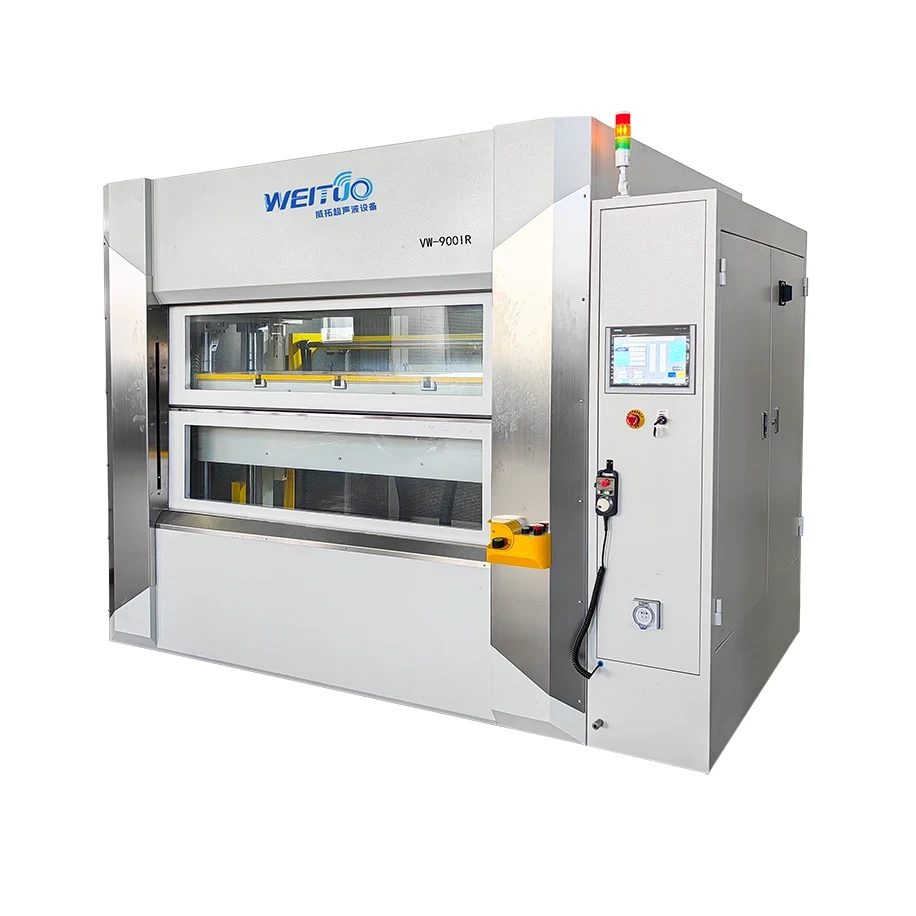
Friction welding machines are specialized joining systems that create strong, solid-state bonds by generating heat through mechanical friction and then applying forging pressure to consolidate the joint. Unlike fusion welding, the process normally does not melt the base material, which helps reduce distortion, filler-metal dependence, shielding-gas requirements, and many metallurgical defects associated with melting and solidification.
In plastics processing and industrial manufacturing, the term is used most often for metal joining equipment, but the same machine family also includes friction stir welding systems, which are widely used in lightweight structures and advanced fabrication. The main machine classes are rotary friction welders, linear friction welders, orbital friction welders, and friction stir welding machines, each optimized for different part geometries, load paths, and production objectives.
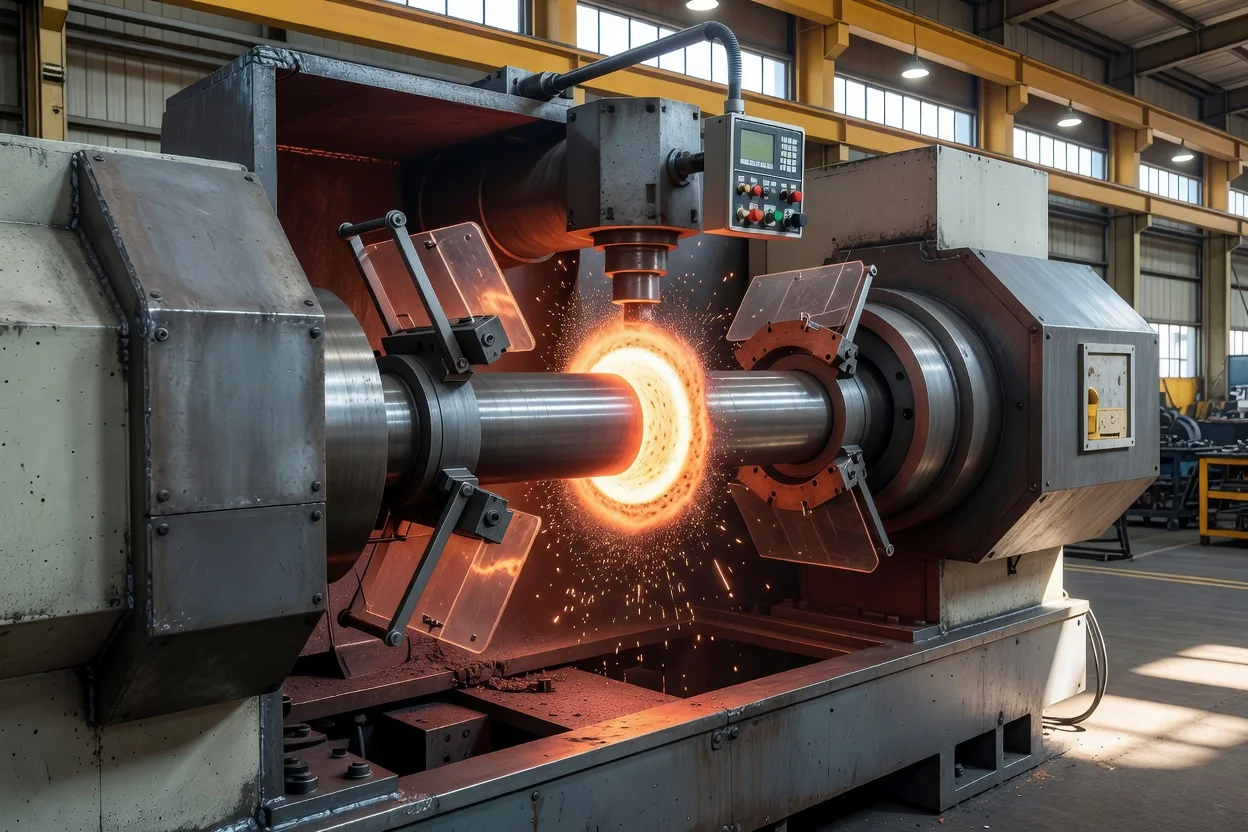
The technology evolved from early rotary systems used for round parts into CNC-controlled, highly repeatable production equipment with servo drives, programmable force profiles, and in-process monitoring. Modern systems are valued for joining dissimilar materials, supporting automated production, and producing repeatable welds with forged-quality integrity, while continuing to face challenges related to tooling, capital cost, process validation, and part geometry limitations.
History and development
Friction welding is generally traced to rotary friction welding, which was developed in the early 1950s and became established as a high-throughput process for circular parts.
A second milestone came in the late 1960s, when linear friction welding was conceptualized to address non-circular butt joints, especially in demanding aerospace assemblies such as blisks and compressor components.
A third major advance was the invention of friction stir welding in 1991 by Wayne Thomas at The Welding Institute in Cambridge, which extended solid-state joining to sheet and plate structures that are difficult to weld conventionally, particularly aluminum alloys.
Over time, machine builders moved from mechanically simpler, often manually set systems to CNC- and servo-controlled platforms with programmable rotation speed, axial force, upset length, braking behavior, and dwell timing. This shift improved process repeatability, enabled tighter dimensional control, and expanded friction welding from a niche technique into a mainstream industrial joining method.
Technical overview
Friction welding machines work by bringing two workpieces into contact under high axial force while one part moves relative to the other. The relative motion can be rotary, linear, or orbital, and the generated friction raises the interface to a plasticized state; the motion is then stopped or altered and the assembly is forged under pressure.
A typical rotary cycle includes four stages: friction, braking, forge, and cooling under load. During the friction stage, low-to-moderate axial pressure generates heat and surface plasticity while contaminants are expelled as flash; during the forge stage, force is increased to consolidate the bond and reduce the joint to its final length.
Key engineering variables include:
- Rotational speed for rotary systems, commonly in the range of about 1,500 to 3,000 rpm in many production descriptions, though machine and material combinations vary widely.
- Linear reciprocation frequency for linear friction welding, commonly around 25 to 125 Hz with small amplitudes in the millimeter range.
- Axial force / forge force, which may range from tens of megapascals in process descriptions to very large machine-level forces on heavy systems.
- Upset length and forge collapse, which serve as important process-quality indicators because they reflect how much plasticized material was displaced during bonding.
- Peak interface temperature, which remains below melting; in general descriptions, friction welding operates at roughly 0.6 to 0.9 of the absolute melting temperature of the base material.
Solid-state joining is a defining feature. Because the material does not fully melt, friction welding can produce joints with low porosity, minimal solidification cracking, and reduced heat-affected-zone problems compared with fusion welding.
Main machine types
| Type | Relative motion | Typical parts | Principal strengths | Main limitations |
|---|---|---|---|---|
| Rotary friction welding | One part rotates against a stationary part | Shafts, rods, tube-to-tube, end fittings | High productivity, strong round-section joints, well-suited to automation | Best for rotationally symmetric geometries |
| Inertia friction welding | Stored rotational energy in a flywheel | High-volume round parts | Stable energy delivery and robust repeatability | Less flexible than direct-drive in parameter shaping |
| Direct-drive friction welding | Motor-driven rotation with controlled braking | Precision components, mixed materials | Fine control of speed, force, and upset profile | Higher control-system complexity |
| Linear friction welding | Rapid reciprocating motion | Blisks, aero structures, non-round parts | Excellent for complex cross-sections and aerospace-grade joints | High machine stiffness and large force demands |
| Orbital friction welding | Controlled orbital movement | Selected noncircular joints | Useful where relative motion must be distributed across the interface | More specialized, less common than rotary systems |
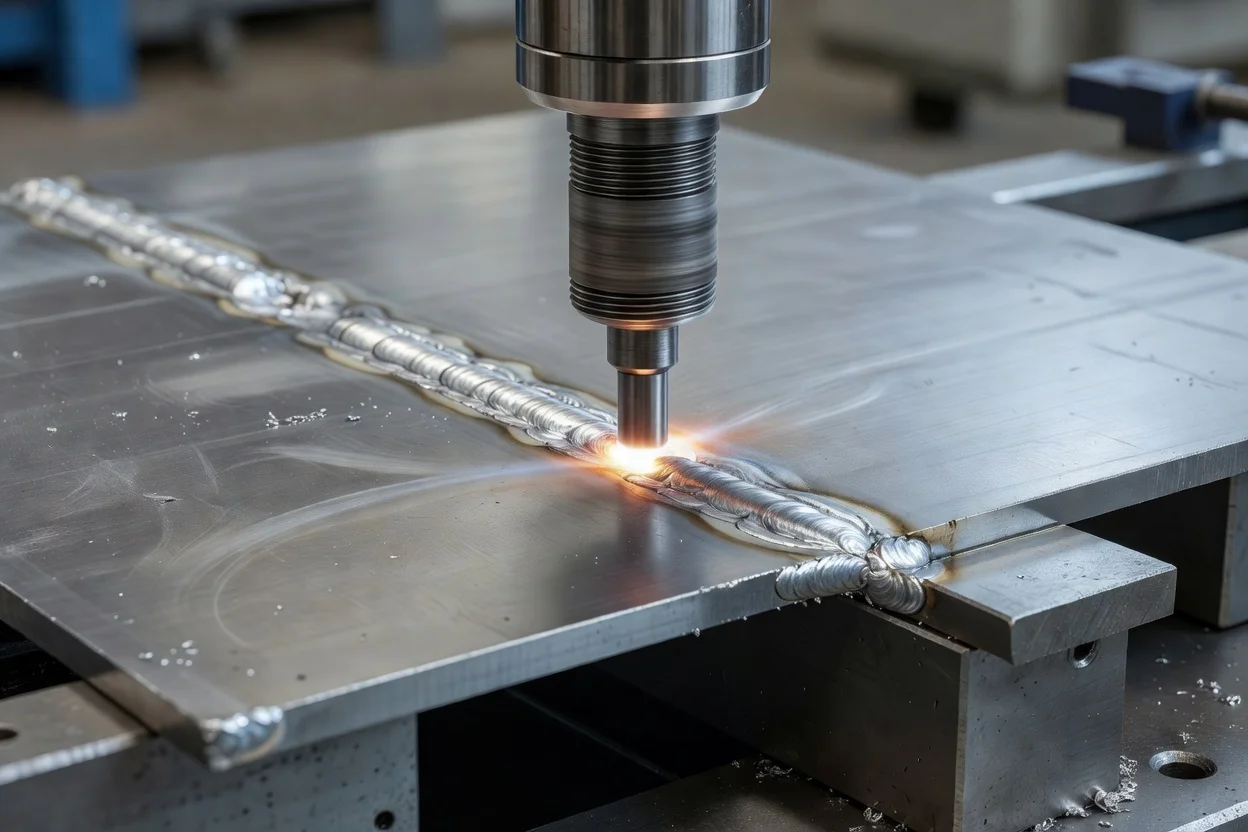
| Friction stir welding | Rotating tool traverses the seam | Sheets, plates, extrusions | Excellent for aluminum structures, low distortion | Requires backing support and is not a direct replacement for all butt or round joints |
Key specifications and performance ranges
Manufacturers describe a wide range of machine sizes, from compact units to large systems with very high forge capacities. KUKA, for example, offers rotary friction welding systems with forge forces up to 1,500 kN for medium to large components, and Thompson-branded machines are offered with forge capacities up to 400 t.
Typical process values reported in technical references include:
- Rotary surface speed: roughly 1–3 m/s
- Linear reciprocation frequency: roughly 25–125 Hz
- Linear stroke amplitude: roughly 1–3 mm
- Cycle time: often 1–30 s depending on material and component size
- Temperatures: typically below melting, often described as a plasticized solid-state window rather than a molten pool
The quality signature of a successful weld is often the controlled formation of flash and upset length. Production systems use these measurable outputs as indirect confirmation that sufficient heat input and forge pressure were achieved.
Applications and uses
Friction welding machines are used where strong, reliable joints are needed and where conventional fusion welding may be slow, distortion-prone, or metallurgically less suitable.
Major application areas include:
- Automotive and transportation: driveshafts, axle components, valve parts, transmission shafts, and other rotationally symmetric assemblies.
- Aerospace: blisks, compressor spools, fan components, and high-integrity noncircular structures joined by linear friction welding.
- Oil and gas / energy: drill-string and tube assemblies, downhole components, and selected dissimilar-metal joints.
- Industrial machinery: shafts, tool shanks, couplings, and wear-resistant end fittings.
- Defense and heavy equipment: mission-critical components requiring repeatable weld quality and low defect rates.
A poor-fit use is thin ornamental sheet work or highly decorative fabrication, where the equipment cost, clamping requirements, and flash management are usually disproportionate to the application.
Material compatibility
Friction welding is especially effective for same-metal and selected dissimilar-metal joints. Industrial sources describe successful joining of steels, aluminum alloys, cast metals, nickel alloys, magnesium, and some exotic materials that are difficult to join by conventional welding.
Its ability to join dissimilar combinations is one of the process’s major advantages, but metallurgy remains important. Differences in thermal conductivity, flow stress, oxidation behavior, and intermetallic formation can strongly influence weldability, process window width, and post-weld performance.
Automation and process control
Modern friction welding machines increasingly integrate:
- Servo-controlled force and displacement
- Closed-loop speed regulation
- Programmable weld recipes
- Length-loss or upset monitoring
- Data logging for traceability
- Robot loading and inline inspection
These features support high-volume production and help maintain consistency across shifts and facilities. The process is especially automation-friendly because cycle times are short and the weld state can be inferred from force, speed, energy, and upset data rather than from operator observation alone.
Advantages
- Solid-state bonding without full melting, filler metal, or shielding gas in typical rotary and linear variants.
- Short cycle times suited to mass production.
- High repeatability with CNC-controlled force and motion profiles.
- Strong joints with forged-quality characteristics and low defect incidence when properly set up.
- Good dissimilar-metal capability in suitable combinations.
- Reduced distortion compared with many fusion welding processes because heat input is localized and limited.
Limitations
- Geometry constraints, especially for rotary systems, which favor axisymmetric parts.
- High machine stiffness and force requirements, particularly for linear and large-diameter applications.
- Flash generation, which may require trimming or secondary machining.
- Tooling and fixturing complexity, especially for precision or nonstandard parts.
- Capital cost, which can be high relative to conventional welding equipment, particularly for large automated systems.
Environmental and sustainability aspects
Friction welding can support sustainability goals by reducing consumables such as filler wire, flux, and shielding gas in many applications. Because the process is solid-state and localized, it can also reduce rework, scrap, and distortion-related energy losses compared with less controlled joining routes.
The process is not automatically low-impact, however. Large machines can be energy-intensive, and flash trimming creates material that must be recovered or recycled efficiently. Sustainability performance therefore depends on machine efficiency, part yield, fixture design, and the extent to which the joining line supports lightweighting or part consolidation.
Economic and market impact
Friction welding has had sustained industrial importance because it enables high-volume, high-integrity joining where downtime, scrap, and field failure are costly. Machine builders such as MTI Welding, KUKA/Thompson, TWI-associated technology providers, and other specialized manufacturers serve sectors that value weld quality, traceability, and process repeatability.
Market demand is shaped by several trends:
- Greater use of lightweight alloys in transportation and aerospace
- Increased interest in dissimilar-material joining
- Expansion of automation and digital quality control
- Pressure to reduce scrap, rework, and energy intensity
These forces have kept friction welding relevant even though it remains a specialized capital-equipment category rather than a universal joining method.
Current challenges and innovations
Current engineering challenges include:
- Process qualification for critical joints, especially in aerospace and defense
- Tool and fixture wear in high-force or high-temperature variants
- Joining dissimilar alloys without forming brittle intermetallic layers
- Integrating process monitoring with factory data systems
- Managing flash and dimensional control without slowing production
Innovation is concentrated in servo-driven control, adaptive force profiling, real-time monitoring, multi-axis friction stir systems, and improved machine rigidity for large components. Some suppliers also emphasize modular platforms that can be configured for different part sizes and production layouts, reflecting the need for flexibility in modern manufacturing.
Future outlook
Friction welding machines are likely to grow in importance where manufacturers need lightweight assemblies, high joint reliability, and automation-ready processes. Continued development is expected in hybrid drive systems, predictive maintenance, digital traceability, and specialized machines for complex alloys and nontraditional geometries.
The strongest future prospects are in aerospace, electric mobility, energy systems, and precision industrial components, where part integration and metallurgical integrity can create a clear value case. Friction stir welding will likely continue expanding in aluminum-intensive structures, while rotary and linear friction welding will remain central for robust production joining of round and complex-section metal parts.
Summary
Friction welding machines are solid-state joining systems that use controlled friction, pressure, and forge collapse to create forged-quality joints. Their main strengths are speed, repeatability, low distortion, and compatibility with automation, while their principal constraints are geometry limits, high capital cost, and the need for precise process control.
References
- •
MTI Friction Welding Solutions & Manufacturing Services. (2026, July 14).Link
- •
Friction welding. (n.d.).Link
- •
Friction Welding — Process Guide. (2026, August 11).Link
- •
Friction_welding, EQUIPMENT and how it works. (n.d.).Link
- •
Insider's Guide to Friction Welding (FRW). (2021, July 25).Link
- •
The Friction Welding Process | Team AFW. (2019, January 22).Link
- •
ETA 100T. (2000).Link
- •
RSM 1 - RIEXINGER. (2022, May 12).Link
- •
Friction welding machines|Product information. (n.d.).Link
- •
Rotary friction welding machines. (2020, March 5).Link
- •
Manufacturing. (n.d.).Link
- •
Friction Welding - Working Principle, Equipment, Advantages .... (2021).Link
- •
Thompson friction welding machines (RFW). (2020, February 5).Link
- •
NCT FRICTION WELDING. (2001).Link
- •
KUKA Invictus | KUKA Global. (2022, January 6).Link
- •
Understanding Friction Welding Machines - JIH-I Machinery. (2025, April 22).Link
- •
[PDF] ROTATIONAL FRICTION WELDING. (n.d.).Link
- •
Innovative Operation For.... (2021, January 25).Link
- •
Friction Stir Welding (FSW) Machines - Bond Technologies. (2026, February 13).Link
- •
How Does Friction Welding Work. (2015, August 9).Link
- •
What is Friction Welding? - TWI. (n.d.).Link
- •
Friction Welding Machines: A Comprehensive Guide. (2024, April 30).Link
- •
Understanding Different Types Of Friction Welding | Artizono. (2024, June 28).Link
- •
Direct Drive Friction Welding Machines. (2025, November 20).Link
- •
FRICTION WELDING MACHINE - Coimbatore. (n.d.).Link
- •
Friction welding. (2005, January 30).Link
- •
Spin Friction Welding - Coldwater Machine Company. (2023, June 7).Link
- •
Friction Stir Welding Machines. (2026, April 14).Link
- •
Friction Welding - Process, Benefits, Report. | KUKA Global. (2017, July 11).Link
- •
Rotary Friction Welding Machines. (2024, April 10).Link
- •
Friction Welding - an overview. (n.d.).Link
- •
Rotary friction welding - Wikipedia. (2020, December 18).Link
- •
RV MACHINE TOOLS. (n.d.).Link
- •
Friction Welding Equipment. (2020, April 1).Link
- •
Types of Friction Welding | Rotary, Linear, Friction Stir, and .... (2025, March 20).Link
- •
American Friction Welding: Rotary Friction Welding .... (2013).Link
- •
Industrial Friction Welding Machines for Metal Fabricators. (2025, May 12).Link
- •
The Friction Welding Dictionary. (2021, March 2).Link
- •
Friction stir welding - Wikipedia. (2005, February 12).Link
- •
Friction weld machine. (2025, January 20).Link
- •
Advances in Friction Welding - SME.org. (2016, October 10).Link
- •
Friction Processes - Welding, Surfacing and Dissimilar .... (n.d.).Link
- •
Friction Welding: What is it?. (2022, August 26).Link