
Introduction
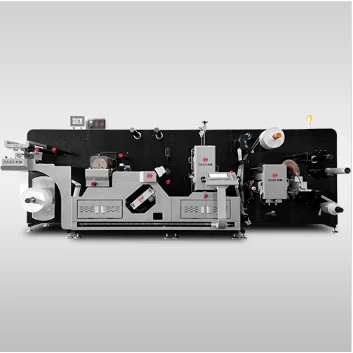
Post-processing machines are industrial systems used to finish parts after the primary manufacturing step, improving dimensional accuracy, surface quality, cleanliness, appearance, or functional performance. In the plastics industry, the term most often refers to equipment used after additive manufacturing, molding, extrusion, or machining, although it can also describe software that translates CAM output into machine-ready code for CNC equipment.
In additive manufacturing, post-processing machines have become a distinct class of automation technology because printed parts frequently require support removal, powder cleaning, resin washing, curing, deburring, or surface finishing before they are fit for end use. In CNC manufacturing, post-processing instead refers to the software layer that converts CAM toolpaths into controller-specific NC code or G-code, making the machine executable instructions compatible with a particular tool and kinematic configuration.
The segment has expanded as manufacturers seek higher throughput, more consistent quality, reduced labor intensity, and better repeatability in production environments where manual finishing is slow, variable, and difficult to scale. Recent systems increasingly combine hardware, software, and chemistry, and many are designed for integration with automation cells, closed-loop monitoring, and Industry 4.0 workflows.
History and development
The concept of post-processing in manufacturing predates modern plastics machinery, but its industrial importance grew sharply with the rise of CNC, injection molding automation, and additive manufacturing. Early CNC post processors were primarily translators between generic toolpath data and machine-specific code, while modern versions also handle kinematics, safety logic, offsets, and optimization routines.
Three milestones are especially important:
- The emergence of CAM-to-machine translation established the post processor as the bridge between machine-independent programming and machine-specific execution in CNC machining.
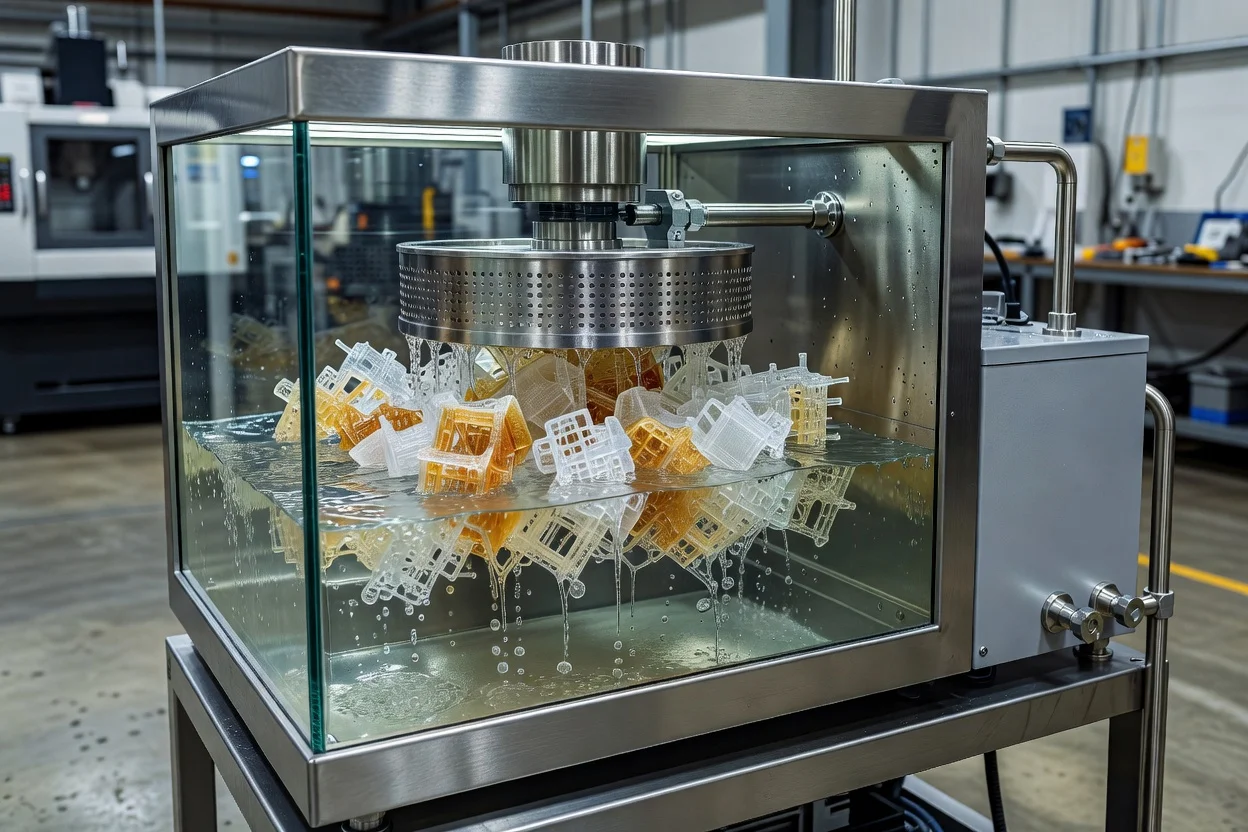
- The growth of additive manufacturing post-processing created demand for dedicated finishing equipment for support removal, washing, curing, and surface refinement of polymer parts.
- The introduction of automated post-processing platforms brought integrated systems that combine motion control, chemistry, and software to improve throughput and consistency at scale.
Technical overview
Post-processing machines are best understood as finishing systems positioned downstream of the primary process. In plastics manufacturing, they address two broad needs: preparing polymer parts for final use and adapting digital manufacturing instructions for machine execution.
Main functional categories
- Additive manufacturing finishing systems: remove supports, clean powder or resin, cure photopolymers, smooth surfaces, or apply surface treatments.
- Mechanical finishing systems: deburring, tumbling, polishing, blasting, or washing molded and machined plastic parts.
- CNC post-processors: software tools that convert CAM output into NC programs or G-code for a specific machine controller.
- Hybrid systems: integrated platforms that combine multiple finishing steps in one automated cell.
Typical performance parameters
Technical specifications vary by process, but common benchmarks include:
- Powder or resin support removal systems for additive parts may process batch or chamber volumes sized for small components through medium production runs.
- Rotor or impeller-based cleaning and depowdering systems use controlled agitation, jets, media flow, or chemical action rather than high mechanical force when delicate polymer surfaces must be protected.
- Throughput can range from small-batch laboratory systems to industrial platforms intended for continuous production, with vendor systems explicitly marketed for higher throughput and scaled part quality.
- Residual moisture after centrifugal or aqueous dewatering in plastic-part cleaning lines is typically driven as low as practical before thermal drying or curing; the exact value depends on part geometry, resin, and subsequent process requirements. Because the supplied sources do not give a universal moisture figure, only process-specific validation is reliable here.
- Specific energy consumption is strongly machine-dependent. Automated finishing can reduce labor per part, but energy use may rise if thermal drying, compressed air, or aggressive washing is required.
CNC post-processing mechanics
In CNC contexts, the post processor:
- converts generic CAM data into controller-specific instructions.
- accounts for machine kinematics on 3-axis, 4-axis, and 5-axis machines.
- handles tool length compensation, feed and speed translation, safe tool-change positions, and collision-avoidance logic.
- outputs NC files, usually G-code, that can be executed without manual editing.
Types and variations
| Type | Primary function | Typical plastics relevance | Key technical note |
|---|---|---|---|
| Additive support-removal machine | Removes sacrificial supports from printed parts | SLA, DLP, PolyJet, FDM | Optimized to preserve detail and minimize breakage |
| Resin cleaning and wash system | Removes uncured photopolymer from printed parts | SLA, DLP | Often paired with post-cure units |
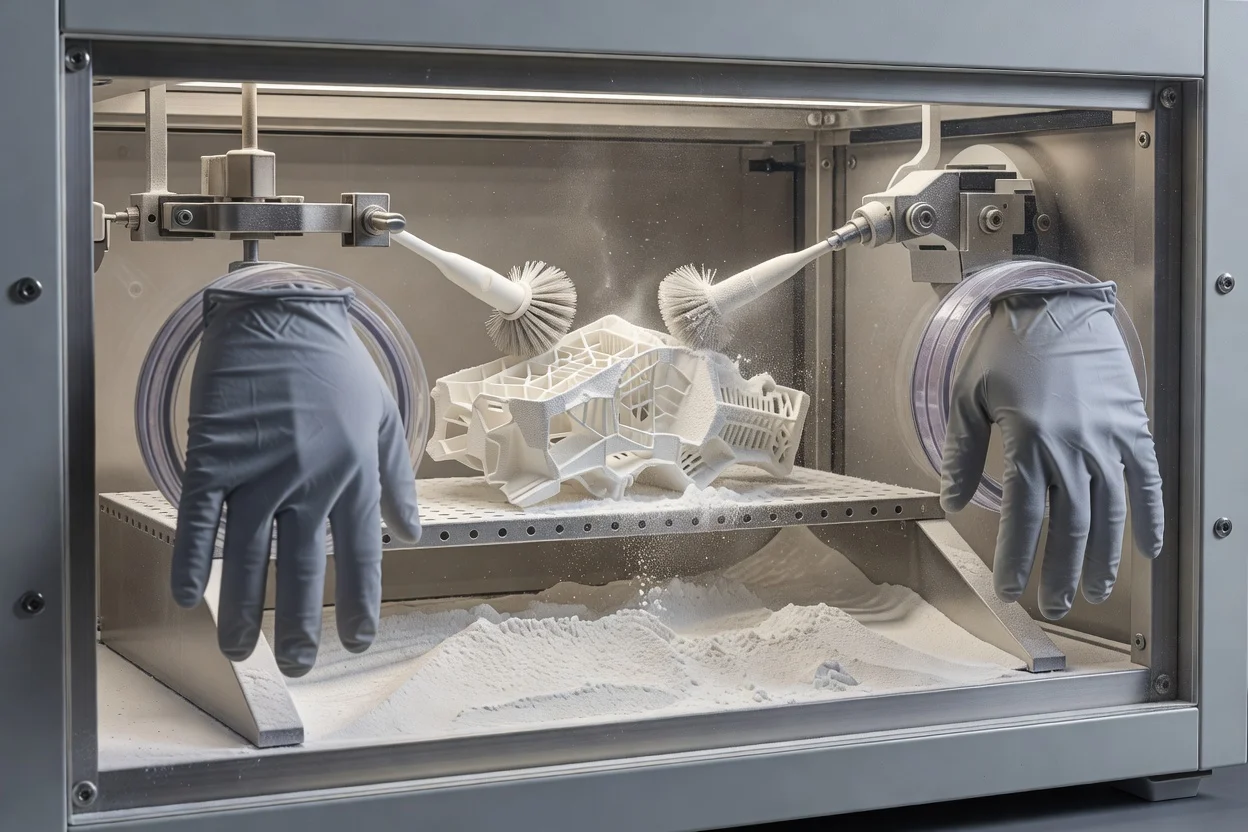
| Depowdering system | Cleans loose powder from sintered parts | SLS and related powder-bed processes | Designed to protect thin walls and internal channels |
| Surface-finishing machine | Smooths, polishes, or conditions part surfaces | Printed, molded, or machined plastics | Can be mechanical, chemical, or hybrid |
| CNC post processor | Converts CAM toolpaths into machine code | Plastic machining, moldmaking, tooling | Software rather than hardware |
Applications and uses
Post-processing machines are used across plastics processing wherever the part leaving the primary process is not yet final.
- Aerospace: additive post-processing improves surface finish, dimensional reliability, and part readiness for precision applications.
- Medical and dental: cleaning, curing, and finishing support biocompatibility, repeatability, and appearance requirements.
- Automotive: tooling components, prototypes, fixtures, and low-volume end-use parts benefit from faster, more consistent finishing.
- Consumer products: visible surfaces often require smoothing, coloring, or coating to meet aesthetic standards.
- Industrial manufacturing: support removal, washing, and deburring improve assembly fit and reduce downstream rework.
A poor-fit use is highly fragile micro-feature parts with internal channels that trap media or washing chemistry, because aggressive post-processing can damage geometry or leave residues unless the system is specifically validated for that design.
Automation and digital integration
Automation is one of the defining trends in this segment. Post-processing platforms increasingly combine:
- machine vision for part detection and inspection,
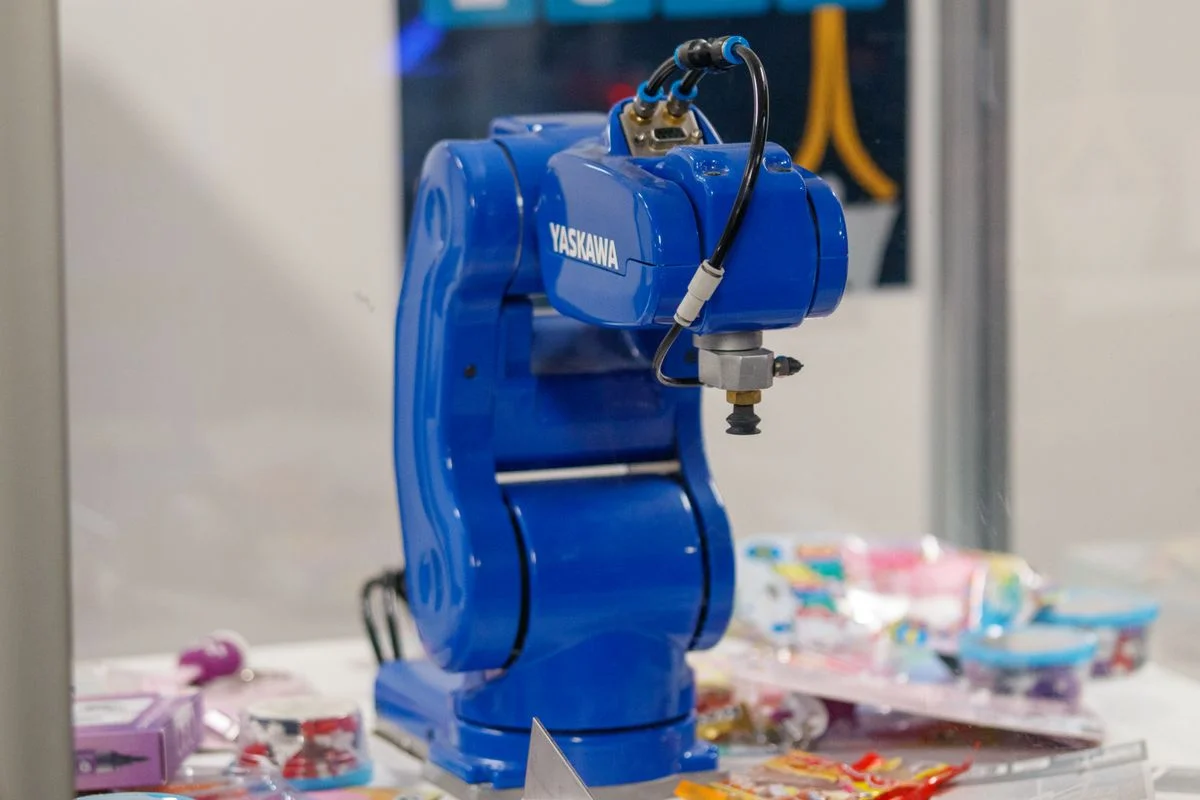
- robotics for loading and unloading,
- chemistry control for consistent cleaning or surface treatment,
- software orchestration for recipe-based repeatability, and
- data logging for traceability and process validation.
For CNC workflows, integration occurs through post-processor libraries, machine-specific configuration files, and controller-aware output generation that reduces manual code editing and setup error.
Environmental and sustainability aspects
Post-processing machines can improve sustainability when they reduce scrap, rework, and manual handling, but environmental performance depends heavily on process design.
Positive sustainability contributions include:
- Waste reduction through better first-pass quality and fewer rejected parts.
- Material recovery in powder-based additive systems, where unused polymer powder can sometimes be recirculated after sieving and qualification.
- Labor efficiency, which can lower the footprint per finished part when production is scaled appropriately.
Trade-offs include:
- solvent use in resin or surface-cleaning workflows,
- water and detergent consumption in wash systems,
- energy demand from drying, curing, and thermal finishing,
- media disposal in abrasive or tumbling processes.
Economic and market impact
The economic value of post-processing machines lies in their effect on total manufacturing cost rather than just equipment price. Automated finishing can reduce labor hours, improve throughput, and make additive manufacturing viable for production rather than only prototyping.
Market demand is strongest where part volumes are high enough that manual finishing becomes a bottleneck, but part variability is still large enough that full-line automation must remain flexible. This has encouraged suppliers to design modular platforms that can serve multiple applications such as PolyJet support removal, wax cleaning, resin washing, and FDM finishing.
Current challenges and innovations
Several technical challenges continue to shape the field:
- Part variability: different resins, polymers, support structures, and geometries require different process recipes.
- Surface sensitivity: aggressive media or chemistry can damage fine features and optical surfaces.
- Validation burden: regulated industries require repeatable, documented, and auditable finishing processes.
- Machine compatibility: in CNC, incorrect post-processor configuration can cause collisions, poor surface finish, or scrap.
Current innovations focus on:
- smarter recipe control,
- closed-loop process monitoring,
- integrated wash/cure/finish cells,
- more accurate machine-specific CAM posting,
- and broader use of standardized automation interfaces.
Future outlook
Post-processing machines are likely to become more integrated, more data-driven, and more application-specific. In additive manufacturing, the strongest growth potential lies in automated systems that can remove supports, clean parts, and finish surfaces with less operator intervention and more predictable quality.
In CNC and hybrid manufacturing, post-processing software will continue to grow in importance as machines become more complex, especially in multi-axis environments where accurate kinematic translation is essential. Across plastics processing, the long-term direction is toward end-to-end manufacturing cells in which finishing is treated not as a separate afterthought but as a controlled, measurable part of production quality.
References
- •
PostProcess Technologies. (2026, September 2).Link
- •
Understanding Post Processors - Modern Machine Shop. (2026, May 4).Link
- •
PREVO 700™ | Automated SLS Depowdering Solution. (2026, July 27).Link
- •
3D Printing Post-Processing Automation. (2025, April 29).Link
- •
Videos - PostProcess Technologies. (2026, August 4).Link
- •
3D Print Post Processing - Ultimate Guide - 16 Ways. (2018, August 6).Link
- •
Post processor - Wikipedia. (2015, October 12).Link
- •
PostProcess Technologies - TriMech Advanced Manufacturing. (2025, August 13).Link
- •
Postprocessing - an overview | ScienceDirect Topics. (n.d.).Link
- •
CNC Post-Processor: What It Does and When to Update It. (2026, July 21).Link
- •
The Unseen Hero of CNC Machining: CNC Post Processors | Innovative Machining. (2024, September 10).Link
- •
PC-based control increases throughput in additive manufacturing. (n.d.).Link
- •
Post-Processor: Definition, How it Works, and Uses | Xometry. (2023, December 7).Link
- •
Archives: Products - PostProcess Technologies. (n.d.).Link
- •
News. (2026, March 31).Link
- •
Briefly about NX CAM postprocessors. How and what they are .... (2025, September 23).Link
- •
7 Post Processor Manufacturers in 2026. (2023, March 2).Link
- •
Choosing the Correct Post-Processing Technology. (2024, June 13).Link
- •
What Is a CNC Post Processor and Why Do I Need One? - Tormach. (n.d.).Link
- •
Introduction to Post-Processing of Different Processes - First Mold. (2026, March 4).Link
- •
Post processing. (n.d.).Link
- •
PostProcess Technologies Releases the Hybrid Series Automated .... (2016, May 19).Link
- •
Fusion Help | Post processing. (2026, January 4).Link
- •
Guide to post-processing 3D printed parts. (2021, September 8).Link
- •
Post Processing. (2025, July 3).Link
- •
Post Processing for CAD/CAM Software: Your Complete .... (2022, March 10).Link
- •
Introduction to Post Processors in Fusion [Update 2025]. (2025, September 4).Link
- •
Additive Manufacturing Post Processing. (2025, November 5).Link
- •
Post Processor in CNC: CAM to Machine-Ready G-Code. (2026, April 27).Link
- •
What is a Post Processor?. (2021, May 21).Link
- •
What is Post-Processing? Understanding Its Importance .... (2021, January 1).Link
- •
What Is a Post-Processor in CAM Software and How to .... (2026, April 1).Link
- •
Beyond The Print: Post-Processing Techniques In 3D .... (2025, January 7).Link
- •
Post-Production Finishing Processes Utilized in 3D Printing .... (n.d.).Link
- •
Post Processor in CNC machine. (2025, May 3).Link
- •
Post-processes & finishes | Protolabs Network. (n.d.).Link
- •
CNC Post Processor. (2026, March 12).Link
- •
Post-processing in 3D printing. (2019, April 26).Link
- •
Technology Processing after 3D printing. (2025, April 26).Link
- •
Post-Processing in 3D Printing. (n.d.).Link
- •
What is Post-Processing in Additive Manufacturing?. (2022, September 16).Link
- •
Understanding Food Processing Equipment: Key Types .... (2025, May 23).Link