
परिचय
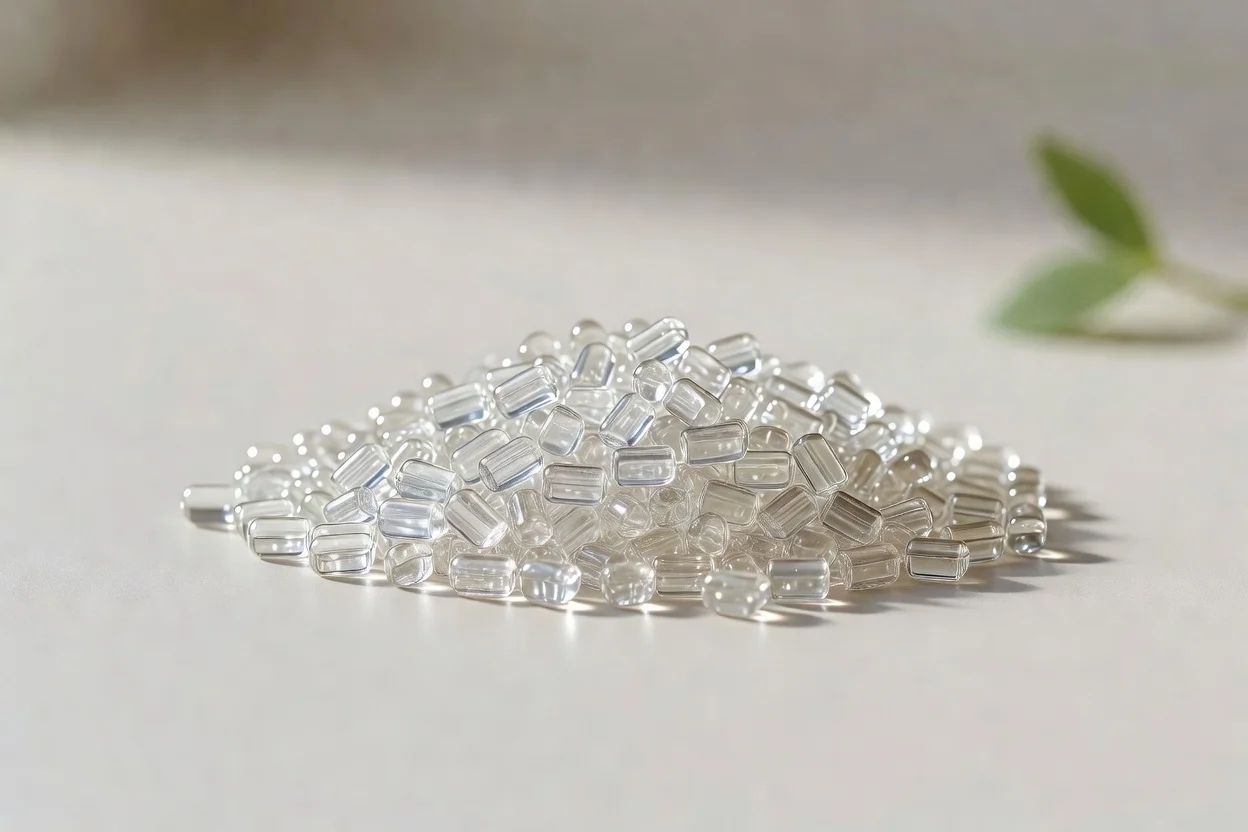
Bio-PET (biobased polyethylene terephthalate; 生物基聚对苯二甲酸乙二醇酯) is a drop-in, bio-based version of PET that is chemically and functionally very close to conventional petroleum-based PET. In commercially established grades, the bio-based fraction is usually concentrated in the monoethylene glycol (MEG) component, while the terephthalic acid (PTA) portion is still typically fossil-derived, so the material is often around 30% bio-based rather than fully bio-based.
Bio-PET matters in plastics because it combines the processing familiarity, transparency, strength, and recyclability of PET with a partial renewable-carbon input, making it especially important in bottles, transparent packaging, and textile applications. It is also central to current industry debates on how far “bio-based” can reduce carbon footprint without changing end-of-life behavior, because Bio-PET is not biodegradable and is designed to enter the same recycling streams as conventional PET.
History and Development
PET was introduced as a high-performance polyester with broad utility in packaging, fibers, and engineering uses because of its clarity, strength, and chemical resistance. Bio-PET emerged later as a response to fossil-resource dependence and the desire to lower greenhouse-gas intensity without disrupting established PET infrastructure.
The earliest commercial Bio-PET products were positioned as partial renewable-content materials, especially in beverage bottles, with sugarcane-derived ethanol or MEG serving as the main bio-based route. Since then, research and patent activity has increasingly focused on fully bio-based PET pathways, including bio-based PTA or renewable aromatic precursors, although commercial supply remains much more limited than for MEG-only Bio-PET.
Chemical Structure and Key Properties
Bio-PET is a polyester built from the same core repeating chemistry as conventional PET; the distinction lies in the origin of one or both monomer feedstocks rather than in the polymer backbone itself. As a result, Bio-PET typically preserves the same density, transparency, stiffness, thermal resistance, and bottle/fiber processability associated with PET.
Key properties
- Transparency: suitable for clear bottles and display packaging.
- Mechanical strength: high enough for blow-molded containers and textile fibers.
- Thermal performance: comparable to fossil PET in drop-in grades.
- Chemical resistance: useful for consumer packaging and many industrial applications.
- Recyclability: can be recycled with conventional PET in existing systems.
Practical limits and workarounds
- Poor oxygen and aroma barrier → PET, including Bio-PET, provides only moderate gas barrier performance for sensitive foods and beverages → workaround: use multilayer structures, barrier coatings, or copolymer/blend designs when shelf-life demands are higher.
- Low surface energy before treatment → untreated PET surfaces can have limited adhesion for inks, coatings, and metalization → workaround: corona, plasma, chemical priming, or coating pretreatments are commonly used in packaging lines.
- Not biodegradable → Bio-PET does not compost in the way some other bioplastics do → workaround: design for mechanical recycling, chemical recycling, and closed-loop collection rather than composting.
- Partial biobased content only → many commercial grades still rely on fossil PTA → workaround: move toward bio-based PTA, bio-aromatics, or fully bio-based PET routes, although these are still emerging.
Common composition patterns
| Variant | Bio-based portion | Typical status |
|---|---|---|
| MEG-only Bio-PET | about 20–30% | Most commercial products |
| Partial bio-PET with bio-PTA and bio-MEG | higher than conventional partial grades | Limited commercialization and development stage |
| Fully bio-based PET | near 100% | Mostly developmental or patent-led |
Production Processes and Raw Feedstocks
Commercial Bio-PET is usually made by replacing fossil-derived MEG with bio-MEG while keeping standard PET polyesterization chemistry and existing PET equipment largely unchanged. The bio-MEG is commonly produced from sugarcane ethanol through conversion to ethylene and then to MEG, although other bio-based routes are under development.
Typical feedstock chain
- Sugarcane, corn, or other biomass → fermentative or thermochemical conversion to ethanol or other intermediates.
- Bio-ethanol → dehydration to ethylene → oxidation/hydration route to MEG.
- PTA → usually still petroleum-derived in mainstream commercial Bio-PET.

Polymerization route
Bio-PET is produced through the same esterification or transesterification followed by polycondensation used for conventional PET. In industrial practice, the process may also include solid-state polycondensation to raise molecular weight for bottle-grade resin, and this processing similarity is one reason Bio-PET is considered a “drop-in” material.
Mechanistic note
- Typical bottle-grade additive system: antimony-, titanium-, or germanium-based catalysts, with phosphorus-containing stabilizers often used to control color and thermal stability in PET processing.
- Function: these catalyst/stabilizer systems help drive polycondensation and limit degradation or discoloration during melt processing.
Applications and End-Use Markets
Bio-PET is used wherever conventional PET is already established, with the strongest fit in applications that value clarity, toughness, and compatibility with existing recycling systems.
Major applications
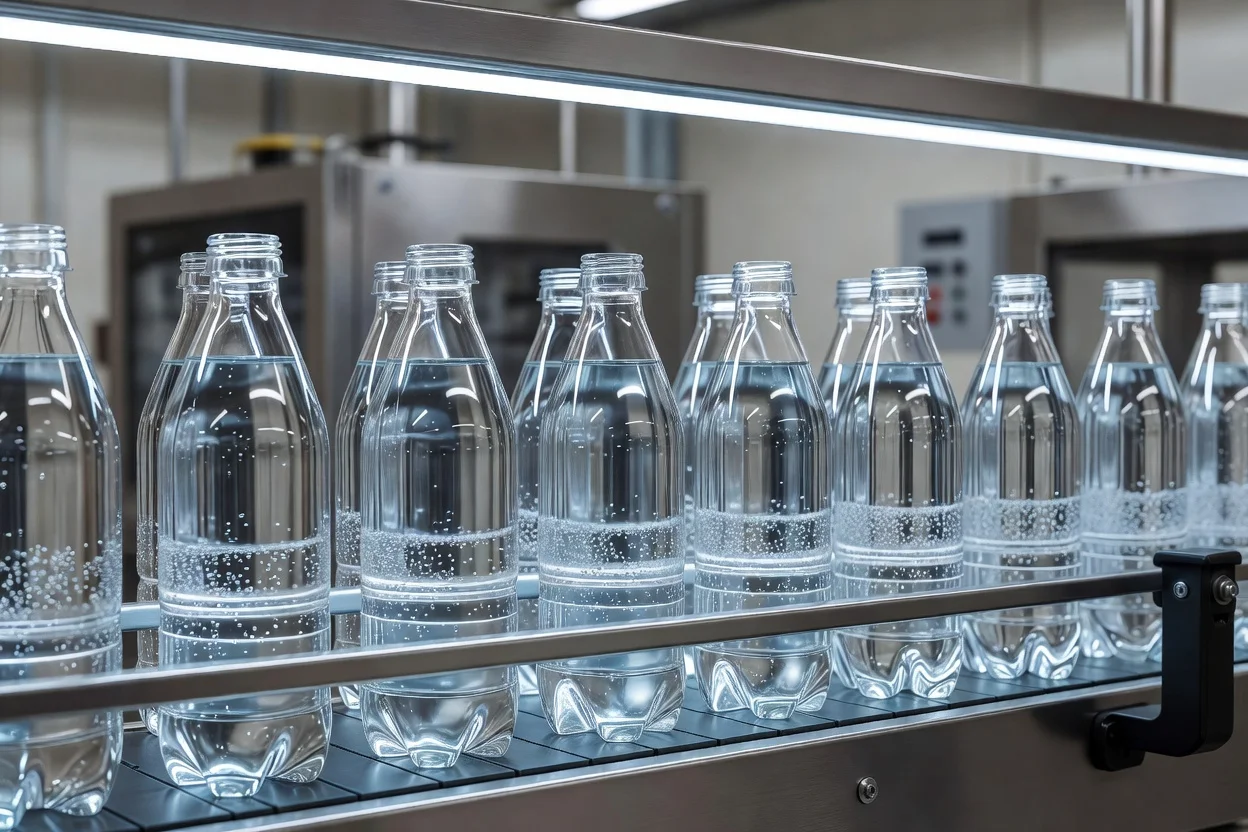
- Beverage bottles: the most visible Bio-PET market, especially for carbonated drinks, still water, and juice bottles.
- Transparent food and consumer packaging: trays, clamshells, cosmetic packs, and clear containers.
- Textiles and fibers: polyester staple fiber and filament applications remain a major PET outlet, and Bio-PET can serve as a lower-fossil alternative in the same spinning and drawing systems.
- Films: oriented packaging films where clarity and stiffness are important.
- Thermoformed items and injection-molded parts: reusable containers and technical packaging components.
- Specialty uses: labels, strapping, and certain engineering or consumer goods where PET chemistry is already standard.
Best-fit and poor-fit uses
| End use | Fit for Bio-PET | Reason |
|---|---|---|
| Beverage bottles | Excellent | High clarity, strength, existing recycling streams |
| Transparent packaging | Excellent | Same appearance and processing as PET |
| Textile polyester | Strong | Familiar fiber chemistry and spinning routes |
| Multilayer barrier packaging | Moderate | PET barrier is often insufficient alone |
| Compostable packaging | Poor | Bio-PET is not biodegradable |
A notable poor-fit use is true compostable packaging, because Bio-PET is often grouped with bioplastics by renewable origin, but it does not meet the functional role of compostable materials.
Environmental and Sustainability Aspects
Bio-PET is environmentally relevant primarily because it substitutes renewable carbon for a portion of fossil carbon, not because it changes the polymer’s degradability. Recent analyses indicate that bio-derived PET can reduce greenhouse-gas emissions and fossil-energy use versus virgin fossil PET, although the magnitude depends strongly on feedstock sourcing, allocation methods, plant efficiency, and end-of-life scenario.
Sustainability advantages
- Renewable carbon input: partially displaces fossil MEG with biomass-derived carbon.
- Drop-in recyclability: can enter conventional PET recycling streams, helping preserve infrastructure value.
- Potential carbon benefits: cradle-to-grave assessments show emissions reductions versus fossil PET in favorable scenarios.
Sustainability limitations
- Not biodegradable: does not solve litter or leakage by itself.
- Partial bio-content in mainstream grades: much of the mass may still be fossil-derived if PTA remains petroleum-based.
- Feedstock and land-use debates: biomass origin can raise questions about land competition, agricultural inputs, and traceability.
Recycling and circularity
Bio-PET is compatible with mechanical recycling of PET when collection, sorting, and contamination control are adequate. It is also part of broader circularity research that includes chemical recycling, depolymerization, and biological routes for recovering monomers such as TPA and MEG. In practice, the sustainability case for Bio-PET is strongest when it is paired with high collection rates and recycling-compatible product design.
Economic and Global Market Impact
Bio-PET occupies a comparatively small share of the PET market by volume, but it has outsized visibility because it is one of the earliest and most commercially recognizable bio-based plastics. Historical reports indicate that Bio-PET production peaked at more than 900,000 tonnes in 2016, reflecting strong packaging demand and the rapid growth of bio-based bottle initiatives at that time.
The leading commercial draw has been brand-owner demand for partially renewable packaging that does not require new filling lines, new bottle design rules, or separate end-of-life infrastructure. This has made Bio-PET strategically attractive to beverage, cosmetics, and consumer-packaging companies seeking lower fossil content while preserving the PET value chain.
Global production is still constrained by the more difficult economics of bio-based aromatics, especially bio-PTA, which remains much less mature than bio-MEG supply. As a result, the market is best understood as a transition product within the PET industry rather than a complete replacement for conventional PET.
Current Challenges and Innovations
The most important technical bottleneck remains the supply of fully bio-based aromatic monomers, because the PTA fraction is the largest mass share in PET and is harder to produce from biomass at scale. That bottleneck explains why commercial Bio-PET has often remained capped at about 30% bio-based content even after years of development.
Current challenges
- Bio-PTA scalability: renewable aromatic chemistry is more complex than sugar-to-MEG routes.
- Cost competitiveness: bio-based feedstocks and conversion pathways can be more expensive than fossil routes under many market conditions.
- Recycling contamination concerns: although Bio-PET is compatible with PET recycling, sorting systems must still handle labels, multilayer structures, and additives carefully.
- Sustainability credibility: claims can be undermined if renewable content is partial or if biomass sourcing is poorly documented.
Notable innovations
- Fully bio-based PET routes using bio-MEG and bio-PTA or bio-aromatic intermediates.
- Improved catalytic pathways for ethanol-to-ethylene and other biomass conversions.
- Chemical and enzymatic recycling that recover PET monomers for repolymerization.
- Multilayer and coating technologies that extend PET packaging performance without abandoning recyclability.
Future Outlook
Bio-PET is likely to remain important as a drop-in decarbonization option for PET-based packaging and fibers, especially where brand owners want renewable content without changing packaging machinery or recycling behavior. Its future depends less on whether it can replace PET in performance terms—because it already largely matches PET—and more on whether industry can scale bio-based aromatics, reduce cost, and integrate Bio-PET into credible circular systems.
The most plausible development path is a staged one: first, wider adoption of partial bio-PET where MEG substitution is sufficient; second, growth in advanced bio-aromatic supply chains; and third, greater use of recycled and bio-based feedstocks together in hybrid circular PET systems. In that sense, Bio-PET is best viewed not as a final endpoint, but as an enabling material in the longer transition from fossil petrochemicals to lower-carbon polyester value chains.
Summary
Bio-PET is a renewable-carbon variant of PET that preserves the processing, performance, and recyclability of conventional PET while reducing reliance on fossil feedstocks in the MEG fraction. It is most successful in bottles, transparent packaging, and fibers, but it remains non-biodegradable and is only partly bio-based in most commercial forms. The central innovation challenge is the scale-up of bio-based PTA and fully bio-based PET chemistry, alongside stronger recycling and circularity systems.
संदर्भ
- •
Bio-PET for transparent packaging and recyclable bottles. (n.d.). FKuR. https://fkur.com/en/bioplastics/eastlon/Link
- •
Polyethylene terephthalate (PET) is one of the polymers that can be converted to bioplastics known as bio-polyethylene terephthalate (Bio-PET), which has the same structure and qualities as PET[3]. (n.d.). EnPress Publisher. https://systems.enpress-publisher.com/index.php/JPSE/article/download/3040/2788Link
- •
Comparison between Bio-PET and PET for food container. (n.d.). EnPress Publisher. https://systems.enpress-publisher.com/index.php/JPSE/article/viewFile/3040/2788Link
- •
Bio-PET - Biokunststofftool. (n.d.). Biokunststofftool. https://biokunststofftool.de/materials/bio-pet/?lang=enLink
- •
Biobased polyethylene terephthalate (bio-PET) is chemically identical to fossil-based PET. (2025, August 14). PMC. https://pmc.ncbi.nlm.nih.gov/articles/PMC12389413/Link
- •
Polyethylene terephthalate. (2003, August 10). Wikipedia. https://en.wikipedia.org/wiki/Polyethylene_terephthalateLink
- •
A bio-based non-biodegradable PET bioplastic. (2023, January 9). Circular Material Library. https://circularmateriallibrary.org/material/bio-pet/Link
- •
Bio-PET – Polyethylene terephthalate manufactured with partially or completely biobased material. (n.d.). SLU. https://stud.epsilon.slu.se/14164/1/hansson_t_190110.pdfLink
- •
Are Biobased Plastics Green Alternatives?—A Critical Review. (2021, July 21). PMC. https://pmc.ncbi.nlm.nih.gov/articles/PMC8345407/Link
- •
Plastic bottles. (n.d.). Bioökonomie. https://biooekonomie.de/en/economy/products/plastic-bottlesLink
- •
Non-biodegradable biobased plastics and their sustainabil. (n.d.). LUTPub. https://lutpub.lut.fi/bitstream/handle/10024/169691/Bachelorsthesis_Kipkemboi_Moses.pdf?sequence=1&isAllowed=yLink
- •
Report - Biobased and biodegradable plastics. (n.d.). Miljødirektoratet. https://www.miljodirektoratet.no/globalassets/publikasjoner/m1206/m1206.pdfLink
- •
Approaches in Sustainable, Biobased Multilayer .... (n.d.). CRIS Unibo. https://cris.unibo.it/retrieve/ecc2af49-f385-477d-b85d-33aff892207d/polymers-Preserve_2023.pdfLink
- •
Bio-based copolyester or copolyethylene terephthalate. (2016, February 29). Google Patents. https://patents.google.com/patent/WO2016140901A1/enLink
- •
Bio-Polyethylene (Bio-PE), Bio-Polypropylene (Bio-PP) and ... - PMC. (2020, July 23). PMC. https://pmc.ncbi.nlm.nih.gov/articles/PMC7465145/Link
- •
EP 3 507 323 B1. (n.d.). EPO. https://data.epo.org/publication-server/rest/v1.2/publication-dates/2025-11-05/patents/EP3507323NWB1/document.pdfLink
- •
Defining plastics in packaging. (2020, June 17). Packaging Europe. https://packagingeurope.com/defining-plastics-in-packaging/1506.articleLink
- •
CN101525427B - 一种聚酯的生产方法 - Google Patents. (2008, March 4). Google Patents. https://patents.google.com/patent/CN101525427B/zhLink
- •
Biodegradable Polymers, Blends and Biocomposites; Trends and Applications. (n.d.). OAPEN. https://library.oapen.org/bitstream/handle/20.500.12657/92938/9781003304142_10.1201_9781003304142-11.pdf?sequence=1&isAllowed=yLink
- •
Biodegradable Innovations: Harnessing Agriculture for Eco-Friendly .... (2026, January 6). PMC. https://pmc.ncbi.nlm.nih.gov/articles/PMC12821651/Link
- •
Biobased de novo synthesis, upcycling, and recycling — the heartbeat toward a green and sustainable polyethylene terephthalate industry. (n.d.). SciDok. https://scidok.sulb.uni-saarland.de/bitstream/20.500.11880/37452/1/1-s2.0-S0958166924000156-main.pdfLink
- •
Exploring Comparative Energy and Environmental Benefits of Virgin, Recycled, and Bio-Derived PET Bottles. (2018, June 28). ACS Publications. https://pubs.acs.org/doi/10.1021/acssuschemeng.8b00750Link
- •
生物基聚对苯二甲酸乙二醇酯聚合物及制备其的方法. (2009, March 3). Google Patents. https://patents.google.com/patent/CN103483566A/zhLink
- •
一文带你分清!到底什么是生物塑料、生物基塑料、生物降解 .... (2026, September 24). Aibang. https://www.aibang.com/a/55211Link
- •
一种聚对苯二甲酸乙二醇酯. (2008, March 4). Google Patents. https://patents.google.com/patent/CN101525421A/zhLink
- •
生物基聚对苯二甲酸乙二醇酯市场——份额、规模报告(2023年). (2025, June 13). GMI. https://www.gminsights.com/zh/industry-analysis/bio-based-pet-marketLink
- •
生物基聚对苯二甲酸乙二酯包装及制备其的方法. (2010, February 8). Google Patents. https://patents.google.com/patent/CN105254858A/zhLink
- •
Biodegradable Polymers: Properties, Applications, and ... - PMC. (2025, July 18). PMC. https://pmc.ncbi.nlm.nih.gov/articles/PMC12298952/Link
- •
Biodegradable Plastics as Sustainable Alternatives: Advances .... (2025, September 10). PMC. https://pmc.ncbi.nlm.nih.gov/articles/PMC12471672/Link
- •
聚对苯二甲酸乙二醇酯. (2025, January 18). Baidu Baike. https://baike.baidu.com/item/%E8%81%9A%E5%AF%B9%E8%8B%AF%E4%BA%8C%E7%94%B2%E9%85%B8%E4%B9%99%E4%BA%8C%E9%86%87%E9%85%AF/4213063Link
- •
Journal Pre-proof. (n.d.). Sci-Hub. https://sci-hub.se/downloads/2021-06-17/bc/zhang2021.pdfLink
- •
由聚对苯二甲酸乙二醇酯(pet)制备聚对苯二甲酸丁二醇酯(pbt)的方法. (2007, February 26). Google Patents. https://patents.google.com/patent/CN101437868A/zhLink
- •
Bio-Based and Biodegradable Polymeric Materials for ... - PMC. (2024, October 28). PMC. https://pmc.ncbi.nlm.nih.gov/articles/PMC11548373/Link
- •
A Review on Properties and Application of Bio-Based Poly .... (2021, April 29). PMC. https://pmc.ncbi.nlm.nih.gov/articles/PMC8125033/Link
- •
生物基珠光蜡. (2020, February 18). Google Patents. https://patents.google.com/patent/CN113518613A/zhLink
- •
纳米材料改性聚对苯二甲酸乙二醇酯的研究进展. (n.d.). HEP. https://cjournal.hep.com.cn/1005-3360/CN/10.15925/j.cnki.issn1005-3360.2024.01.025Link
- •
聚合物制备方法. (2008, March 28). Google Patents. https://patents.google.com/patent/CN101679622A/zhLink
- •
[PDF] 废弃聚对苯二甲酸乙二醇酯升级再造为碳材料和金属 - 高分子通报. (n.d.). GFZTB. https://www.gfztb.com/rc-pub/front/front-article/download/42831786/lowqualitypdf/%E5%BA%9F%E5%BC%83%E8%81%9A%E5%AF%B9%E8%8B%AF%E4%BA%8C%E7%94%B2%E9%85%B8%E4%B9%99%E4%BA%8C%E9%86%87%E9%85%AF%E5%8D%87%E7%BA%A7%E5%86%8D%E9%80%A0%E4%B8%BA%E7%A2%B3%E6%9D%90%E6%96%99%E5%92%8C%E9%87%91%E5%B1%9E-%E6%9C%89%E6%9C%BA%E6%A1%86%E6%9E%B6%E6%9D%90%E6%96%99.pdfLink
- •
一种高密度全生物质聚酯仿棉面料与摇粒绒复合材料. (2012, November 13). Google Patents. https://patents.google.com/patent/CN102920078A/zhLink
- •
以不同單體與合成方法對於聚對苯二甲酸乙二酯 - 無機層狀材料奈米複合材料之機械性質提升的研究=Development of Polyethylene terephthalate-Inorganic Layered Material Nanocomposites with Improved Mechanical Properties by Changing Monomer and Preparation Methods|Airiti Library 華藝線上圖書館. (2017, January 1). Airiti Library. https://www.airitilibrary.com/Article/Detail/U0017-2408201712500600Link