
Introduction
Plastisol adhesives are single-component, heat-activated bonding materials based primarily on PVC dispersed in a liquid plasticizer. They are applied as a paste or liquid, then fused at elevated temperature to form a flexible, resilient adhesive film with good bond strength and long-term compliance on many substrates.
In plastics and industrial converting, plastisol adhesives occupy a distinct position between conventional solvent-based adhesives and thermoplastic hot-melt systems: they are typically 100% solids, they can be processed by screen printing, rolling, dispensing, or laminating, and they cure by heat-induced fusion rather than by solvent evaporation or chemical crosslinking. Their value lies in combining easy application with durable flexibility, making them useful where vibration, movement, or dissimilar-material bonding must be tolerated.
Although the best-known plastisol technology is PVC-based, the broader plastisol family also includes formulations for coatings, sealants, inks, and molded articles, with adhesive grades tailored for fabrics, films, paper, metals, filters, flooring, and industrial laminates. Sustainability has become a more prominent issue for this class of materials because they commonly rely on PVC and plasticizers, yet they also offer low- or zero-solvent processing and can be formulated with phthalate-free or lower-toxicity additive systems.
History and Development
Plastisol technology emerged as a practical way to process finely divided thermoplastic resin in a plasticizer-rich liquid medium. Over time, formulation know-how improved the control of viscosity, storage stability, and fusion behavior, enabling use in coatings, sealants, inks, and adhesives.
In adhesive applications, the technology matured around the need for a one-component, ready-to-use paste that could be applied accurately and then fused into a tough, flexible bond. That combination made plastisol adhesives attractive for industrial laminating, textile finishing, sealable closures, and specialty assembly tasks where conventional rigid adhesives were less suitable.
Chemical Structure and Key Properties
A plastisol adhesive is a dispersion rather than a true solution at room temperature: fine PVC particles are suspended in a plasticizer, often with stabilizers, fillers, pigments, adhesion promoters, and rheology modifiers. The PVC particle size is critical because it must remain suspended during storage while still fusing effectively on heating; dispersion-grade powder on the order of about 1 micron is commonly cited for good formulation behavior.
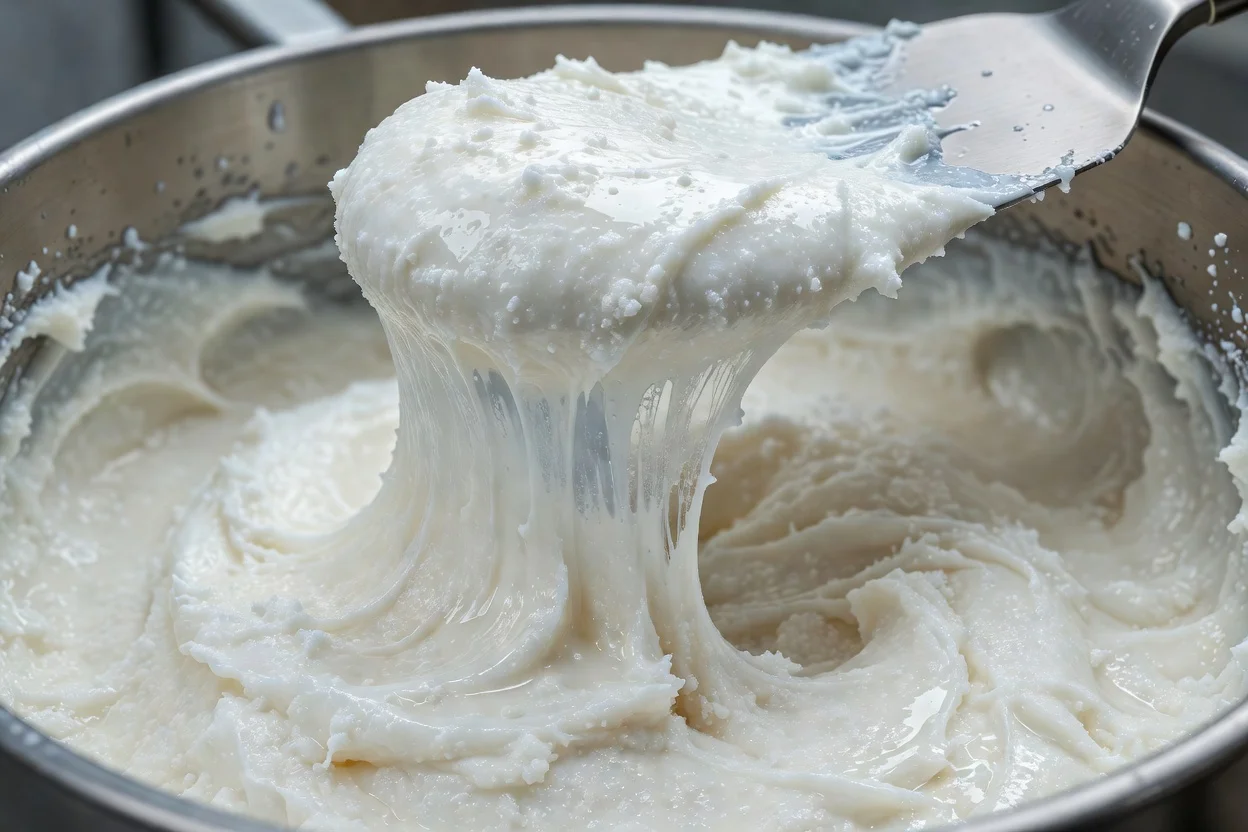
When heated, the PVC particles swell, absorb plasticizer, and convert from a two-phase paste into a single-phase gel that becomes a continuous plasticized polymer film upon cooling. This fusion process is the central mechanism that creates adhesion and flexibility.
Key technical characteristics
| Property | Typical behavior | Practical implication |
|---|---|---|
| 100% solids | Little or no volatile solvent | Low VOC curing and good deposit control |
| Heat activation | Fusion commonly around 150–180 C, with some products cured higher | Requires oven, platen, or heated process step |
| Flexible final film | Tough, resilient, and compliant | Useful on substrates that move or vibrate |
| High viscosity before cure | Paste-like, highly structured rheology | Good for screen printing, dot coating, and bead application |
| Good wetting on porous surfaces | Especially on fabrics, paper, and filter media | Supports anchoring by superficial penetration |
Important limits and workarounds
- Poor room-temperature flow on dense, low-energy substrates → cause: high viscosity and limited wetting on difficult surfaces → workaround: surface treatment, primer, adhesion promoter, or using a formulation with tailored wetting and lower viscosity.
- PVC/plasticizer regulatory scrutiny → cause: concern over certain plasticizers and PVC-related end-of-life issues → workaround: phthalate-free systems, lower-toxicity stabilizers, and careful formulation selection.
- Heat requirement for fusion → cause: particles must swell and coalesce to form the bond → workaround: use heated curing equipment, low-bake systems, or alternative adhesive chemistries when heat-sensitive substrates are involved.
A useful formulation example is a PVC plastisol adhesive built from fine PVC resin, a plasticizer, and a silane adhesion promoter; the promoter improves coupling to difficult substrates, while filler and stabilizer packages tune viscosity, heat resistance, and durability. Another practical example is a low-viscosity, stable plastisol designed to hold its rheology over storage so that printing or dispensing remains consistent in production.
Production Processes and Raw Feedstocks
The core raw feedstocks for plastisol adhesives are PVC resin and plasticizer, supported by stabilizers, fillers, and specialty additives. The PVC is usually a dispersion grade selected for small particle size and storage stability, while the plasticizer controls flexibility, fusion temperature, and final modulus.
Typical production sequence
- Select dispersion-grade PVC resin with appropriate particle size and thermal stability.
- Blend with plasticizer to create a stable paste dispersion.
- Add stabilizers, fillers, pigments, rheology modifiers, and adhesion promoters as required.
- De-aerate and adjust viscosity for the intended application method.
- Package as a ready-to-use one-component product for printing, coating, dispensing, or laminating.
Formulation variables
- Plasticizer level governs softness, flexibility, and cure behavior.
- Filler loading can reduce cost and adjust body, opacity, or heat resistance, but excessive filler may reduce bond strength.
- Adhesion promoters are used to improve bonding to metal, glass, or coated substrates.
- Stabilizer systems have shifted toward low-odor, lower-toxicity, and lower-volatility packages in many applications.
Applications and End-Use Markets
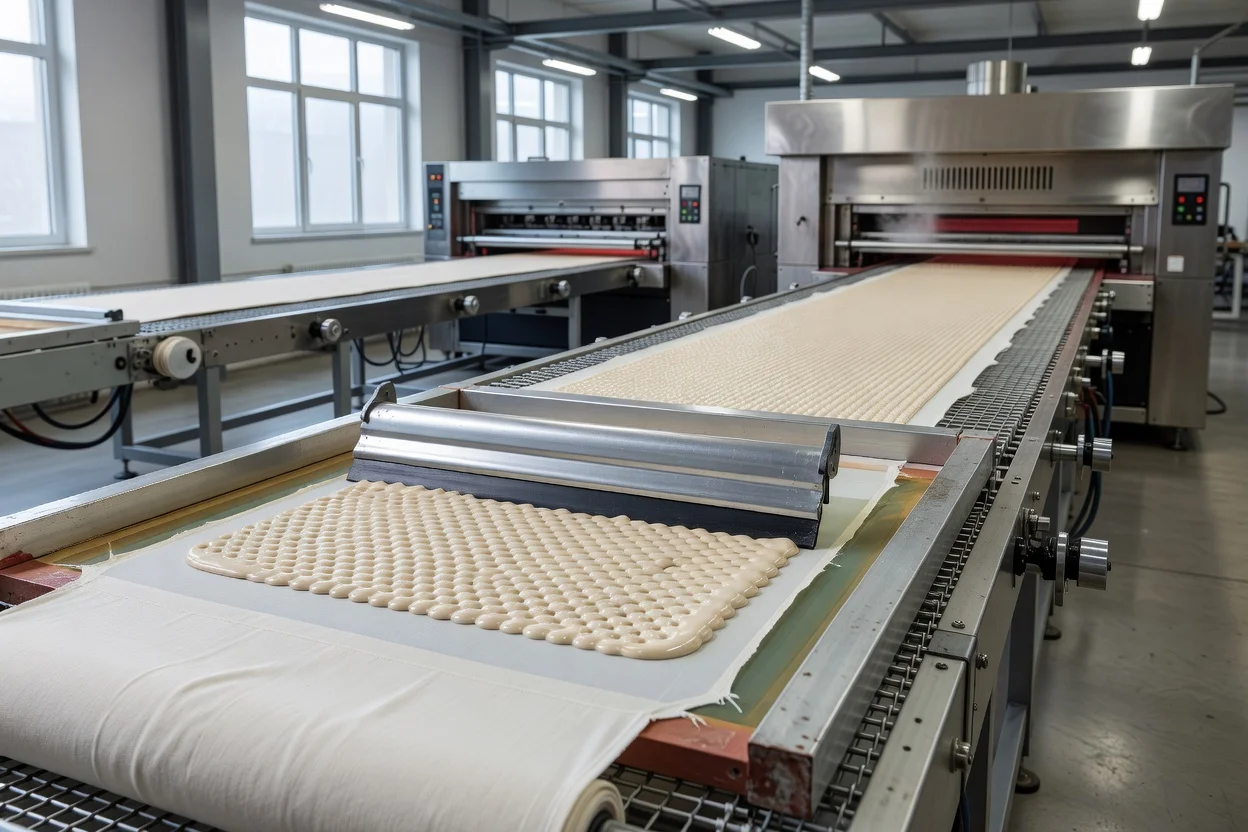
Plastisol adhesives are used where a flexible, heat-cured bond is needed and where a paste application is operationally convenient. They are especially common in laminating, textile conversion, sealing, and specialty assembly.
| End-use sector | Typical grade or process | Why plastisol adhesives fit |
|---|---|---|
| Textiles and fabrics | Screen-printable or laminated adhesive paste | Flexible bonding on porous substrates and decorated goods |
| Tarps, tents, wall coverings, shades | Laminating adhesive | Bonds fabric, paper, and film constructions |
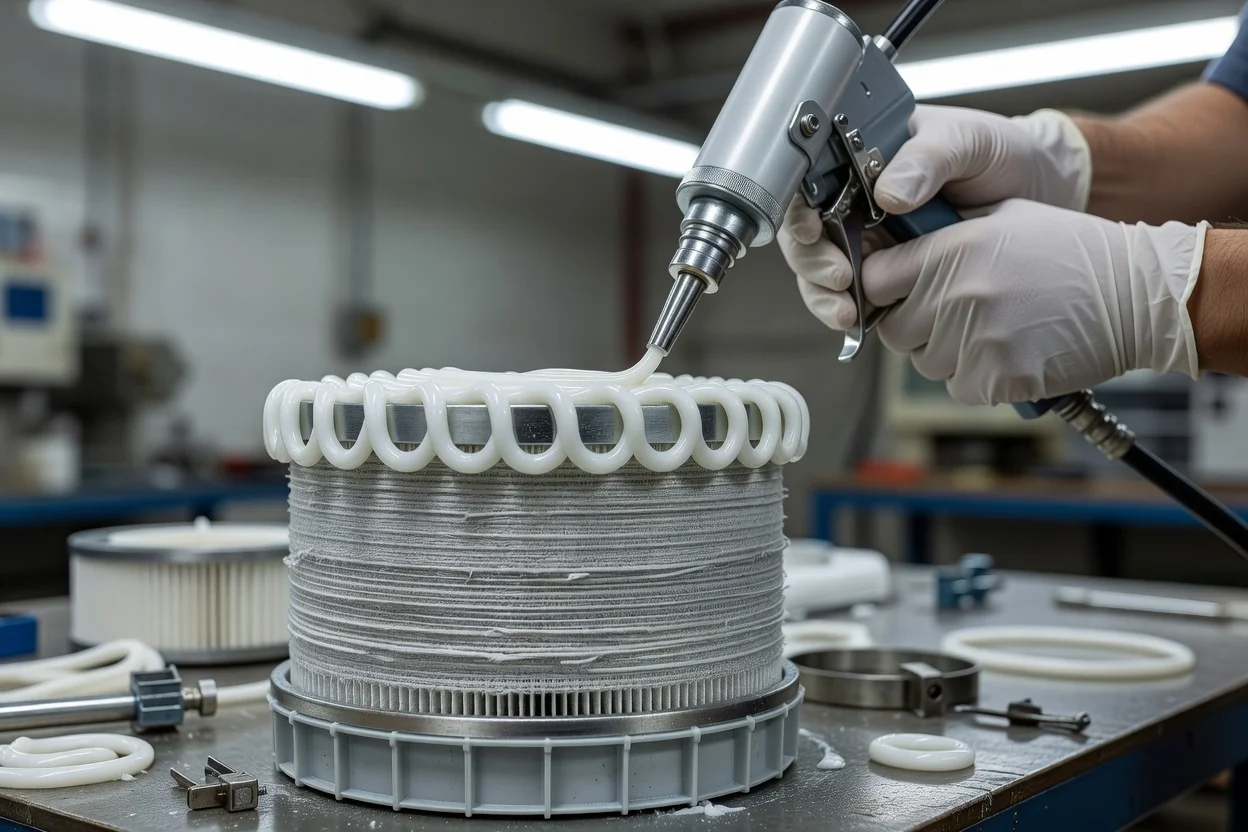
| Filter assembly | Dot, bead, or end-cap bonding | Good adhesion to porous media and durable heat-cured joints |
| Vinyl repair and vinyl-to-vinyl bonding | Heat-activated vinyl adhesive | Chemical compatibility with PVC-rich substrates |
| Flooring and wall-related industrial laminates | High-solids plastisol adhesive | Robust, flexible layer with process stability |
| Ceramic tile dot mounting and specialty mounting | Dispensed paste | Controlled placement and resilient bond formation |
Typical industrial use also extends to seals, gaskets, grips, and coated parts when the same paste-to-solid conversion is advantageous.
One poor-fit use is bonding heat-sensitive substrates that cannot tolerate the curing temperature required for plastisol fusion, because plastisol adhesives generally need elevated temperatures to coalesce fully.
Environmental and Sustainability Aspects
Plastisol adhesives have a mixed sustainability profile. On the positive side, they are often 100% solids systems, which means they do not require large amounts of solvent and therefore can reduce VOC emissions during curing. This is a significant advantage in industrial conversion settings.
On the other hand, the technology is closely associated with PVC and plasticizers, both of which are scrutinized for end-of-life management, additive selection, and potential emissions or migration concerns in sensitive applications. As a result, many suppliers have moved toward phthalate-free or lower-toxicity packages and stabilizer systems designed for lower odor and lower volatility.
Sustainability pathways
- Phthalate-free plasticizers are increasingly used to address regulatory and customer concerns.
- Lower-toxicity stabilizer systems reduce odor and improve compliance in interior or consumer-facing uses.
- Process efficiency is improved by one-component supply, which reduces metering complexity and waste.
- Material efficiency can be strong when plastisols are applied only where needed, such as in dot adhesives or localized seams.
A recurring trade-off is that low-VOC processing does not automatically make a material circular. PVC-based adhesive layers can complicate recycling streams, especially when they are tightly bonded to textiles, films, or composite laminates. That makes design-for-recycling, controlled additive selection, and use-limiting specification increasingly important in newer product development.
Economic and Global Market Impact
Plastisol adhesives are a niche within the broader adhesives and PVC formulations markets, but they are commercially important because they support high-throughput converting, textile decoration, industrial laminating, and specialty assembly. Demand is closely tied to sectors such as construction textiles, filtration, flooring, protective products, and screen printing.
The supply base is shaped by large PVC raw material chains and specialty formulation houses. Companies active in plastisol technologies include formulation specialists and vinyl compound suppliers such as Protech Group, Avient, Follmann, Baerlocher-related application systems, Chemionics, and other regional converters and custom compounders.
Market dynamics are influenced by:
- PVC resin availability and pricing
- plasticizer regulation and substitution trends
- demand from industrial textiles and converted goods
- the adoption of alternative adhesive chemistries in sensitive applications
Current Challenges and Innovations
The main technical challenge is balancing bond performance, processing temperature, storage stability, and regulatory acceptability in a single formulation. High viscosity is useful for print definition and controlled laydown, but it can also complicate dispensing and wetting if the formulation is not properly tuned.
Active innovation areas
- Low-odor, low-volatility systems for interior and consumer applications.
- Phthalate-free plastisols for regulatory and customer compliance.
- Adhesion promoters to improve wetting and bonding to metals, plastics, and coated surfaces.
- Rheology stabilization to preserve viscosity during storage and reduce settling or thinning.
- Lower-bake formulations to broaden the range of acceptable substrates.
A practical mechanism example is the use of a silane adhesion promoter in a PVC plastisol adhesive: the silane improves interfacial bonding by coupling the polymer-rich adhesive phase to mineral or oxide-rich surfaces, which can increase bond durability after thermal fusion.
Future Outlook
Plastisol adhesives are likely to remain important where flexibility, low-solvent processing, and one-component application are valued. Their strongest future opportunities are in engineered textiles, filtration, industrial laminates, protective goods, and specialty bonding systems that benefit from thick-film, heat-fused adhesion.
At the same time, further growth will depend on how effectively the industry addresses PVC-related circularity concerns, plasticizer perception, and substrate compatibility. The most competitive products are likely to be those that combine reliable fusion, lower environmental impact, and tighter formulation control for modern manufacturing lines.
Summary
Plastisol adhesives are heat-cured, PVC-based paste adhesives that transform from a dispensable dispersion into a flexible solid bond upon heating. Their main strengths are 100% solids processing, good flexibility, and broad utility in textiles, laminates, filters, and specialty industrial assemblies, while their main constraints are the need for heat, careful rheology control, and ongoing sustainability pressure tied to PVC and plasticizer chemistry.
References
- •
Additives for PVC Plastisols. (n.d.). BYK. https://www.byk.com/en/applications/pvc-plastisolsLink
- •
Plastisol – Adhesives. (2026, June 8). Protech Group. https://www.theprotechgroup.com/product/plastisol-adhesives/Link
- •
Adhesive Technologies. (2023, September 21). Adhesives/Sealants.org. https://adhesives.org/adhesives-sealants/adhesives-sealants-overview/adhesive-technologies/Link
- •
CORE™ Plastisol Adhesives. (n.d.). Avient. https://www.avient.com/products/vinyl-formulations/vinyl-plastisols-organosols/core-plastisol-adhesivesLink
- •
PVC Plastisols: Ingredients, Usage Level, and Applications. (2024, December 6). SpecialChem. https://www.specialchem.com/adhesives/guide/pvc-plastisol-adhesivesLink
- •
01 - Specialty Materials - Plastisol - Adhesives. (n.d.). Protech Group. https://www.theprotechgroup.com/wp-content/uploads/2025/06/01-Specialty-Materials-Plastisol-Adhesives.pdfLink
- •
PLASTISOL – ADHÉSIFS. (2026, January 15). Solutions de revêtements industriels. https://www.theprotechgroup.com/fr/produit/plastisol-adhesifs/Link
- •
Properties-91900.PDF. (n.d.). ICC Ink. https://www.iccink.com/assets/documents/Plastisol_Properties.pdfLink
- •
Plastisol type adhesive composition used in filter for filtering alcohol-containing fuel. (1997, January 3). Google Patents. https://patents.google.com/patent/US5714030A/enLink
- •
Plastisols for Adhesives and Sealants. (2025, July 3). SpecialChem. https://www.specialchem.com/adhesives/guide/plastisols-for-adhesives-and-sealantsLink
- •
Plastisols - An overview. (n.d.). ScienceDirect. https://www.sciencedirect.com/topics/materials-science/plastisolsLink
- •
Plastisols. (n.d.). Riva Marsa. https://rivamarsa.com/us/Link
- •
Plastisol Adhesives. (n.d.). NW Graphic. https://nwgraphic.com/products/categories/?cat=PLAS_ADHESLink
- •
Plastisol Applications and Properties Overview. (2021, October 17). Chemionics. https://www.studocu.com/en-gb/document/oxford-brookes-university/research-and-study-methods/plastisol-uses-plasticos/18471782Link
- •
Plastisol Adhesive 3805LF. (2000, January 1). Serigraphie Boutique. https://www.serigraphie-boutique.fr/1740-005Link
- •
VISCOLITE®-RC10. (n.d.). Shiraishi. https://f.hubspotusercontent10.net/hubfs/2512619/Shiraishi%20Technical%20Bulletins/Viscolite_RC10_R5.pdfLink
- •
Low Viscosity, Stable PVC Plastisol. (2022, June 21). SpecialChem. https://www.specialchem.com/adhesives/formulation/low-viscosity-stable-pvc-plastisolLink
- •
Plastisol. (n.d.). Chemionics Corporation. https://www.chemionics.com/plastisol/Link
- •
PVC Plastisol for Bonding Vinyl Film to Polyester Textile (B). (n.d.). SpecialChem. https://adhesives.specialchem.com/formulation/pvc-plastisol-for-bonding-vinyl-film-to-polyester-textile-bLink
- •
PLASTIBOND Plastisol adhesive to bond glitters to fabric. (2018, January 1). Screening Supplies Store. https://www.screeningsuppliesstore.com/product-p/a-2010.htmLink
- •
Plastisol Coatings and Adhesives. (n.d.). Princeton Keynes. https://princetonkeynes.com/facilities/eco-friendly-adhesives-and-coatings/plastisol-coatings-and-adhesives/Link
- •
PVC Plastisol Adhesive / Sealant. (n.d.). SpecialChem. https://adhesives.specialchem.com/formulation/pvc-plastisol-adhesive-sealantLink
- •
Plastisols. (2023, October 5). Follmann USA. https://www.follmannusa.com/adhesive-products/plastisols/Link
- •
Baerlocher: Plastisol Applications. (n.d.). Baerlocher. https://www.baerlocher.com/applications/pvc/plastisol-applications/Link
- •
What Applications Can I Use Plastisol Adhesive Ink For? (2024, November 17). Plastisol Inks. https://plastisol-inks.com/what-applications-can-i-use-plastisol-adhesive-ink-for/Link
- •
Vita Liquid Polymers. (n.d.). BASA. https://members.basa.uk.com/activememberdirectory/Details/vita-liquid-polymers-3431259?rendermode=printLink
- •
Plastisol Applications. (n.d.). Lakeside Polymer. https://lakesidepolymer.com/applications/Link
- •
Flexible, High Temperature PVC Plastisol Sealant. (2022, June 21). SpecialChem. https://www.specialchem.com/adhesives/formulation/flexible-high-temperature-pvc-plastisol-sealantLink
- •
Plasticisers don't stand a chance! (2024, May 2). POLIFILM. https://www.polifilm.com/press/plasticisers-dont-stand-a-chance/Link
- •
PVC plastisols: Preparation, properties, and application. (n.d.). Springer. https://link.springer.com/article/10.1134/S181123820701002XLink
- •
PVC plastisol adhesives. (2021, October 20). Google Patents. https://patents.google.com/patent/GB2176201A/enLink
- •
Resistencia Del Pegamento. (2025, July 13). Scribd. https://es.scribd.com/doc/255918875/Resistencia-Del-PegamentoLink
- •
From Coatings to Sealants: The Diverse World of Plastisols. (2024, October 17). Eureka. https://eureka.patsnap.com/blog/what-are-plastisols/Link
- •
Adhesives. (2025, March 7). ScreenPrinting. https://screenprinting.iccink.com/ink-type/screen-printing-adhesives/Link
- •
Plastisol Transfer Adhesive. (n.d.). Lee Supply. https://www.leessupply.com/products/plastisol-transfer-adhesiveLink
- •
Nourybond® Adhesion Promoters for Automotive Plastisol Applications. (n.d.). Evonik. https://products.evonik.com/assets/89/71/Nourybond_adhesion_promoters_for_automotive_plastisol_applications_Americas_EN_Asset_818971.pdfLink
- •
Plastisol. (2008, June 9). Wikipedia. https://en.wikipedia.org/wiki/PlastisolLink
- •
Polyethylene-based plastisol compositions. (1995, September 29). Google Patents. https://patents.google.com/patent/WO1996011232A2/enLink
- •
Chemical Solutions for Adhesives, Sealants & Plastisols. (n.d.). Pico Chemical. https://picochemical.com/industries-we-support/adhesives-sealants-plastisols/Link